
Automation

A simple experiment on Predictive Maintenance and IA2IA

It is not easy to find your way in the sea of technological solutions related to predictive maintenance. As Product Marketing Manager, it is my job to understand and test the real potential of the tools I am dealing with, in this case Yokogawa’s wireless sensors, called “Sushi Sensors”, which monitor parameters such as vibration, pressure and temperature. Read the blog article with the title “A simple experiment on Predictive Maintenance and IA2IA” here.

A simple experiment on Predictive Maintenance and IA2IA Read More »

Three Ways to Improve pH Measurements in Brine

Manufacturing operations in many sectors of industry know that measuring pH in brine or salt water presents technical challenges that, if ignored, lead to product loss, higher sensor wear, inefficient operation and high maintenance costs. For example, the salt solution can have an unfavourable effect on the production process by reducing the service life of the sensor, which the plant operator may not notice. But a remedy is possible. And we deal with the how in our blog article series “Three ways to optimise pH measurements in brine”.

Three Ways to Improve pH Measurements in Brine Read More »

4 questions about an energy digital twin on real ways to improve business operation

Many companies are interested in the benefits a digital twin can bring to their business. The energy sector is no exception, as is the chemical and pharmaceutical sectors. After all, it plays a pioneering role in the introduction of new technologies. That is why we have asked ourselves a few questions about digital twin technology in the energy sector. And precisely how its use can optimise costs and streamline your operations. Register with one click for the free live webinar “An Energy Digital Twin for the most efficient and cost-effective operation”, which will take place on Wednesday 16 September 2020 to see a live demonstration of Visual Mesa EMS and find out how it can work for you.

4 questions about an energy digital twin on real ways to improve business operation Read More »

How to use Design Thinking for digitalisation processes

Clearly, a company has to be digital to be competitive and to maintain this state. However, some questions remain unanswered: To what extent should the digital transformation be implemented? Is it sufficient to take care of the internal infrastructure first? Or do we set ourselves equally ambitious goals, such as a smart factory? How do you realize the defined goals? Since most companies have little or no experience in this area, it often makes sense to get support from outside. One technique for finding a solution together is that of Design Thinking.

How to use Design Thinking for digitalisation processes Read More »

Single source of truth – the time’s come for Industry 4.0!

However, throughout the entire production process, from the purchase of raw materials to the sale of products, countless data are generated that are somehow interrelated. It is therefore not without reason that a central demand in the context of digitisation is the Single Soruce of Truth. This concept of data storage enables all departments to access a central data source which is constantly maintained and therefore only contains consistent and redundancy-free data. This data storage prevents errors due to the use of different data bases, but above all it makes certain evaluations possible. Only in this way can the profit of a company be consistently depicted over the entire value-added chain and across all levels. It is not without reason that it is considered indispensable to lead Industry 4.0 projects to success.

Single source of truth – the time’s come for Industry 4.0! Read More »

M+C sensors, M+O sensors and process analytics

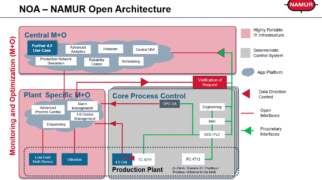
NOA – NAMUR OPEN Architecture – is powerfully on the move. Two terms keep coming up: M+C sensors and M+O sensors. M+O stands for maintenance and optimization. These are the new ones. These are the ones that detect the properties of process components (not the process medium). The detection of vibrations of machine parts such as pumps or valves has already become a classic example of pure M+O sensors.

M+C sensors, M+O sensors and process analytics Read More »

Scroll to Top