
AI Is Redefining Data Center Infrastructure
AI is changing the physical infrastructure of the data center. Higher rack densities, growing power demand, and the transition toward liquid cooling are creating new challenges for power, thermal management, and operational visibility.
However, as AI workloads continue to grow, data centers face unprecedented challenges. Higher rack densities, increasing power consumption, liquid cooling requirements, sustainability targets, and operational complexity are pushing traditional monitoring and management approaches to their limits. According to Yokogawa’s data center industry resources, AI is transforming data centers into highly complex power and cooling infrastructures where accurate measurement, control, and data integration are becoming mission-critical.
Four Infrastructure Challenges Shaping Modern Data Centers
Keeping servers online remains essential, but operators must also improve energy efficiency, reduce operational risk, and build infrastructure that can scale with future demand.
1. Increasing Power Demand
AI applications, high-performance computing, and hyperscale cloud environments are increasing data-center power demand. Data center operators must manage fluctuating loads while maintaining power quality and operational stability.
Power availability, grid constraints, and long interconnection timelines are becoming major factors in data center development. Operators are increasingly exploring on-site generation, battery storage, renewable energy integration, and hybrid power architectures.
2. Cooling System Complexity
One of the most significant challenges today is thermal management.
Modern AI servers generate substantially more heat than traditional computing infrastructure. As a result, liquid cooling systems, cooling distribution units (CDUs), chillers, cooling towers, and water treatment systems have become essential components of modern facilities.
Operational issues such as:
- Insufficient flow measurement coverage or accuracy
- Cooling loop degradation
- Increasing differential pressure across loaded or fouled filters
- Pressure imbalances
- Water quality deterioration
can reduce cooling performance and, if left undetected, increase operational risk. Monitoring these variables gives operators the data needed to identify abnormal conditions and investigate their causes.
3. Limited Infrastructure Visibility
Many operators still struggle with siloed systems and fragmented data sources.
Cooling systems, power infrastructure, environmental monitoring, SCADA platforms, and building management systems often operate independently. This limits the ability to identify inefficiencies, predict failures, and optimize operations.
Integrating measurement, control, and facility data can give operators a more consistent view of system performance and abnormal conditions.
4. Sustainability and Energy Efficiency Targets
Data center operators are under increasing pressure to improve energy efficiency while reducing water consumption and carbon emissions.
Metrics such as:
- PUE (Power Usage Effectiveness)
- WUE (Water Usage Effectiveness)
- Carbon footprint
- Cooling efficiency
are becoming critical operational KPIs.
Managing these indicators requires consistent measurement boundaries, reliable source data, and appropriate metering across the facility.
Why Industrial-Grade Measurement and Automation Matter
Today’s hyperscale and AI-driven facilities increasingly resemble industrial process environments.
A modern AI campus combines significant hydraulic, thermodynamic, and electrical complexity. As infrastructure becomes more dynamic, operators increasingly require measurement and control capabilities beyond traditional building-level monitoring.
Industrial-grade measurement and automation provide the accuracy, speed, and operational context needed to manage these interconnected systems.
How Yokogawa Supports More Efficient and Reliable Operations
Yokogawa applies its industrial measurement, control, automation, and data-integration experience to the power, cooling, and utility systems that support modern data centers.
Precision Flow Measurement for Cooling Systems
Accurate flow measurement is fundamental to balancing cooling distribution, verifying performance, and identifying abnormal conditions early.
Yokogawa’s flow measurement portfolio includes:
- ADMAG magnetic flowmeters
- digitalYEWFLO vortex flowmeters
- ROTAMASS Coriolis flowmeters
These measurements provide the data needed to monitor cooling-water circulation, assess distribution balance, verify cooling performance, and identify opportunities for more efficient operation.
Benefits
✅ Support for cooling-performance assessment and optimization
✅ Better visibility into hydraulic and thermal performance
✅ Earlier identification of abnormal flow conditions
✅ More informed operation and maintenance of critical cooling infrastructure
Advanced Pressure Monitoring
Pressure monitoring is essential throughout cooling loops, chillers, filters, CDUs, heat exchangers, and distribution systems.
The Yokogawa EJX-S Series pressure transmitters provide highly accurate differential and static pressure measurements for:
- Cooling loops
- Filter monitoring
- Chiller systems
- Pump efficiency monitoring
- Cooling distribution units
Pressure and differential-pressure measurements can help operators identify abnormal hydraulic conditions, increasing flow resistance, and indications of filter or heat-exchanger fouling.
Temperature Monitoring and Thermal Visibility
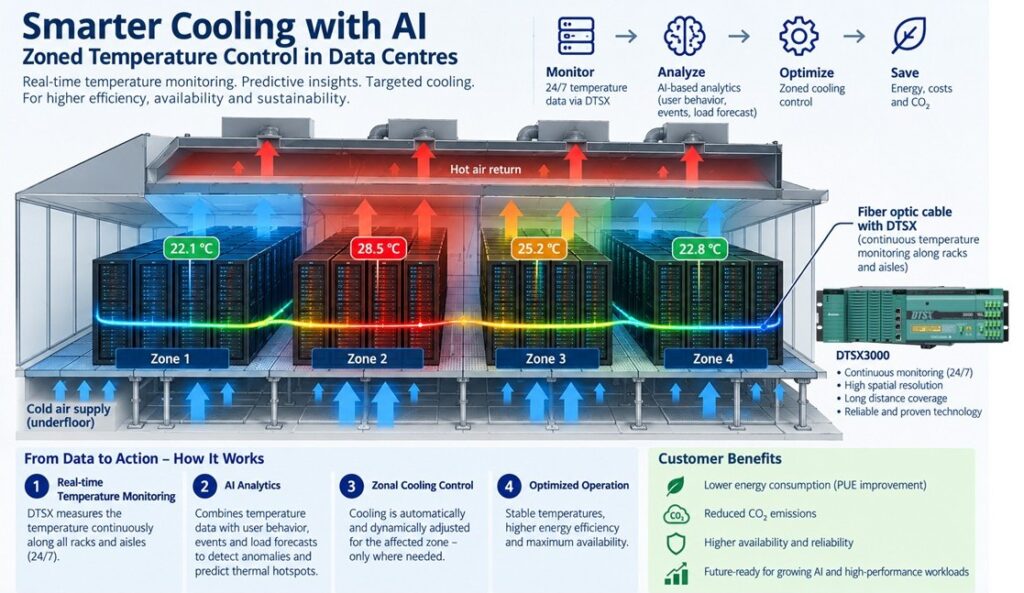
Thermal management has become a primary reliability concern for AI data centers.
Yokogawa offers several technologies for monitoring temperature throughout the infrastructure:
- YTA temperature transmitters
- YTMX580 temperature monitoring systems
- DTSX Distributed Temperature Sensing (DTS)
DTSX uses optical fiber as a distributed temperature sensor, providing a continuous temperature profile over long distances. In data-center infrastructure, this approach can help identify localized temperature changes along:
- Power busbars
- Cable routes
- Cooling networks
- Critical infrastructure assets
Distributed thermal monitoring complements point sensors by improving spatial coverage and helping operators locate abnormal temperature conditions.
Data Integration and Unified Operations
Data is only valuable when it can be transformed into actionable insight.
Yokogawa’s portfolio supports:
- Data Center Management Systems (DCMS)
- SCADA systems
- CI Server
- Historians
- Alarm management platforms
- Energy management systems
These solutions help operators bring together information from multiple sources and create a unified view of facility operations.
The result is:
- Better operational decision-making
- Faster issue detection
- Root cause analysis
- Improved energy-performance visibility and support for PUE optimization
- Reduced operational risk
Predictive Asset Management and Operational Intelligence
Some equipment degradation mechanisms produce measurable changes before functional failure.
Condition monitoring and analytics can support a shift from purely reactive maintenance toward condition-based and predictive approaches by using:
- Historical data
- Real-time monitoring
- Advanced analytics
- Data-driven analysis and optimization
When supported by suitable measurements, diagnostic methods, and maintenance workflows, this approach can help reduce unplanned interventions and improve maintenance planning.
Energy Management and Sustainability Solutions
Modern facilities must balance performance with sustainability.
Yokogawa supports:
- Energy monitoring
- Renewable energy integration
- PUE optimization
- Carbon footprint management
- Utility management
- Energy efficiency reporting
These capabilities provide data and operational tools that can support sustainability programs without separating them from reliability objectives.
Three Reasons Yokogawa Brings Distinct Value
Yokogawa’s relevance to data-center infrastructure is based on three complementary capabilities.
Industrial-Grade Measurement
Yokogawa technologies have been deployed for decades in some of the world’s most demanding industries, including:
- Energy
- Chemicals
- Oil & Gas
- Pharmaceuticals
- Water infrastructure
This industrial experience is relevant to data-center utility systems that require stable measurement, diagnostic visibility, and dependable control.
Integrated Operational Visibility
Unlike vendors that focus on a single component, Yokogawa provides solutions spanning:
- Flow
- Pressure
- Temperature
- Water quality
- Power monitoring
- Control systems
- SCADA
- Energy management
- Analytics
This enables a unified approach to infrastructure management.
Experience with Mission-Critical Infrastructure
For hyperscale and colocation operators, reliable measurement data supports optimization, sustainability reporting, compliance activities, and operational decision-making. Yokogawa’s combination of field instrumentation, control, and data integration can help maintain data continuity from the measurement point to operational systems.
Future-Ready Innovation
Advanced thermal monitoring, analytics, and data integration can help operators adapt infrastructure to changing loads while maintaining visibility of efficiency and reliability.
Conclusion
As AI reshapes data center infrastructure, the boundary between traditional building automation and industrial process control is becoming increasingly blurred. Reliable measurement, integrated data, and intelligent automation will play a growing role in maintaining cooling performance, energy efficiency, and operational resilience.
Yokogawa brings industrial measurement, control, and data expertise into this environment, helping data center operators turn infrastructure data into better operational decisions and more efficient, reliable facilities.
(This article was written and created by the author with the assistance of AI)