All articles of Werner Worringen
Yokogawa has been making ASI – Analyzer System Integration – successful for more than 50 years. But in addition to these so-called greenfield solutions, Yokogawa also offers customized, smaller solutions for brownfield systems if required. So it’s a kind of ASI light.
System integration – when less is more Read More »
Der Einbauposition vieler pH-Sensoren ist durch Ihren inneren Aufbau Grenzen gesetzt. Das gilt nicht für die FU20 und FU24 Sensoren von Yokogawa. Denn FU20 und FU24 schaffen größtmögliche Freiheit bei der Wahl der Messstelle. Warum?
Lesen Sie unseren Blog-Artikel
The pH sensor that turns measurement on its head Read More »
Manufacturing operations in many sectors of industry know that measuring pH in brine or salt water presents technical challenges that, if ignored, lead to product loss, higher sensor wear, inefficient operation and high maintenance costs. For example, the salt solution can have an unfavourable effect on the production process by reducing the service life of the sensor, which the plant operator may not notice. But a remedy is possible. And we deal with the how in our blog article series “Three ways to optimise pH measurements in brine”. Click here for the second article.
Measuring pH in Brine Solutions: Corrosive Environments Read More »
Manufacturing operations in many sectors of industry know that measuring pH in brine or salt water presents technical challenges that, if ignored, lead to product loss, higher sensor wear, inefficient operation and high maintenance costs. For example, the salt solution can have an unfavourable effect on the production process by reducing the service life of the sensor, which the plant operator may not notice. But a remedy is possible. And we deal with the how in our blog article series “Three ways to optimise pH measurements in brine”.
Three Ways to Improve pH Measurements in Brine Read More »
NOA – NAMUR OPEN Architecture – is powerfully on the move. Two terms keep coming up: M+C sensors and M+O sensors. M+O stands for maintenance and optimization. These are the new ones. These are the ones that detect the properties of process components (not the process medium). The detection of vibrations of machine parts such as pumps or valves has already become a classic example of pure M+O sensors.
M+C sensors, M+O sensors and process analytics Read More »
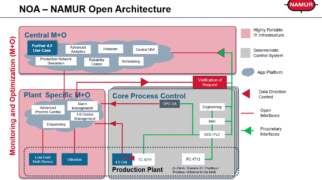
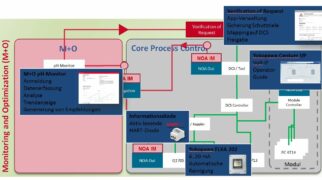
When it comes to NOA, there is much talk about leaving the classic automation pyramid and the resulting consequences, especially with regard to (data) security. There is no question that this must be ensured. Many initiatives are on their way. This blog article aims to show why these efforts are worthwhile. The PAT demonstrator, which was presented at the NAMUR Annual General Meeting in 2018, serves as an example here.
How NOA can add value for process analytics Read More »
Where NOA comes into play: If process analysis technology delivers more and more complex data and experience sometimes requires changes, then we need an additional piece of intelligence. This is not properly stored in the analyzer. Because the type of intelligence is also determined by the process. In the control system, the additional data becomes tight; changes are possible there, but not necessarily popular. A separate software, for example in the form of an app, frees us from these restrictions and gives us the necessary flexibility for specific adaptations.
PAT-Demonstrator – NOA is the ideal partner Read More »
Full steam ahead into digitalisation: Just as older analogue model steam locomotives – i.e. brownfield models – can be operated digitally with appropriate retrofitting, proven analogue sensors and analysers can also be combined into one system with a data management system, which is used as a gateway, the worlds of analogue and digital systems.
Full steam ahead into digitalisation Read More »