Real-time, Model Based Digital Twin for Energy and Emissions Management

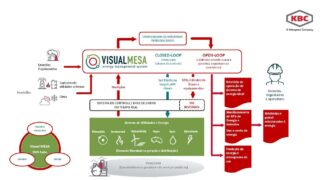
The Visual MESATM energy management applications suite is configured to work autonomously, gathering, and processing the necessary forecasts of the external variables—such as fuel/power price projections and weather forecasts -, executing calculations, historizing key performance indicators, producing and distributing the resulting reports. These can run as open loop or closed loop actions, depending on whether targets generated from the schedule are to be automatically passed from the scheduler to the optimizer and, from there, to be manually implemented by the Operators or flowing down to the Advanced Process Control (APC) or basic control layer.
Consistency among the decisions systems at different time scales, optimizing in real time but accounting for the constraints imposed by the optimal schedule is guaranteed. Consequently, overall cost and GHGs emissions can be substantially reduced with the help of a real-time, model based Digital Twin approach.

Real-time, Model Based Digital Twin for Energy and Emissions Management Read More »
Measuring pH in Brine Solutions: Corrosive Environments

Manufacturing operations in many sectors of industry know that measuring pH in brine or salt water presents technical challenges that, if ignored, lead to product loss, higher sensor wear, inefficient operation and high maintenance costs. For example, the salt solution can have an unfavourable effect on the production process by reducing the service life of the sensor, which the plant operator may not notice. But a remedy is possible. And we deal with the how in our blog article series “Three ways to optimise pH measurements in brine”. Click here for the second article.

Measuring pH in Brine Solutions: Corrosive Environments Read More »

Three Ways to Improve pH Measurements in Brine

Manufacturing operations in many sectors of industry know that measuring pH in brine or salt water presents technical challenges that, if ignored, lead to product loss, higher sensor wear, inefficient operation and high maintenance costs. For example, the salt solution can have an unfavourable effect on the production process by reducing the service life of the sensor, which the plant operator may not notice. But a remedy is possible. And we deal with the how in our blog article series “Three ways to optimise pH measurements in brine”.

Three Ways to Improve pH Measurements in Brine Read More »

And the Oscar Goes To…Sushi Sensor (Part 1 of 2)

Our IIoT solution Plant Asset Management (PAM) with integrated Sushi Sensor and GA10 AI software has been awarded this year’s innovation prize for the best asset monitoring technology by the trade journal ‘Hydrocarbon Processing’. This award honours the best innovations and innovators in the hydrocarbon processing industry. Read the first of our two articles for more information.

And the Oscar Goes To…Sushi Sensor (Part 1 of 2) Read More »

4 questions about an energy digital twin on real ways to improve business operation

Many companies are interested in the benefits a digital twin can bring to their business. The energy sector is no exception, as is the chemical and pharmaceutical sectors. After all, it plays a pioneering role in the introduction of new technologies. That is why we have asked ourselves a few questions about digital twin technology in the energy sector. And precisely how its use can optimise costs and streamline your operations. Register with one click for the free live webinar “An Energy Digital Twin for the most efficient and cost-effective operation”, which will take place on Wednesday 16 September 2020 to see a live demonstration of Visual Mesa EMS and find out how it can work for you.

4 questions about an energy digital twin on real ways to improve business operation Read More »

How to use Design Thinking for digitalisation processes

Clearly, a company has to be digital to be competitive and to maintain this state. However, some questions remain unanswered: To what extent should the digital transformation be implemented? Is it sufficient to take care of the internal infrastructure first? Or do we set ourselves equally ambitious goals, such as a smart factory? How do you realize the defined goals? Since most companies have little or no experience in this area, it often makes sense to get support from outside. One technique for finding a solution together is that of Design Thinking.

How to use Design Thinking for digitalisation processes Read More »

Scroll to Top