Basic Policy
Based on the "Yokogawa Group Human Rights Policy" the Yokogawa Group is committed to responsible mineral sourcing as a global company. We work to prevent the risk of contributing to serious human rights abuses and other adverse impacts that may be associated with the mining, trading, or handling of minerals originating from conflict-affected and high-risk areas.
Examples of conflict-affected and high-risk areas include the Democratic Republic of the Congo and its neighboring countries. Conflict minerals*1 and other minerals sourced from these regions may become a source of funding for armed groups and may contribute to human rights abuses, environmental destruction, and other serious social issues.
To address these global challenges, the Yokogawa Group has established a group-wide management framework based on the OECD Due Diligence Guidance for Responsible Supply Chains of Minerals from Conflict-Affected and High-Risk Areas (OECD Due Diligence Guidance). Under this framework, we conduct mineral due diligence and supply chain management throughout our supply chain to help prevent the procurement of products containing minerals associated with risks such as human rights abuses, bribery, and corruption in conflict-affected and high-risk areas.
When entering into business agreements with suppliers, we request their endorsement of the YOKOGAWA Group Sustainable Procurement Guidelines for Suppliers and their cooperation with related surveys and information disclosure activities. If investigations identify involvement in the funding of armed groups, human rights abuses, environmental destruction, or other related risks, we will request corrective actions and, depending on the status of those corrective actions, review our business relationship as necessary to avoid the use of such minerals.
The Yokogawa Group will continue to make every effort to promote responsible mineral sourcing throughout its supply chain.
Our Systems
With reference to 5 Steps described in OECD DD Guidance, roles are set according to the functions of each department, and the Yokogawa Group has established a system for initiatives. The outline is shown below.

Procurement Control division: (Department that formulates procurement strategies and controls globally)
- Promote activities related to sustainable procurement and organize and disclose information related to procurement activities. (This includes sharing records related to conflict minerals with relevant departments and conducting analysis for risk assessment.)
- Cooperate and synchronize with the human rights initiatives of the Yokogawa Group.
Controlling Product-related Laws and Regulations function: (The department responsible for investigating and managing information on product laws and regulations)
- Confirmation by CMRT/EMRT*2 etc. and storage of confirmation results.
- Participate as a member in the "Responsible Mineral Procurement Study Group" of the industry group JEITA, and stay updated with the latest information while coordinating with the industry. We continuously share the latest information across the entire Yokogawa Group.
- Standardize and develop procedures*3 within the Yokogawa Group for information and investigations on conflict minerals.
Product Liability division: (Sales / Planning Department of products / solutions provided to customers)
- We handle customer inquiries and survey requests related to Article 1502*4 of the US Dodd-Frank Act, as well as other requests.
Production Responsibility division: (Manufacturing departments responsible for purchasing their parts)
- We will request surveys such as CMRT/EMRT our suppliers and collect the answers.
- When requesting surveys, we emphasize the importance of sustainable procurement and convey Yokogawa Group's expectations*5 to help build stronger supplier relationships.
Results of Minerals Survey
The Yokogawa Group's survey results using CMRT/EMRT are as follows.
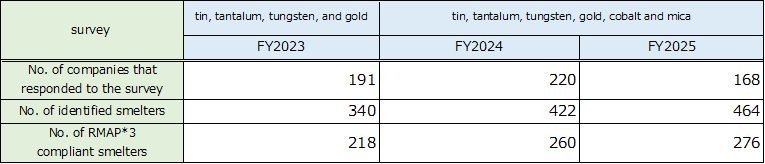
Based on the results of the responsible mineral sourcing investigation, no conflict-related risks were identified.
*1 Conflict minerals: Generally, tantalum, tin, tungsten, gold, etc. are produced in the Democratic Republic of the Congo or its neighboring countries and are the source of funds for armed groups that are serious human rights infringers in the place of origin and its supply chain. It refers to the minerals that have become.
*2 CMRT(Conflict Minerals Reporting Template)/EMRT(Extended Minerals Reporting Template): A Conflict Minerals Survey Form issued by RMI (Responsible Minerals Initiative)
*3: In response to customer inquiries, Yokogawa requests information from its parts suppliers based on Yokogawa product design information, and records and stores the results of its investigations.
*4: US "Dodd Frank Act" Article 1502: Under Section 1502 of the U.S. Dodd-Frank Act, U.S. publicly listed companies are required to submit annual reports to the U.S. Securities and Exchange Commission (SEC) regarding whether tin, tantalum, tungsten, gold (collectively known as 3TG), and any other minerals designated by the U.S. Secretary of State that originate from the Democratic Republic of the Congo and its nine adjoining countries are used in their products.
Although Yokogawa and its group companies are not publicly listed companies in the United States, we conduct this survey in response to requests from customers who are subject to these reporting requirements.
*5: The Yokogawa Group requests that its suppliers support and endorse the principles set forth in the Yokogawa Group Sustainable Procurement Guidelines for Suppliers and cooperate with our due diligence activities, including conflict minerals surveys, when responding to our survey requests.