
Yokogawa has focused on developing a supply chain that considers environmental protection and human rights. We will actively identify risks that impede sustainable procurement, embark on a path to improvement with our business partners, and strengthen activities aimed at achieving our sustainability goals "Three Goals".
Summary of Activities
1) Activity Policy
We are identifying risks that impede sustainable procurement with our suppliers, focusing on revealing the actual conditions of the following 4 areas(defined in Yokogawa Group Sustainable Procurement Guidelines for Suppliers) : "Labor and Human rights" "Health and safety" "Environment" and "Ethics". In case a risk is realized, we work with our suppliers to take measures against it. We also develop educational programs on sustainable procurement both inside and outside the company. We set KPIs to manage and measure the progress of sustainable procurement activities.
2) Activity System
The Global SCM Headquarters of Yokogawa Electric Corporation has established a sustainable procurement policy based on human rights due diligence (DD) in the supply chain and promotes sustainable procurement activities in collaboration with the Product Regulatory Compliance function, group business entities, and affiliated companies.

The Global SCM Headquarters has established group-wide common rules, including items to be checked when initiating transactions with suppliers, and monitors whether business entities and affiliated companies are conducting appropriate procurement processes. We collect not only transaction information but also information on suppliers related to purchased products from affiliated companies that have direct contact with suppliers. In addition, we utilize integrated systems shared among group companies and other product-related information, and conduct data analysis from a group-wide perspective with reference to business information from business entities. The results are used for supply chain risk assessment.
Overview of Suppliers
1) About our Suppliers
The Yokogawa Group conducts business with approximately 10,000 suppliers in more than 70 countries each year. Prior to distributing the FY2025 SAQ, we screened all Tier 1 suppliers based on FY2024 procurement spend data. The table below shows the number of suppliers and the percentage of procurement spend by country.
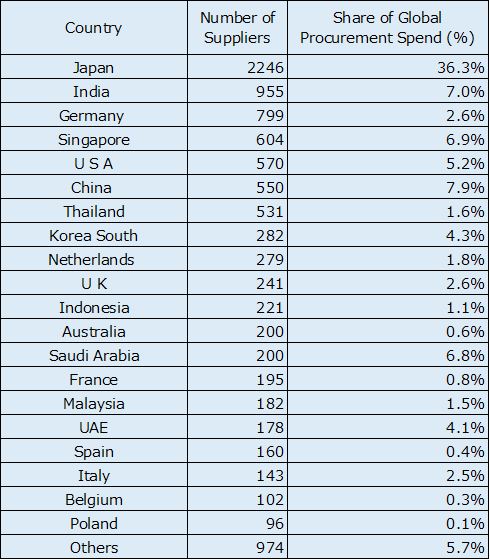
Among the suppliers included in the table, significant suppliers account for 33.6% of Yokogawa's total procurement spend. As part of the contracting process, suppliers are requested to acknowledge and agree to Yokogawa's Sustainable Procurement Guidelines.
2) Communication and Education with Suppliers
Yokogawa strengthens its partnerships with key suppliers by engaging with their management teams and representatives in each region.
In Japan, Yokogawa regularly holds "Partners' Day" events to share information on its management policies, business plans, and procurement strategies with suppliers.
For example, in Japan, we regularly hold “Partners Day” events for our suppliers, during which we explain our management policies, business plans, and procurement strategies. In addition, by providing venues at our facilities for supplier-specific component exhibitions and technical seminars, we create opportunities for Yokogawa Group product development departments to engage directly with suppliers regarding technological and market trends related to the products they provide.


Furthermore, to better understand the actual circumstances of our suppliers, the Yokogawa Group provides opportunities for direct dialogue (“Integrity Dialogue”) between suppliers and our compliance function, which operates independently from the purchasing organization. Through these dialogues, suppliers can openly share their perspectives and challenges with a neutral function outside the buyer-supplier relationship. In addition, using the Yokogawa Group Sustainable Procurement Guidelines Supplementary Handbook, we explain the importance of key topics such as human rights and labor, health and safety, environment, and ethics, as well as updates to relevant laws and regulations. We will continue to promote this initiative as part of our ongoing commitment to sustainable procurement.
SAQ Activity Report (FY2025)
Yokogawa is committed to enhancing sustainability throughout its supply chain by continuously assessing and improving CSR-related risks through the use of Supplier Self-Assessment Questionnaires (SAQs).
To increase the effectiveness of its human rights’due diligence efforts, Yokogawa adopts a phased approach under which priority risk areas and assessment methodologies are reviewed every three years in response to changes in the business environment and supply chain risks.
Phase 1 (2020-2022): Establishing the foundation for human rights due diligence and promoting the reduction of CSR-related risks.
Phase 2 (2023-2025): Expanding the scope of risk identification and assessment by integrating environmental and other ESG-related risks.
1)PDCA Cycle of Activities
Based on annual procurement records, the Yokogawa Group conducts screening of all suppliers by utilizing transaction data and other available information from the following four perspectives, and assigns ESG risk score:
- Transaction value
- Risks associated with the supplier’s country of operation (e.g., Corruption Perceptions Index)
- Supply chain risks based on the characteristics of purchased products
- The supplier’s business importance to Yokogawa
Based on the results of this assessment, the 600 suppliers with the highest scores are defined as significant suppliers. Self-Assessment Questionnaires (SAQs) are sent to these 600 suppliers over a three-year cycle, and the responses are analyzed. Where necessary, we request improvements and conduct follow-up interviews, promoting continuous improvement through the PDCA cycle.
The diagram below illustrates the cycle for promoting sustainable procurement using the SAQ.

2)SAQ Implementation Process
In accordance with the PDCA cycle illustrated above, we distribute, collect, and provide feedback on the Self-Assessment Questionnaire (SAQ). In addition, when necessary, we conduct follow-up surveys in the following year. The details of each step are described below.
SAQ Distribution:
Excluding suppliers that completed the second phase of the SAQ in the previous year, we distribute the SAQ to 200 suppliers with higher ESG risk scores based on the screening results. By continuing this process over the three-year period from 2023 to 2025, SAQs were distributed to a total of 600 significant Tier-1 suppliers.
SAQ Collection:
Suppliers are requested to complete and submit the SAQ based on the conditions at the facilities that manufacture products supplied to the Yokogawa Group.
SAQ Analysis:
All submitted SAQs are reviewed and analyzed in detail for every questionnaire item to identify risks and evaluate sustainability-related activities within the Yokogawa Group's supply chain.
Feedback and Requests for Improvement:
The analysis results are returned to suppliers in the form of a feedback sheet that includes response scores, overall average scores, and improvement points for each category, such as Human Rights & Labor, Occupational Health & Safety, and Environment. For important facilities, on-site interviews are conducted by an independent third-party organization to identify issues and propose improvement measures.
An excerpt from the feedback sheet is shown below.

Follow-Up Assessment:
For suppliers identified as requiring improvement, we request a follow-up SAQ in the following year to monitor progress.
FY2025 SAQ Results:
A summary of the FY2025 SAQ results is shown below.
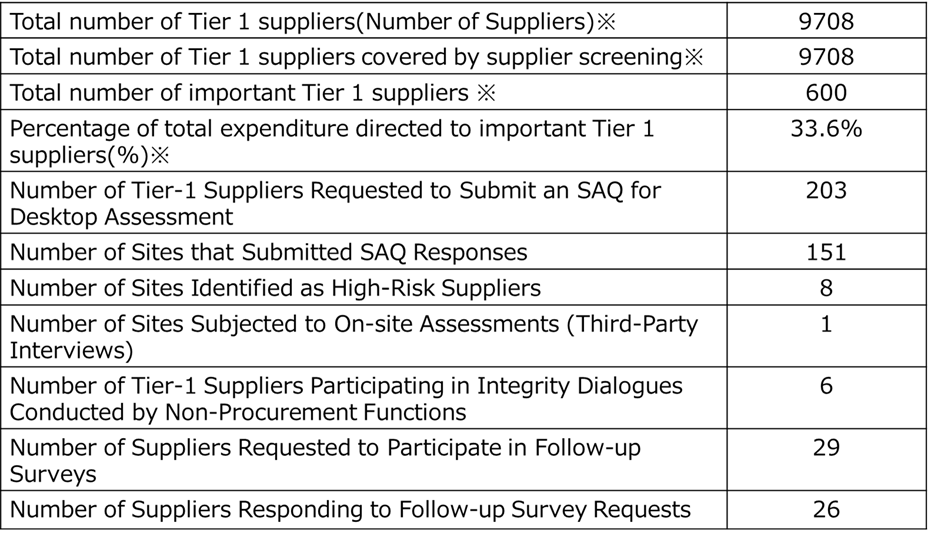
Note: Data marked with asterisks (*) have been verified by an independent third-party assurance provider.
For details, please refer to the statement below.
Statement
3)KPI Monitoring
We continue to record the responses to the SAQ from 2020 (Stage 1) and our requests, and analyze changes in the responses of individual suppliers and trends in the overall average score.
In Stage 2, we place emphasis on engagement with business partners, and compare the average percentile values of business sites that responded to the SAQ as critical suppliers in both Stage 1 and Stage 2 for the items "human rights and labor" and "occupational health and safety" that are common to Stage 1 and Stage 2. (Since the questions are different, we cannot compare the scores themselves, so we compare the percentile values.).
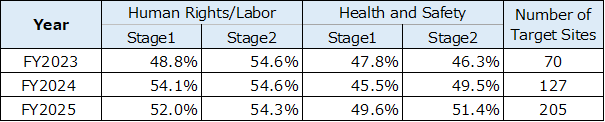
The percentile indicates the ranking of the responding companies and whether there are any other facilities that have a lower score than the one in question; a higher number can be inferred to mean that there has been improvement.
Improvement in Scores Through Follow-Up Assessments:
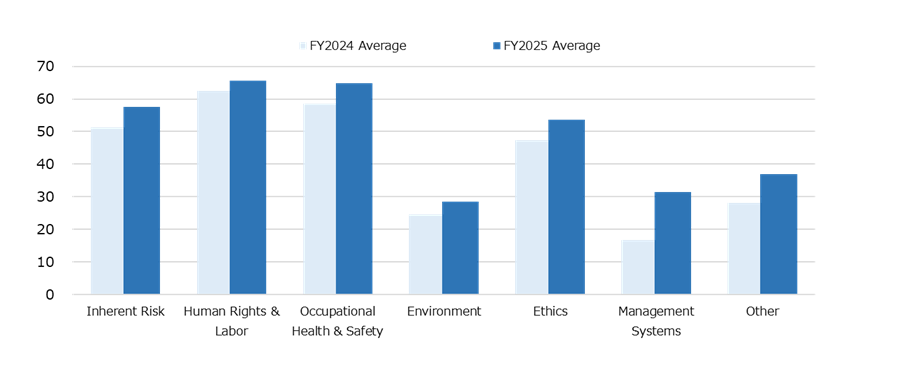
Based on the results from FY2023 and FY2024, follow-up SAQs were conducted for 29 sites in FY2025, with responses received from 26 sites. Improvements in the average SAQ scores were confirmed across all assessment areas.
About Risk Analysis
We conduct risk analysis based on the answers to the SAQ and other information.
1)SAQ score analysis
We conduct detailed analysis of responses to the SAQ and attitudes regarding response submission, and instead of just calculating averages, we continually record the score distribution for each field, such as "human rights and labor," "occupational health and safety," and "environment," and analyze responses to our requests to analyze changes in individual supplier responses, trends by category, and overall average scores. The distribution of overall scores is shown below.
The histogram of overall scores for the submitted issues is shown below. In addition, although we do not make the results public, we identify trends by item and response and conduct risk assessments.
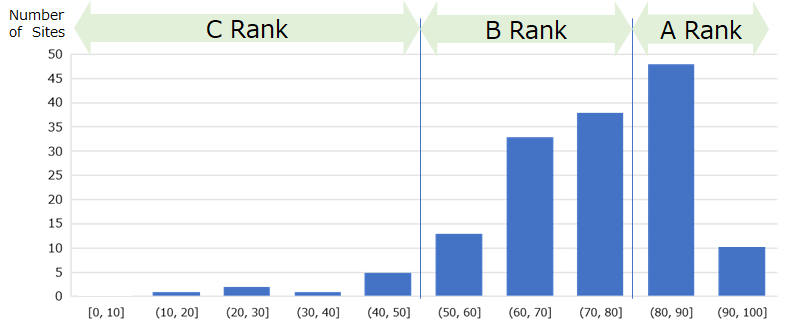
Each year, sites receiving a comprehensive evaluation rating of C are identified as high-risk suppliers and are subject to follow-up assessments and other engagement activities. In FY2025, eight sites were classified as high-risk suppliers, and follow-up assessments are planned for FY2026.
Furthermore, Integrity Dialogues were conducted with six suppliers subject to the Act on Promotion of Fair Transactions for SMEs, Etc. to Subcontractors. These dialogues were carried out directly by the compliance control function, independent of the buyer departments. During the discussions, we provided explanations on the revised Act, human rights due diligence based on the Yokogawa Group Sustainable Procurement Guideline Supplementary Handbook, and supply chain developments related to environmental and other sustainability topics. We intend to continue these efforts in the future.
2)Other Investigations apart from SAQ
As part of our ongoing compliance efforts, Yokogawa Group regularly conducts screenings of key regulatory entity lists to ensure that our suppliers are not listed. Based on the latest review, no Yokogawa Group suppliers were found on any of the relevant entity lists.
Education for Implementing Sustainable Procurement
1)Strategic Procurement Excellence Program
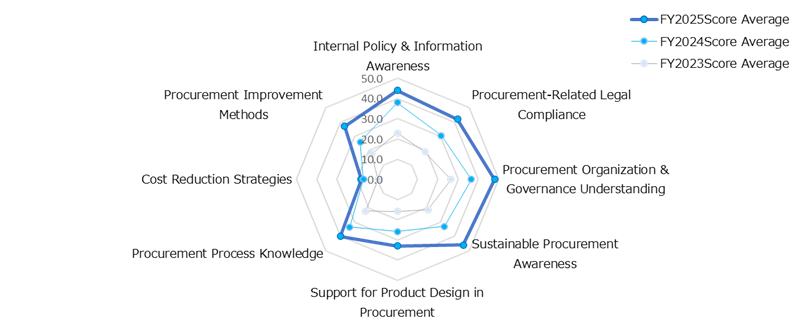
Yokogawa Group oversees its global procurement organization and has established a structured procurement talent development framework. We have defined 130 knowledge items across various fields and assess the achievement levels of procurement personnel in all procurement departments, including those of domestic and overseas group companies. This enables us to monitor year-on-year changes in knowledge levels across the Group's procurement function. The comparative results for FY2023, FY2024, and FY2025 are shown below.
2)Confirmation of Sustainable Procurement Policy for Yokogawa Procurement Members
Yokogawa Group holds an annual meeting with key representatives from its global procurement headquarters. At the May 2025 meeting, a workshop was conducted to address challenges in sustainable procurement, and participants shared initiatives and best practices from their respective countries.

3)The Act on Promotion of Fair Transactions for SMEs
In January 2026, Japan’s Act on Promotion of Fair Transactions for SMEs was amended, requiring further strengthening of fair business practices and compliance throughout the supply chain. In response, Yokogawa established a cross-functional task force spanning its domestic group companies and undertook the necessary preparations to strengthen its compliance framework.
In preparation for the enforcement of the amended Act in January 2026, Yokogawa launched a training program to promote understanding of the revised legal requirements and provided e-learning courses primarily for employees in procurement-related functions.
Furthermore, to deepen understanding through practical examples aligned with actual business operations, training programs were conducted for all employees in Japan. These initiatives are intended not only to raise awareness of the revised legal requirements, but also to strengthen understanding of the practical transaction and payment operations governed by the Act, thereby helping employees identify potential compliance risks and prevent unintended violations.
In addition, procurement managers have been appointed in each department and group company to enhance information sharing related to the Act on Promotion of Fair Transactions for SMEs and to establish a Group-wide compliance framework.
4)Encouraging Suppliers to Promote Sustainable Procurement
In addition to Yokogawa Group’s internal initiatives to advance sustainable procurement, we actively participate in industry-wide efforts led by organizations such as JEITA (Japan Electronics and Information Technology Industries Association) and GCNJ (Global Compact Network Japan). Through these collaborations, we contribute to the development of practical tools and engage in awareness-raising activities to promote responsible procurement practices across the supply chain.
5)Supporting SMEs in Sustainable Procurement and Human Rights Due Diligence
As part of the activities of the CSR Committee of JEITA (Japan Electronics and Information Technology Industries Association), the Sustainable Procurement Partnership (SPP) Working Group supports small and medium-sized enterprises (SMEs) in implementing human rights due diligence. Yokogawa Electric has been actively involved in the planning and implementation of this program since its launch in FY2023.