Introduction
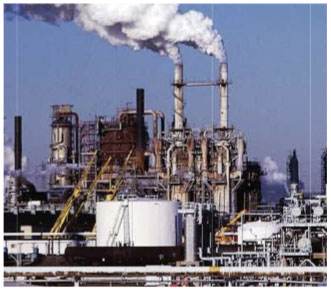
 Delayed Coker is a type of coker who's process consists of heating residual oil feed to its thermal cracking temperature in a furnace. The most important variable in industrial furnace control is temperature. Temperature is measured throughout the furnace in different zones and temperature effects the materials being manufactured and therefore must be precisely monitored to prevent deviations in quality of the final product.
Benefits
- Minimized plant startup time and downtime
- Improved product quality, continuous temperature monitoring leads to improvement of the product quality
- Reduced maintenance effort (NO wires, NO routing problems, NO cable maintenance issue)
- Optimized fuel consumption and reduced operation cost (OPEX)
- Reduced total power consumption, low power consumption devices enable cost savings
- Enabled easy integration with existing host system, industry proven Modbus platform enables easy and seamless integration with a wide range of host systems
Requirements
 Coker tube furnace is the heart of the delayed coking process. The heater provides all the heat in the process. The output temperature of the furnace is typically around 500 degree C.
- Temperature monitoring is required due to the following reasons:
-
- Coker furnaces are designed to have a constantly rising temperature gradient to reach the thermal cracking temperature quickly and thus optimize the fuel consumption.
- The burners are controlled by the measurement of tube temperatures.
- The furnace needs to be decoked or cleaned. Continuous operation of the cork drum forms a layer of insulation on the inner lining of the tubes resulting in the variation of temperature on the coke drum skin.
- Delayed coking is one of the processes used in many refineries. Depending on the capacity, number of coke drums in operation varies from 4 to 8. Each coke drum will require up to 24 temperature points to be monitored.
 Coker tube furnace is the heart of the delayed coking process. The heater provides all the heat in the process. The output temperature of the furnace is typically around 500 degree C.
Solution
 Three YTMX580 multi input temperature transmitters were installed. Each of these accepts 8 temperature inputs and it reduces the quantity of transmitters required to only 3 on each coke drum. Field wireless access point was installed on the control room located 600m from the measurement area with dense obstructions. Two repeaters were used to establish redundant communication paths between the measurement devices and the field wireless access point. The field wireless management station was integrated with 3rd party host system using RS485 series Modbus communication.
The ISA100 wireless system provides an easy customizable GUI with deterministic topology monitoring for the operator. It identifies the wireless condition such as error rate of both primary and secondary communication paths to visualize communication quality.
Conclusion
- Wireless solutions enabled reduction of huge bundles of cable running from the field to the control room.
- High capacity Lithium Thionyl battery powered devices enabled savings in OPEX with proven battery life of better than 1.6 years with an update time of 10 sec for the temperature measurements (eight inputs).
- Industry proven Modbus platform enabled easy integration with existing 3rd party host systems.
- Wider application coverage ISA100 wireless minimized infrastructure which reduces installation time and expense, this is reflected as direct savings to the users.

- Best in class signal availability of ISA100 wireless architecture with stable wireless connections proved to be a trustworthy wireless solution, perfectly meeting the user requirements.
- Maintainable topology reduced the cost of ownership and enabled more points to be added as necessary in the future.

Yokogawa has a proven track record of delivering reliable, scalable and open technologies for a century. ISA100 wireless solutions address the specific challenges of the industrial automation industry while lowering cost ownership for our end users and maximizing their return on the investment.
Verwandte Industrien
-
Refining & Petrochemical
The refining and petrochemical industries are facing major challenges from the energy transition, digitalization, and market volatility. To stay competitive, companies must improve operational agility, efficiency, and sustainability. Drawing on decades of industry expertise, Yokogawa helps customers achieve safe, reliable, and optimized operations through advanced automation and digital solutions.
Zugehörige Produkte & Lösungen
-
Drahtlose Feldinstrumentierung
Drahtloslösungen zeichnen sich durch ihre flexiblen Einsatzmöglichkeiten aus. Der Investitionsaufwand für die eigentliche Infrastruktur ist geringer. Dennoch können auf diese Weise deutlich wertvollere Einblicke in den Anlagenbetrieb gewonnen werden.
-
Drahtloser Temperaturmessumformer YTA510
Der leistungsstarke Temperaturmessumformer YTA510 kann Signale von einem Thermoelement oder Widerstandsthermometer bzw. Ohm oder DC-Millivolt aufnehmen. Messumformer dieser Baureihe übermitteln nicht nur Prozessvariablen, sondern auch die Einstellparameter mithilfe von Funksignalen. Die Messumformer werden über interne Akkus gespeist. Da somit keine feste Verkabelung erforderlich ist, können Einsparungen im Hinblick auf die Installationskosten erzielt werden. Die Kommunikation basiert auf den Spezifikationen des ISA100.11a-Protokolls.
-
Temperaturmessumformer YTMX580 mit mehreren Eingängen
Der YTMX580 kann Signale von bis zu 8 Messstellen wie Thermoelementen (8 Typen: K, E, J usw.) und Widerstandsthermometern (3 Typen: Pt100 usw.) aufnehmen. Anschließend wandelt er die entsprechenden Messwerte in ein Funksignal um. Darüber hinaus kann er auch Gleichspannungssignale, Widerstandssignale und Signaleingänge im Bereich von 4 bis 20 mA DC aufnehmen.
-
Verwaltungsstation YFGW410 für die drahtlose Feldinstrumentierung
Die Verwaltungsstation YFGW410 für die drahtlose Feldinstrumentierung fußt auf dem Standard ISA100.11a für Funkkommunikation im Bereich der industriellen Automation, der von der International Society of Automation (ISA) entwickelt wurde. Das Produkt punktet mit verschiedenen auf ISA100.11a basierenden Funktionen und kann beispielsweise als Systemmanager, Sicherheitsmanager und Gateway eingesetzt werden. In Verbindung mit dem Zugangspunkt (YFGW510) und/oder dem Medienkonverter (YFGW610) bildet die Verwaltungsstation das System für die drahtlose Feldinstrumentierung.
-
YFGW520 Field Wireless Access Point
YFGW520 Field Wireless Access Point has backbone router function based on ISA, and combining this with Field Wireless Management Station (YFGW410) and/or Field Wireless Media Converter (YFGW610) composes the field wireless system.
-
Zugangspunkt YFGW510/YFGW520 für die drahtlose Feldinstrumentierung
Der Zugangspunkt YFGW510/YFGW520 für die drahtlose Feldinstrumentierung fußt auf dem Standard ISA100.11a für Funkkommunikation im Bereich der industriellen Automation, der von der International Society of Automation (ISA) entwickelt wurde. Das Produkt kann basierend auf ISA als Backbone-Router eingesetzt werden. In Verbindung mit der Verwaltungsstation (YFGW410) und/oder dem Medienkonverter (YFGW610) bildet der Zugangspunkt das System für die drahtlose Feldinstrumentierung.