Application Scope
Industry: Refining
Product: Gas Density Meter
Introduction
The top gas generated at the top of a distillation column in a petroleum refinery’s fluid catalytic cracker(FCC) is used to produce gasoline and LPG. As the composition of this gas varies depending on the running conditions of the cracker as well as the composition of the crude oil, its density (= molecular weight) must be constantly monitored and measured. The GD402 Gas Density Meter has been introduced for this explosion protected application. It features an intrinsically safe and explosionproof design, fast response, and a dust-proof, anti-corrosive, and flameproof construction.
Expected Benefits
- Ensures stable and rapid measurement of gas density under hazardous conditions
- Capable of displaying specific gravity and molecular weight readings derived from the density data
- Greatly reduces the workload by ensuring continuous and accurate measurement
Process Overview
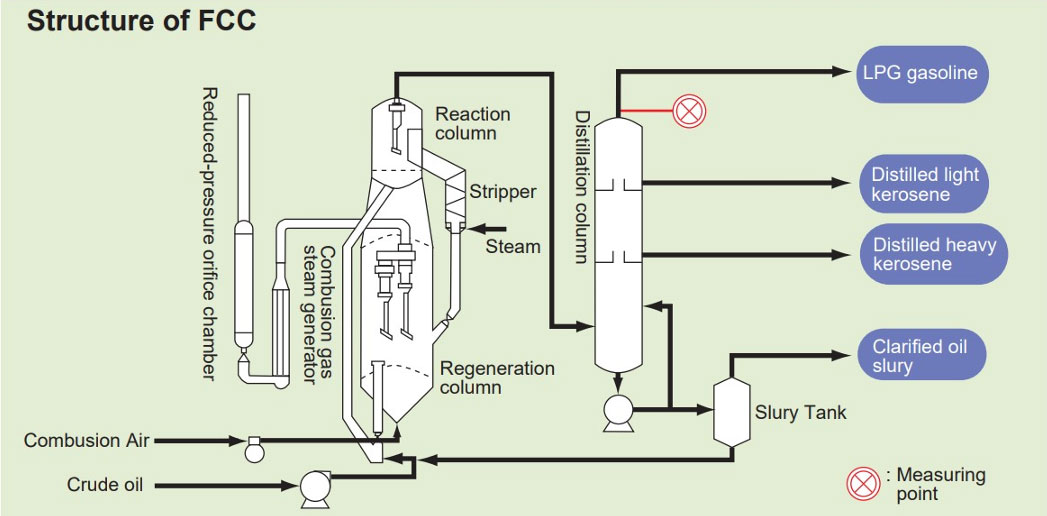
In the petroleum refining system, an atmospheric distillation column or reduced-pressure distillation column is used to refine crude oil into gasoline, kerosene, and lubrication oil. In addition, the petroleum refining system incorporates an FCC to distill high-octane gasoline and LPG from the heavy contents of the crude oil. In many refineries the FCC unit serves as the primary unit, converting, or cracking low-value crude oil heavy ends into a variety of higher value, light products. The primary function of the FCC unit is to produce gasoline. Modern FCC units can process a wide variety of feedstock and can adjust operating conditions to maximize production of gasoline, middle distillate olefins (LCO) or light olefins to meet different market demands.
The top gas generated in the fraction column of the FCC goes through a heat exchanger and is then pumped to a high pressure. The resulting gas content is transferred to the LPG recovery system and the liquid content to the gasoline generation system. In this process, it is important to measure the density (specific gravity) of the gas because the data is essential as a critical parameter in controlling the operation of the FCC. In addition to being used to monitor the system and the quality of the product, this measurement can also help prevent pump pressure surges.
The GD402 Gas Density Meter has been introduced for this explosion protected application. It features an intrinsically safe and explosion-proof design, fast response, and a dust-proof, anti-corrosive, and flameproof construction. GD402 will ensure stable and rapid measurement of gas density under hazardous conditions. It is capable of displaying specific gravity and molecular weight readings derived from the density data, and it will greatly reduce the workload by ensuring continuous and accurate measurement.
Solution Details
Measurement System
Gas Density Meter (explosionproof type) : GD40/...
Converter : GD402--E-E/...
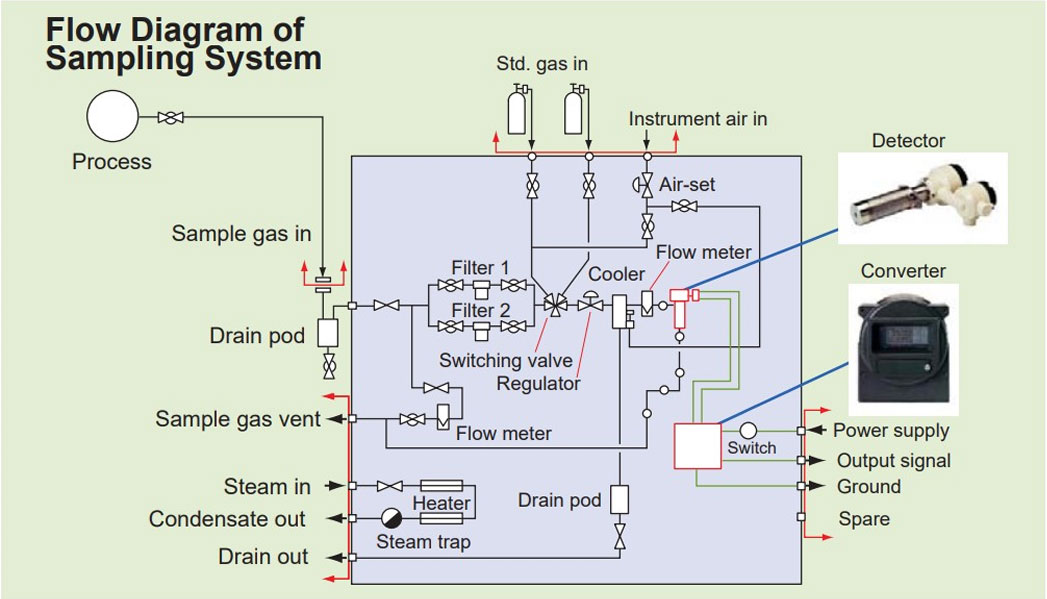
Sampling system : Customized
Cubicles for detector and converter : Customized
Utilities
Power supply :
Rated voltage, frequency ; 100 to 240 V AC, 50/60 Hz
Operating voltage, frequency ; 85 to 264 V AC, 47 to 63 Hz
Power consumption: 12 W (max.)
Steam ; 120 to 180°C (300 to 700 kPa)
Saturated steam (15 to 20 kg/h)
Field Data
Process conditions
Measurement point : Outlet of the top fraction column in the FCC
Temperature : 34°C
Pressure : 75 kPa to 185 kPa
Humidity : Wet
Gas composition : O2, N2, CO, H2, H2S, C1 to C5
Dust : None
Measurement Range
1,600 to 1,800 kg/Nm3
Notes
- The cubicles for the detector and converter are separated to prevent the gas in the sampling section from cooling and liquefying while the converter is operating.
- The capillary tubes for introducing the gas that is to be measured and the inside of the cubicles are heated with steam so that the heavy contents (C5 or more) will not liquefy.
Gerelateerde Industrieën
-
Downstream olie & gas
De downstream olie- en gasindustrie wordt de laatste jaren met een toenemend aantal uitdagingen geconfronteerd. Deze omvatten de veranderende kenmerken van de te verwerken grondstoffen, veroudering van procesinstallaties en apparatuur, stijgende energiekosten, gebrek aan geschoolde fabrieksoperators die een raffinaderij veilig en efficiënt kunnen leiden en de steeds veranderende eisen van zowel de markt als de klant.
In de loop der jaren is Yokogawa een samenwerkingsverband aangegaan met vele downstream bedrijven om industriële oplossingen te bieden die gericht zijn op het oplossen van deze uitdagingen en problemen. Yokogawa's oplossingen hebben plantmanagers geholpen om maximale winstgevendheid en duurzame veiligheid binnen hun fabrieken te realiseren.
-
Refining
In de steeds veranderende markt worden raffinaderijen niet alleen gezien als installaties voor de verwerking van ruwe olie, maar moeten ze ook rendement opleveren. Tegelijkertijd is men zich bewust van de noodzaak van veiligheid in dergelijke installaties. Een totale productieoplossing die planning, beheer en controle omvat, is vereist om de lange termijn doelstellingen inzake rentabiliteit, efficiëntie en milieubescherming te bereiken. Met jarenlange expertise op het gebied van automatisering kan Yokogawa u betaalbare totaaloplossingen bieden voor efficiëntere productie en een schonere wereld.
Gerelateerde producten & oplossingen
-
GD40 Detector
The GD40 detector is designed for intrinsically safe and flameproof, explosion protected applications. It is designed to be virtually maintenance free for all accepted applications.
-
GD402 Analyzer
The Model GD402 gas density analyzer and Model GD40 detector not only provide continuous measurement of gas density, but also several other valuable parameters, including specific gravity and molecular weight. The Model GD402 is a rugged microprocessor-based converter designed in two versions to meet both general area and explosion-proof application requirements.
-
Gas Density Meter GD80, GD802G, GD802S
Fast-response gas density measurement for safe and stable operation. More than density, monitor gas concentration, molecular weight, specific gravity, hydrogen purity, and replacement concentration.