Application Scope
Industry: Refining
Product: Gas Density Meter
Introduction
The top gas generated at the top of a distillation column in a petroleum refinery’s fluid catalytic cracker(FCC) is used to produce gasoline and LPG. As the composition of this gas varies depending on the running conditions of the cracker as well as the composition of the crude oil, its density (= molecular weight) must be constantly monitored and measured. The GD402 Gas Density Meter has been introduced for this explosion protected application. It features an intrinsically safe and explosionproof design, fast response, and a dust-proof, anti-corrosive, and flameproof construction.
Expected Benefits
- Ensures stable and rapid measurement of gas density under hazardous conditions
- Capable of displaying specific gravity and molecular weight readings derived from the density data
- Greatly reduces the workload by ensuring continuous and accurate measurement
Process Overview
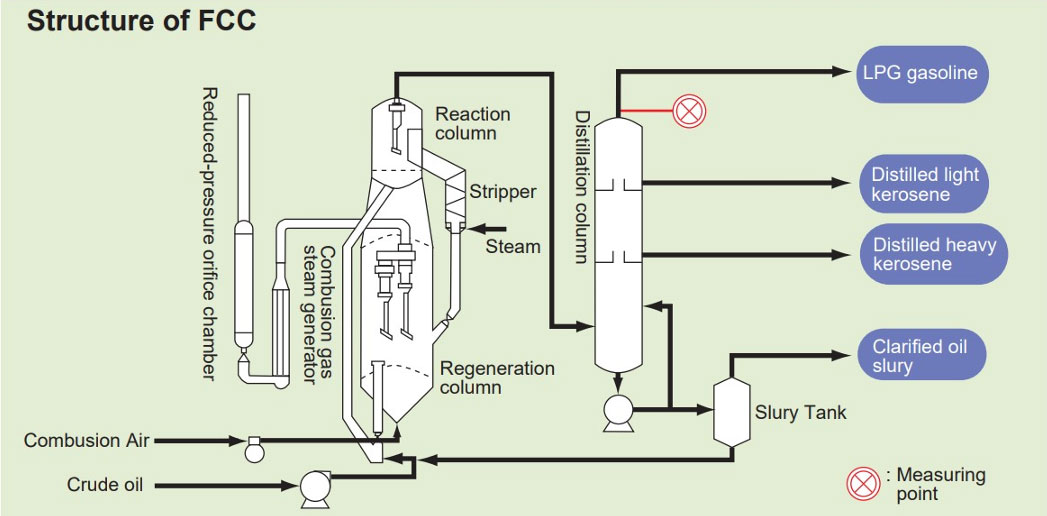
In the petroleum refining system, an atmospheric distillation column or reduced-pressure distillation column is used to refine crude oil into gasoline, kerosene, and lubrication oil. In addition, the petroleum refining system incorporates an FCC to distill high-octane gasoline and LPG from the heavy contents of the crude oil. In many refineries the FCC unit serves as the primary unit, converting, or cracking low-value crude oil heavy ends into a variety of higher value, light products. The primary function of the FCC unit is to produce gasoline. Modern FCC units can process a wide variety of feedstock and can adjust operating conditions to maximize production of gasoline, middle distillate olefins (LCO) or light olefins to meet different market demands.
The top gas generated in the fraction column of the FCC goes through a heat exchanger and is then pumped to a high pressure. The resulting gas content is transferred to the LPG recovery system and the liquid content to the gasoline generation system. In this process, it is important to measure the density (specific gravity) of the gas because the data is essential as a critical parameter in controlling the operation of the FCC. In addition to being used to monitor the system and the quality of the product, this measurement can also help prevent pump pressure surges.
The GD402 Gas Density Meter has been introduced for this explosion protected application. It features an intrinsically safe and explosion-proof design, fast response, and a dust-proof, anti-corrosive, and flameproof construction. GD402 will ensure stable and rapid measurement of gas density under hazardous conditions. It is capable of displaying specific gravity and molecular weight readings derived from the density data, and it will greatly reduce the workload by ensuring continuous and accurate measurement.
Solution Details
Measurement System
Gas Density Meter (explosionproof type) : GD40/...
Converter : GD402--E-E/...
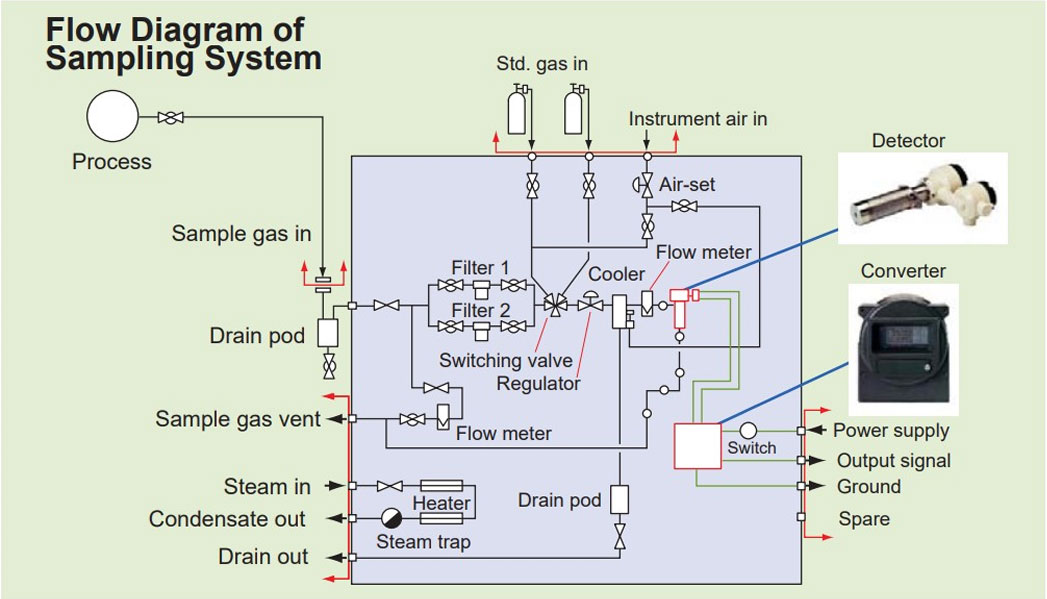
Sampling system : Customized
Cubicles for detector and converter : Customized
Utilities
Power supply :
Rated voltage, frequency ; 100 to 240 V AC, 50/60 Hz
Operating voltage, frequency ; 85 to 264 V AC, 47 to 63 Hz
Power consumption: 12 W (max.)
Steam ; 120 to 180°C (300 to 700 kPa)
Saturated steam (15 to 20 kg/h)
Field Data
Process conditions
Measurement point : Outlet of the top fraction column in the FCC
Temperature : 34°C
Pressure : 75 kPa to 185 kPa
Humidity : Wet
Gas composition : O2, N2, CO, H2, H2S, C1 to C5
Dust : None
Measurement Range
1,600 to 1,800 kg/Nm3
Notes
- The cubicles for the detector and converter are separated to prevent the gas in the sampling section from cooling and liquefying while the converter is operating.
- The capillary tubes for introducing the gas that is to be measured and the inside of the cubicles are heated with steam so that the heavy contents (C5 or more) will not liquefy.
相关行业
-
油气下游
近年来,石油天然气下游行业正面临日益增多的挑战。这些挑战包括:需处理的原料特性不断变化、工艺设施与设备逐渐老化、能源成本持续攀升、能够安全高效运营炼油厂的熟练操作人员紧缺,以及市场和客户需求的快速变化。
多年来,横河电机与众多下游企业携手合作,提供专注于解决这些挑战与难题的工业解决方案。横河电机的 VigilantPlant解决方案助力工厂业主实现工厂内的更大盈利和可持续安全运营。
-
炼油
在不断变化的市场环境中,炼油厂不仅被视为原油加工单元,更是利润中心。与此同时,业界对这些设施的安全需求保持着高度重视。要实现长期盈利、效率提升与环境保护的目标,需要一套涵盖规划、调度、管理与控制的完整生产解决方案。凭借在自动化领域多年的专业积淀,横河电机能够为您提供高性价比的整体解决方案,助力提升运营效能,共创更清洁的世界。
相关产品&解决方案
-
GD402 检测仪
GD402型和GD40型气体密度检测仪可以连续测量气体密度,而且还可以测量气体的比重和分子量等重要参数。GD402型是一种坚固的基于微处理器的转换器,设计有两种版本,可以满足一般领域和防爆应用的要求。
-
GD40检测仪
GD40检测仪专为本安、防火、防爆等应用而设计,它被设计为对所有被接受的应用几乎免费维护。
-
气体密度计GD80、GD802G、GD802S
快速测量气体密度,助力安全稳定运行。不止测量密度,还可监测气体浓度、分子量、比重、氢气纯度及置换气体浓度