Reducing Slurry Noise for Stable and Accurate Measurements
Plant Name: Power Plant
Industry: Chemical
Product(s): Power Process
Application
In order to reduce emissions of air pollutants such as sulfur oxides (SOx) and nitrogen oxides (NOx), power plants have installed flue gas desulfurization systems known as scrubbers.
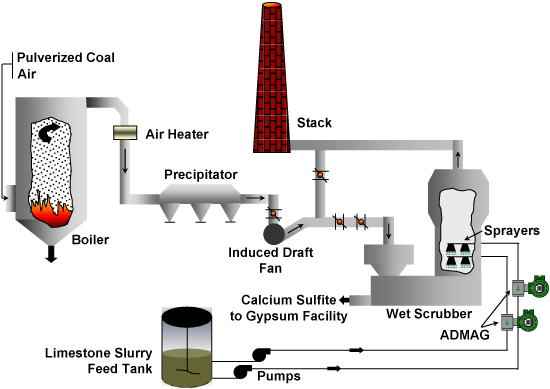
Figure 1: Flue Gas Desulfurization
Challenges
Wet flue gas desulfurization or scrubber systems are very effective in reducing sulfur dioxide (SO2) emissions caused by coal combustion boilers. The flue gas discharged from the boiler is fed into the absorber, where a mixture of water and pulverized limestone is sprayed on the flue gas. The limestone slurry reduces sulfur emissions by absorbing the SO2 contained in the flue gas. The limestone reacts with SO2 to produce calcium sulfite. The calcium sulfite then reacts with oxygen and is finally removed as gypsum.
Magnetic flowmeters are typically used to measure the flow of the limestone slurry to the sprayers. A key issue is that the limestone and gypsum slurries are very abrasive. In this application, a conventional, polytetrafluoroethylene (PTFE) lined magnetic flowmeter has a short life expectancy. Non-retained liners and electrodes that expose their seals to the slurry can cause meters to fail. Once the liner wears away or the seal around the electrode is eroded, the process fluid can damage internal components such as coils and electrode wiring.
In addition, electrodes that protrude into the process can increase signal noise as the limestone or gypsum solid particles collide with them. Since conventional electronics cannot distinguish the noise from the flow signal, the resulting erratic output from the meter is unsuitable for control.
Incorrect installation can also cause metering problems. In addition to the typical installation requirements in terms of lengths of upstream and downstream straight pipe runs, maintaining the velocity of the slurry within certain limits is very important. If the flow rate is below 1.5 m/sec (5 ft/sec), the limestone can fall out of suspension. In a horizontal pipe, this can subject the bottom of the meter to excessive wear. If the flow rate is greater than 2 m/sec (7 ft/sec), the limestone can cause increased wear in the liner. These conditions can significantly decrease the life of the meter.
Solution
Yokogawa has designed the ADMAG Total Insight, AXG magnetic flowmeters for this application. As shown in Figure 2, retained liners and insertion style electrodes isolate the sealing surface from the process fluid and increase service life. The flush electrode reduces the potential for slurry noise. In addition, ADMAG's dual-frequency excitation and the optional, enhanced dual-frequency module will provide more stable and accurate measurement than comparable flowmeters.

Figure 2 - Retained liners and insertion style electrodes remove sealing surface from process fluid for enhanced service life
For limestone slurry flow measurement, best practice is flow in an upward direction through a vertical pipe at a velocity between 1.5 to 3 m/sec (5 to 10 ft/sec). This keeps the limestone suspended in the water and minimizes liner wear. A metal hat “earth ring” can also reduce erosion by protecting the leading edge of the liner.
When these installation recommendations cannot be met, a ceramic-lined meter should be considered. The ADMAG ceramic meter would be well suited to such applications due to the abrasion resistance of its liner and to the flush and fused platinum electrode, which reduces slurry noise. Furthermore, the ADMAG CA, capacitance type magnetic flowmeter, which is ceramic lined and has no wetted electrodes, offers a solution for abrasion resistance and immunity to slurry noise.
Key Advantages

- Dual-frequency excitation provides fast response time, zero stability, and noise reduction to enable precise control.
- Retained liners and insertion style electrodes extend service life, minimize OPEX and long-term total cost of ownership (TCO).
- PFA and ceramic liners significantly reduce meter failures and downtime in harsh conditions such as slurry flow measurement.
Related Products & Solutions
-
ADMAG AXF
The AXF magnetic flow meter is a sophisticated product with outstanding reliability and ease of operation, developed on the basis of decades of field experience. Based on FOUNDATION™ fieldbus specifications, AXF Fieldbus Magnetic Flow meter models offer more flexible instrumentation.
-
ADMAG CA
ADMAG CA magnetic flow meter is excellent at measurement in ultra-low conductivity fluids down to 0.01 microS/cm, adhesive fluids, or slurry fluids.
Have Questions?
Contact a Yokogawa Expert to learn how we can help you solve your challenges.