The 25th Green Phoenix Project (GPP) Lecture & Workshop was held at Waseda University on September 12, 2025. This joint project integrating industry, government, and academia was launched as a learning community in 2021 by Yokogawa and the Waseda University Governance and Sustainability Research Institute (Waseda University GSRI). In this time of increasing chaos, the GPP is a co-creation forum generating new value through creativity and collaboration by envisioning a future through multifaceted perspectives transcending industry and positions. At present, it has 39 organizational members.
Participation for this event was a total of 53 individuals from 22 organizations. Early- to mid-career professionals from Japan were joined by online participants from overseas, including the UK and Saudi Arabia. This three-part feature spotlights both insights and dialogue from the event.
The GPP story: A forum for open discussion of the future
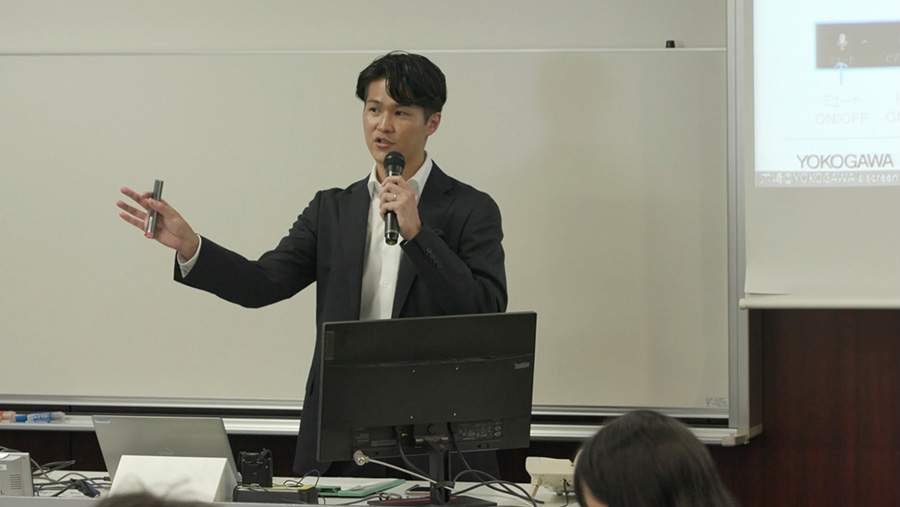
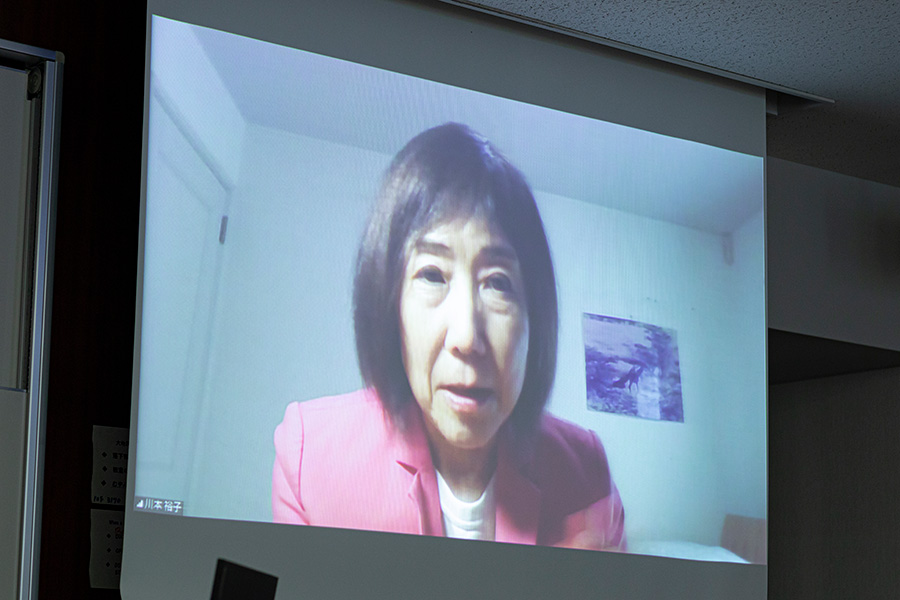
Future Co-creation Initiative Scenario Ambassador* Shogo Ohsaki (Human Resources & General Affairs Headquarters, Yokogawa Electric Corporation) moderated the event. The welcoming address was delivered by Waseda University GSRI Founding Director Yuko Kawamoto, a cofounder of the GPP and current President of Japan’s National Personnel Authority.
*Scenario Ambassadors are millennials (aged late 20s to early 40s) selected from each department; they form the core of the Future Co-creation Initiative.
“I was in total agreement when Nobuyuki Tamaki launched the project four years ago, harnessing scenario planning to cultivate holistic-minded talent. It was all so utterly innovative—even the note-taking style in meetings—and I thoroughly enjoyed every session. I’ll never forget what he said: Scenario planning is a rehearsal for the future. This opportunity feels exceedingly critical given the era of rapid change and uncertainty in which we live.”
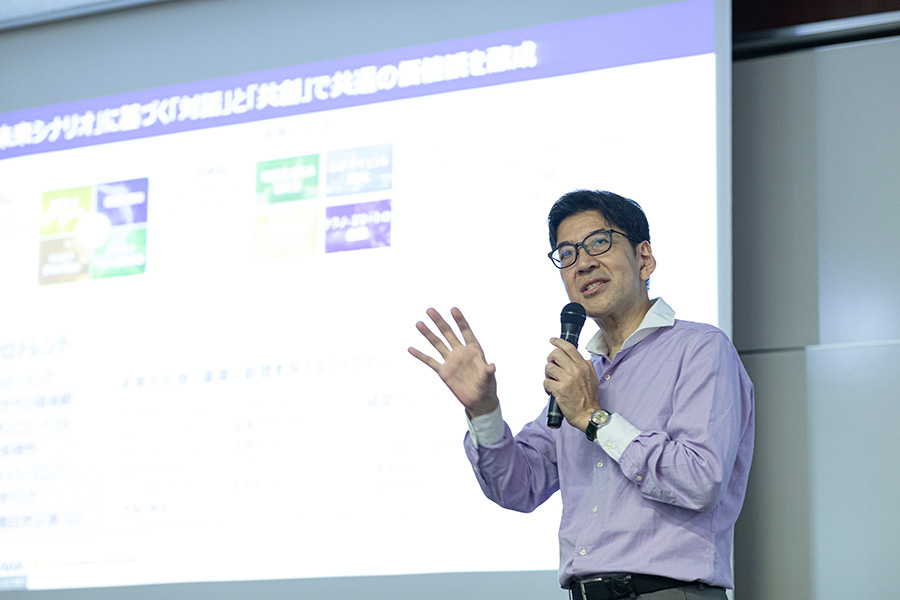
The next speaker was Professor Jusuke Ikegami (Dean of Waseda University Business School, Graduate School of Business and Finance), a strong supporter of the GPP since its inception, who took the stage with a smile and provided an overview of the organization.
“GPP members conventionally study and explore diverse fields, such as economics, technology, geopolitics, and management trends. The GPP affords a space for participants to freely exchange ideas and mutual insights without regard to corporate position. To ensure this, we established three operating principles: Constructive Conflict, which encourages accepting opposing views and discussing them constructively; Contribution Mindset, which values not only taking but also giving; and the Chatham House Rule, which prevents speakers from being identified.
An open co-creation platform
Next, Nobuyuki Tamaki, cofounder of the GPP with Professor Ikegami and Future Co-creation Initiative Project Leader, explained the objectives of the initiative.
“Through our activities, we seek to foster co-creational leaders and cultures, promoting systemic change through stakeholder dialogue both within and beyond the company. Rather than relying on planning carried out in secret, the program stands out because young professionals engage in open dialogue to create future scenarios that are shared with the public.
“However, the real aim is not the creation of future scenarios but rather the unique approach of scenario planning to foster co-creational leadership and networking.
“Each session welcomes executives, management, and next-gen leaders from a range of industries. Participants vary, depending on the topic at hand, enjoying both discussion and insights.”
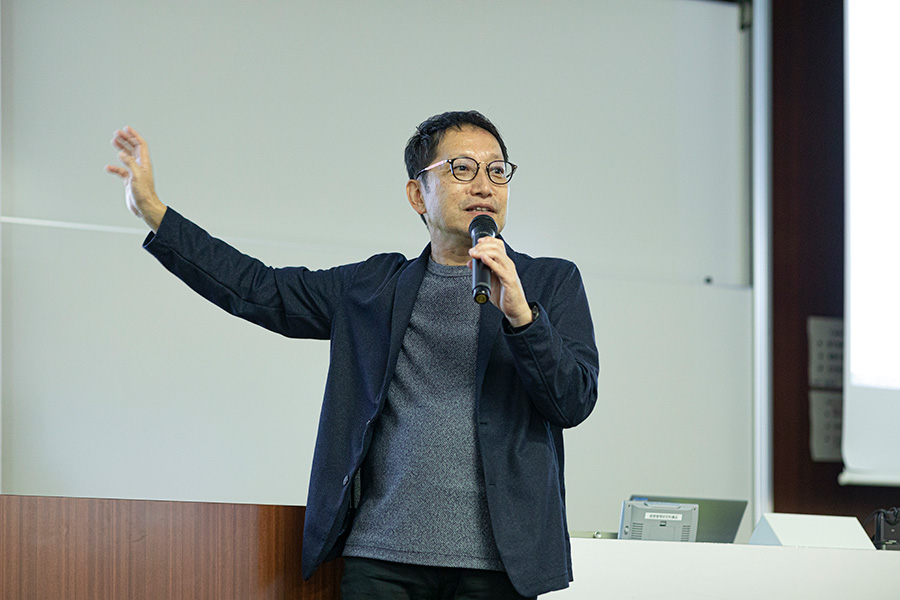
The Future Co-creation Initiative is a Yokogawa in-house effort, while the GPP embraces corporate partners from multilateral sectors. Linking these two has yielded an open co-creation business platform.
Future Scenario 2040: A white paper born from dialogue with executives and experts
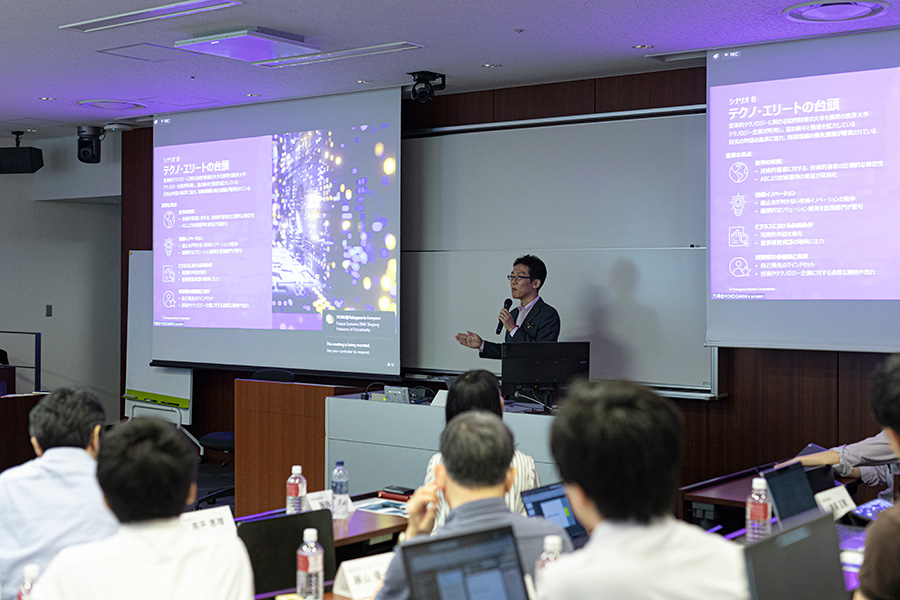
Opening addresses were followed by an overview of Future Scenario 2040, presented by Scenario Ambassador Shinichi Chiyoda (Marketing Headquarters, Yokogawa Electric Corporation).
“Yokogawa primarily develops solutions for manufacturers in the B2B domain. However, to envision our customers’ future, we expanded the scope of our scenario planning to B2B2C because we also felt the necessity to depict the future of end consumers—the general public.”
The first step in this process is an analysis of the external environment.
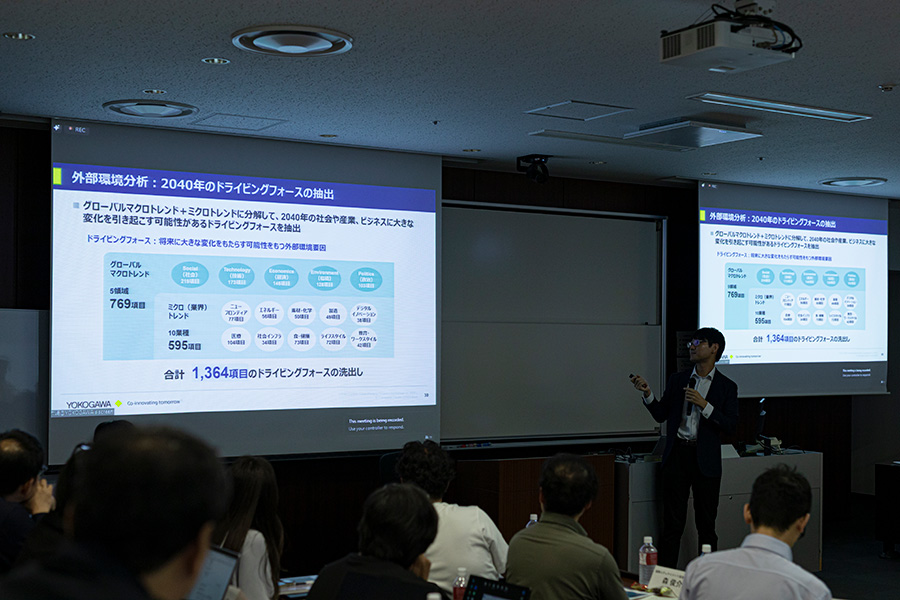
“We began by enlisting external environment analysis frameworks such as STEEP and Five Forces, delineating key macro-level change variables rendering long-term social impact. Next, we identified micro-level change variables for ten industries selected based on the future economic landscape. That process yielded 1,364 driving forces. We separated that enormous number of driving forces into abstract clusters, subjectively evaluating their impact and uncertainty. That in turn produced five megatrends which are likely to occur and generate a major impact.”
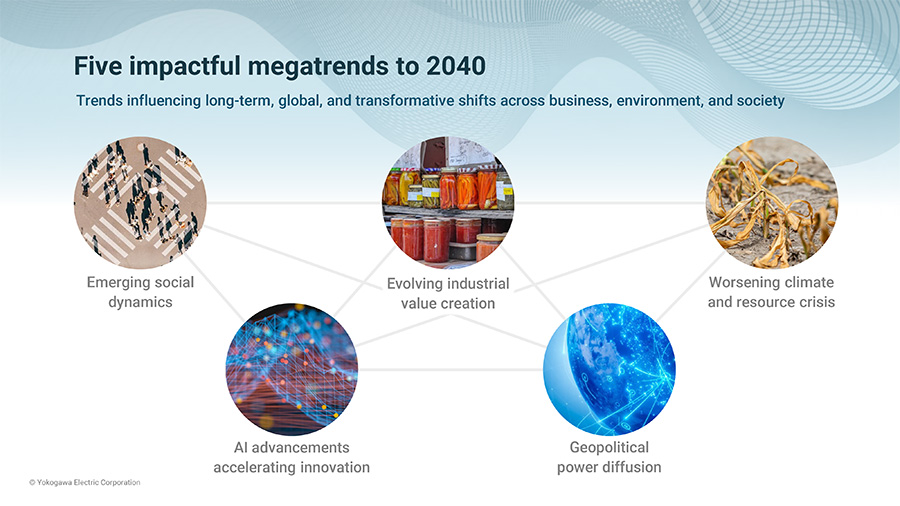
Scenario Ambassador Jun Kobayashi (Marketing Headquarters, Yokogawa Electric Corporation) took over, providing an overview of the scenario drivers.
“Scenario drivers are the key uncertain variables significantly impacting directionality. Because differing combinations produce diverse scenarios, these factors were carefully and thoroughly examined. With material growth reaching its limits, we debated how to position less quantifiable factors, such as sustainability and happiness, and ultimately established dual axes representing the biosphere and technology.”
The first axis was “strategies for addressing biospheric risks,” while the second was “approaches to governing transformative technologies.” Ikegami offers insights into these two scenario drivers.
“While other companies incorporate scenario drivers beyond human control, Yokogawa’s distinctive strategy is to focus on those within human sway, demonstrating a belief in human potential.”
Combining these two scenario drivers on vertical and horizontal axes generates the following four scenarios.
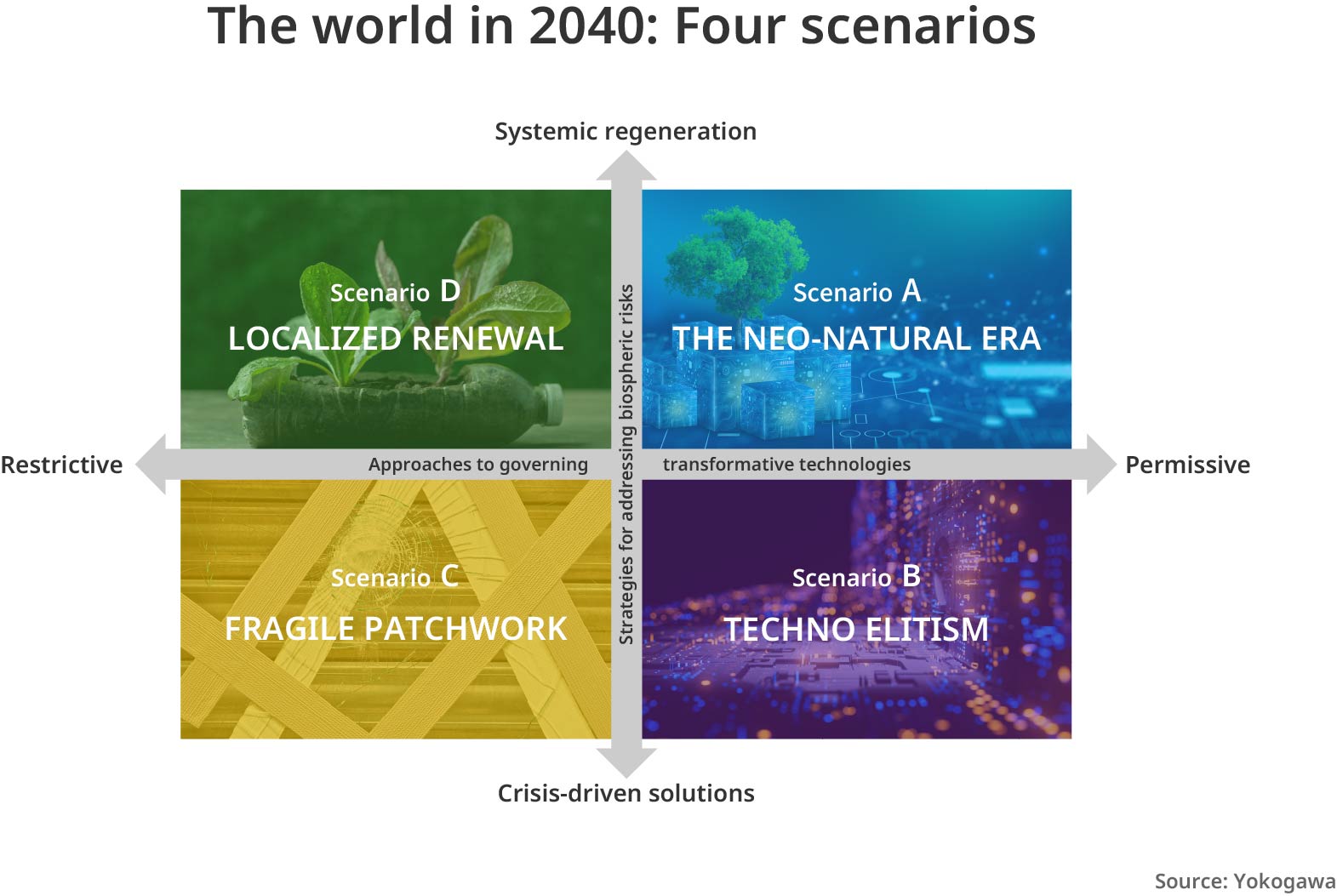
See Future Scenario 2040 for details.
Kobayashi offered concluding remarks.
“Those of us functioning as scenario ambassadors actively leverage AI and consult with external executives and experts as we craft scenarios. Thanks to your support, we have gained invaluable insights into the very core of our scenarios.
“Going forward, the future vision developed through dialogue between Future Co-creation Initiative members and management should translate into strategy through expanded collaboration among business sectors and industry-government-academia and through transformation of our business portfolios. With each member acting as a boundary spanner within and beyond the company, we can ignite the transformative spirit of others. At the same time, expanding “weak ties,” those that are outside our own corporate chain of command, will lead to new insights and initiatives.”
Details
Future Co-creation Initiative Menu

HOME
Top page of Yokogawa’s “Future Co-creation Initiative”

Interviews
Our collaborators discuss the value and meaning of “Future Co-creation Initiative” from various perspectives.
Activity Overview
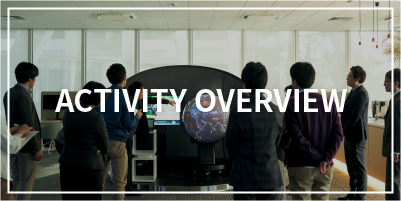
Introduction of our next-generation leadership development and a co-creation network beyond the scope of business.
Activity Objectives
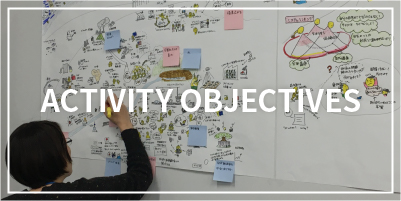
Background and aspirations behind launching co-creative activities in an age without clear answers.
Future Scenarios
Future scenarios generated by young leaders of the future through scenario planning and co-creative dialogue.
Scenario Ambassadors
Introduction of Scenario Ambassadors—representatives selected from each Yokogawa department enjoying growth and learning.

Collaborator Networks
Fostering “weak ties” among our supporters, partners and individual companies, while building an industry-government-academia network.
Sponsor Article
Article published by WIRED, the US-based tech culture magazine.
Looking for more information on our people, technology and solutions?
Contact Us