

全球首款真正整合的安全控制器
ProSafe-RS 是 Yokogawa 符合 IEC61508 與 ANSI/ISA 84 的安全系統,已應用於超過 3,500 個專案,涵蓋大型整合流程自動化專案到獨立解決方案。Yokogawa 的 ProSafe-RS 安全系統具備專業能力、全生命週期支援與長期可持續性。
最新發行資訊:R4.11.10(2025年11月)
IT Security 3
IT Security 3(版本 3.0)是我們用於強化執行 Yokogawa 產品的 Windows 系統的安全設定工具的最新更新版本。使用此版本,所有安全設定可透過 IT Security 工具一次完成設定。
在版本 2.0 的基礎上,IT Security 3 引入了基於 CIS 基準 (*1) 的額外設定,提供更廣的設定選項並進一步降低網路安全風險。
*1:CIS 基準是由美國網際網路安全中心(CIS)發佈的系統安全設定最佳實務指南。請注意,並非所有 CIS 建議都已應用。部分設定與 CIS 指引有所不同,以確保 Yokogawa 產品的正常運作。
ProSafe-RS 概覽
全球首款真正整合的安全控制器
Yokogawa 透過 ProSafe-RS 終結 DCS 與 SIS 之間的不相容問題,這是全球首款真正整合的流程工業「安全 PLC」。在傳統上,實現分散控制系統(DCS)與安全儀表系統(SIS)之間的完全整合,往往涉及複雜的設計與整合問題。過去,DCS 與 SIS 需要兩套獨立的監控與操作環境,不同的通訊方式及專用硬體架構都必須建立。為了優化流程運作,廠務管理者通常都認為專案時間與成本必然會增加。
關於 OpreX
OpreX 是 Yokogawa 工業自動化(IA)與控制業務的完整品牌。OpreX 代表 Yokogawa 透過與客戶共創價值而培育出的技術與解決方案的卓越性,涵蓋 Yokogawa 全系列的 IA 產品、服務與解決方案。此品牌包含五大類別:OpreX Transformation、OpreX Control、OpreX Measurement、OpreX Execution 與 OpreX Lifecycle。其中,OpreX Control 旗下的產品群之一為 OpreX Control and Safety System 系列,包括 ProSafe-RS。透過多樣化的 OpreX Control 解決方案,Yokogawa 能迅速為客戶帶來管理與運營上的轉型,並提供高可靠度的控制技術,確保工廠運作的高效率、高品質,以及安全穩定。
藉由 OpreX 品牌,Yokogawa 將提供整合解決方案,滿足特定需求並支持客戶的轉型與業務成長。
Details
Engineering
ProSafe-RS is composed of the Safety Engineering PC (SENG) equipped with engineering and maintenance functions, the Safety Control Station (SCS) for safety control and Vnet/IP for control network to communicate with each of those equipment.

ProSafe-RS can be integrated with the CENTUM VP. The SCS can be operated and monitored by the HIS (Human Interface Station) of the CENTUM VP. It is also possible to connect to other DCSs and PLCs via subsystem communication (Modbus communication).
HART communication on ProSafe-RS allows Plant Resource Manager (PRM) to manage the HART communication devices connected to I/O modules on SCS. Also, the AO signal allows PRM client to conduct Partial Stroke Test (PST) on HART-supported valve positioner equipped with the PST function.
One architecture
Seamless architecture achieves true integration of DCS and SIS, contributing to plant optimization.
Expected operational benefits:
- faster project implementation at a lower cost - using just one process network saves engineering design time
- greater operational efficiency - integrated information displays are clearer and more usable
- lower cost of ownership - common control and network architecture standards cut maintenance overhead
Eliminating SIS selection complexities
ProSafe-RS is SIL3 certified in a single module configuration. Redundancy is already built-in to each ultra-compact input, output, and processor card. This intrinsically simple modularity makes it possible to design systems with ease. If additional system availability is required, users can add redundancy on a function by function basis by simply plugging in the appropriate module.
Yokogawa's parallel engineering
Application engineering and hardware engineering can progress independently and parallel. This parallel work shortens the project schedule, either by starting later or by possibly enabling an earlier start-up.

1. Early start-up of a plant
Starting up a plant more quickly has long been an issue that directly affects customers’ profits.
Although the start-up of instruments and the installation of I/O modules can be performed in parallel, the loop check is completed only after the FAT (Factory Acceptance Test) is finished and the controller and the engineering environment are installed.

In Yokogawa’s parallel engineering, there is no need to wait for the controller and engineering environment to be completed. The integrity of loops can be checked only with N-IO modules and Field Commissioning Support Package. If any change is found in the I/O definition information, it can be corrected on the spot, and the corrected definition can then be refiected in the master information in the plant.
2. Reducing risks to scheduled project delivery
The I/O definition often needs to be changed due to physical constraints. Such problems usually occur during commissioning and may prolong the project schedule, as well as require costly re-wiring.
The I/O definition of N-IO modules can be changed more fiexibly. Signal types among DI/DO/AI/AO can be switched only with software, and there is no need to change I/O modules. Since signal types can be designated at each channel, there is no need to stock I/O modules for each signal type, reducing maintenance costs.
Automation Design Suite (AD Suite)
ProSafe-RS R4 features AD Suite, the same engineering environment used with the CENTUM VP integrated control system, allowing the integrated management of CENTUM VP and ProSafe-RS data.
With this feature, ProSafe-RS engineers can use AD Suite to design the I/O.
AD Suite also has functions for managing the change history and recording changes that save time when renovating systems.

Better Operations, easier Engineering and Hardware Reduction

FGS (Fire & Gas System)
- Standard FGS HMI parts for gas, flame, smoke and heat detectors are added for better operations.
- Standard function blocks for FGS detectors are added for easier engineering.
- ProSafe-RS analog module can reset smoke and heat detectors alarms without additional hardware such as relays and DO modules.
The logical solution for perfect control
One network
ProSafe-RS plugs directly onto the same network used by Yokogawa's field-proven CENTUM VP. No gateway or interface hardware is required for data exchange between SIS and DCS functions. Safety communication between SIS controllers is realized and certified in a mixed DCS - SIS configuration.
Expected benefits:
- simple and quick route to system realization
- reduced engineering complexity and cost for connecting SIS and DCS
- lower maintenance costs for large process plants

Safe, reliable and available control without compromise
One architecture
Seamless architecture achieves true integration of DCS and SIS, contributing to plant optimization.
Expected operational benefits:
- faster project implementation at a lower cost - using just one process network saves engineering design time
- greater operational efficiency - integrated information displays are clearer and more usable
- lower cost of ownership - common control and network architecture standards cut maintenance overhead

Eliminating SIS selection complexities
ProSafe-RS is SIL3 certified in a single module configuration. Redundancy is already built-in to each ultra-compact input, output, and processor card. This intrinsically simple modularity makes it possible to design systems with ease. If additional system availability is required, users can add redundancy on a function by function basis by simply plugging in the appropriate module.
Significant gains in the capabilities of plant displays

- Common human-machine interface (HMI)
No more separate monitoring of SIS and DCS. While continuing to use the interface that they are most familiar with, operators can more rapidly predict which process conditions are likely to reach emergency levels. - Unified event data
Sample screens such as "faceplate" style instrument and alarm displays are provided that enable easy data comparison and decision making. - Back-tracking analysis
A further benefit of data integration is the ability to analyze events preceding an alarm - a powerful tool for effective process safety management.

It's now easy to create displays that integrate DCS and SIS data.
Virtualization Platform
Yokogawa's virtualization separates system software operations from physical hardware dependencies, allows software reusability to optimally commission system hardware.
Virtualization platform enables a single server to perform the work of multiple virtual computers, thus reducing the number of computers required to configure a control system. With this platform, both the hardware and software required to build a virtual environment are provided.
By means of this virtualized server environment, it is possible to separately update and make modifications to hardware and software as required.
This translates to customer's business centric benefits like smooth migration to new physical hardware with reduced downtime, shorter migration process and system tests time.
From maintenance point of view, segregation of hardware and software maintainability are also the significant advantages.
In addition to conventional I/O modules dedicated for specific signal types (FIO module), ProSafe-RS R4 can offer the N-IO module, which handles different signal types at each channel.
By concurrently accepting both types of module, ProSafe-RS R4 can deal more flexibly with a customer’s plant design requirements.

N-IO (Network I/O): Smart Configurable I/O (SCIO)
Features
- DI/DO/AI/AO signals can be handled at a single module.
The types of I/O signal at each channel can be changed with software. - Remote installation up to 50 km is available by using optical cables.
- SIL3 can be achieved with single configuration. Redundant configuration is also selectable.
- Terminal block has a disconnect function of signal loop of field devices as a standard function.
- An N-IO baseplate is available for intrinsically safe barriers.
For more detailed information please visit the below sites. - N-IO eliminates the need for marshalling cabinets, further saving space and costs. Thus this is ideal for flexible and distributed installation in the field.


FIO (Field network I/O)
Features
- A variety of I/O modules (AI/AO/DI/DO/Communication function) are available.
- Modbus TCP/RTU communication (Master/Slave) is available by using communication modules.
- Remote installation up to 50 km is available by using optical cables.
- SIL3 can be achieved with single configuration. Redundant configuration is also selectable.
- Dedicated terminal boards, terminal blocks, and cables for FIO are supported.

A single, simple, SIL3 solution
Yokogawa designers have employed state-of-the-art electronic design techniques and component packaging to miniaturize the safety controller circuitry. Every ProSafe-RS processor, input module, and output module features a dual architecture, providing users with SIL3-level protection on a single card. This architecture is simplicity itself to understand, design, install and maintain. Complete safeguarding now comes in one box. Furthermore, the design has an extremely high diagnostic coverage factor of more than 99%, providing users with a means of rapid fault detection that can allow repairs to be effected within an acceptable period - with minimal impact on the process.

Plug-in availability
If even higher system availability and fault tolerance is required, ProSafe-RS can be configured for dual redundancy while maintaining SIL3 by simply plugging in the appropriate additional card. Because the I/O or processing functions of ProSafe-RS have a modularity that extends down to the function level, redundancy can be applied exactly where it is needed - to input, output, or processor modules - providing a combination of safety and economy that is unprecedented in the SIS market. This flexibility allows any mix of dual redundancy to be configured such as a single input and redundant output or a redundant input and single output.

Versatile Modular Redundancy (VMR)
With its flexible selection of redundant CPU and I/O modules, ProSafe-RS delivers the high availability required by even SIL3 applications. Rather than making selections at the system or rack level, you can apply redundancy exactly where it is needed - in specific input, output or processor modules - depending on such factors as the required SIL for a loop or the reliability of field devices.This is possible because the I/O and processing functions of ProSafe-RS have a modularity that extends down to the function level.
Even when an internal failure occurs, safety functionality is maintained, reducing the likelihood of a false trip in a process.
We call this flexible plug-in availability “VMR / Versatile Modular Redundancy™".

Partial Stroke Test (PST)
Under normal conditions, valves that are integrated with a safety instrumented system (SIS) are not activated. (They are only actuated when the SIS initiates a process shutdown after an abnormality is detected in a process.) It is therefore necessary to periodically test valves to ensure that they are in good working order and will respond properly when needed.
This periodic check is called a “proof test,” and generally it involves a full stroke test (completely closing the valves). When a plant is up and running, the costly installation of a bypass is necessary to conduct a proof test. If this is not possible, the only other option for conducting this test is to shut down the plant. As a consequence, proof tests of the valves are usually conducted only once every several years.
An alternative to the full stroke test is the partial stroke test (PST), which involves slightly closing a valve to diagnose problems. A PST can be conducted without stopping a process, and it can be performed remotely from locations such as a control room.
By conducting a PST, plant owners can significantly reduce their maintenance costs. And by checking the valves more frequently than is possible with the full stroke test, they can anticipate great benefits such as increased reliability .
Note: although the PST does not eliminate the need for a full stroke test, it makes it possible to extend the proof test interval without sacrificing the required safety level.

SIL2 wireless gas detection system
SIL2 wireless gas detection system is available for FGS.
In conjunction with expertise in production control, safety instrumentation, field wireless engineering and consulting, Yokogawa offers the most efficient and timely approach to deliver end to end wireless solution.

ProSafe-RS (SIL3 SIS) and
YFGW510 (Field Wireless Access Point)
Wireless devices have a number of advantages such as allowing installation in difficult-to-access locations and the reduction of installation costs, and they are increasingly seen as essential elements in plant safety solutions.
This is a particularly important consideration with gas detection systems, whose operation can be easily influenced by factors such as installation location and ambient conditions. Even after system installation, ongoing efforts to optimize its overall configuration may necessitate occasional changes in the location and number of detection devices. The use of wireless technology eliminates the need to worry about wiring and thus greatly facilitates the process of moving and/or installing additional detection devices.

Complied Certificate
- TÜV SIL3
- ISASecure CSA 1.0.0 Level 1 *2
*2: It complies with IEC 62443-4-2 and IEC 62443-4-1 international standards for security in control devices.
Click here for ISASecure Certification details
Complied Standards
ProSafe-RS system hardware conforms to the standards listed below. Please use the ProSafe-RS system in the industrial environment only.
PLC (Programmable Logic Controller)
- IEC 61131-2
Functional safety
- IEC 61508, IEC 61511-1, IEC 62061
Application
- EN 54-2, EN 298, EN 50156-1, NFPA85, NFPA86, NFPA72
Safety
- CSA
- CE Marking
- EAC Marking
- Morocco Compliance Marking
- UKCA Marking
EMC Standards
- CE Marking EMC Directive
- RCM
- KC Marking
- EAC Marking
- Functional Safety
- Morocco Compliance Marking
- UKCA Marking
Hazardous location equipment
- FM Non-Incendive
- ATEX Ex “ec”
- IECEx Ex “ec”
- ECAS-Ex “ec”
- UKEX-Ex “ec”
Marine Standards
- American Bureau of Shipping (ABS)
- Bureau Veritas (BV)
- Lloyd’s Register
- DNV
Migration from Legacy System to ProSafe-RS
Difficulty in continuing to maintain your legacy system due to higher costs of maintenance, deteriorating performance, unavailable of spares parts (SIS and PC), uncertain documentation and compliance issues. Yokogawa provides latest SIS and engineering services to migrate/replace your existing system.
Depending on your site situation and migration window, Yokogawa ProSafe-RS offers two options of IO system namely F-IO (conventional IO) and N-IO (smart configurable IO) to allow smooth and low risk migration..
Yokogawa offers services to reverse documentation and application of your legacy system. Validation can be done offline in advance with subject matter experts (Operator, Process Engineer, Maintenance Engineer) and leads to high level of confidence of the conversion. Finally, the validated documents can be imported to ProSafe-RS for application generation.
Migration from ProSafe-PLC to ProSafe-RS
 Yokogawa is now offering a service that will allow you to migrate from the well proven ProSafe-PLC platform to our latest safety instrumented system, ProSafe-RS. ProSafe-RS uses a faster CPU and is seamlessly integrated with the CENTUM DCS, greatly improving performance and eliminating the need for a dedicated DCS gateway. ProSafe-RS provides complete integration with the operation and monitoring functions of the CENTUM DCS.
Two migrations plans are available to suit your project needs:
Plan 1 (recommended)
This is a complete replacement of the entire ProSafe-PLC system, including control and I/O modules, terminal boards, and wiring, with all elements of the ProSafe-RS system. The compact terminal boards are a key element of this plan.
Plan 2
The ProSafe-PLC control and I/O modules are replaced with ProSafe-RS control and I/O modules. With this plan, the existing field wiring can be used because the modified system continues to use the ProSafe-PLC terminal boards. This plan is implemented with the migration adaptors and the related products.
(Note: The end of support date for the ProSafe-PLC terminal boards is 2018.)
參考


- Rapid Implementation of Integrated CENTUM CS 3000 and ProSafe-RS.
- The highly reliable CENTUM CS 3000 system has also helped TOL maintain high productivity at this plant.


- A robust and reliable integrated control and safety system (ICSS) made up of the CENTUM CS3000 PCS and the ProSafe-RS SIS ensures safe operations while fully automating key processes.
- A variety of analytical instruments accurately measure the concentrations of key components, and this data can be monitored and controlled by the Yokogawa PCS.

- Legacy ProSafe-PLC SIS replaced with ProSafe-RS to improve sustainable lifecycle support at LNG terminal.
- The seamless use of the same HMI for both PCS and SIS, and improved safety and integrity.


GC8000 was selected to detect components responsible for stainless steel corrosion of pipeline.
GC8000 with custom container analyzes crude oil components every 4 mins at an offshore platform.

- FDT compliant FieldMate manages a wide variety of digital process instruments of multi-vendors.
- The SNF engineers can manage the complete lifecycle of assets and configure devices by using FieldMate.

Yokogawa provided integrated control and safety system to Banagas's CGP-3 gas processing plant.
N-IO based system contributes to reducing maintenance and other operating expenses (OPEX).


- Integration of CENTUM CS 3000 with ProSafe-RS improves plant safety and reliability.
- Yokogawa's PRM package manages more than 500 HART field devices including control valves.


In maintaining and managing industrial plants, monitoring waste water pH/ORP is both a legal obligation and an unavoidable necessity for protecting the environment. Monitoring without an attentive eye can lead to severe consequences.

Process automation end users are under more pressure than ever to do more with less. The current economic climate means that many automation capital projects are on hold. With capital budgets tighter than ever, users instead focus on operational budgets (where cost cutting is also a key concern), or on automation investments with a very rapid return on investment.

Yokogawa has come a long way in making its message clear to the world of process automation. Last year, the company embarked on a full-scale global marketing campaign to make customers aware of the company's focus on system reliability, security, dependability, and robustness. Dubbed "Vigilance", the campaign created a unified message for the company and greatly helped expand awareness of the Yokogawa brand and corporate philosophy.
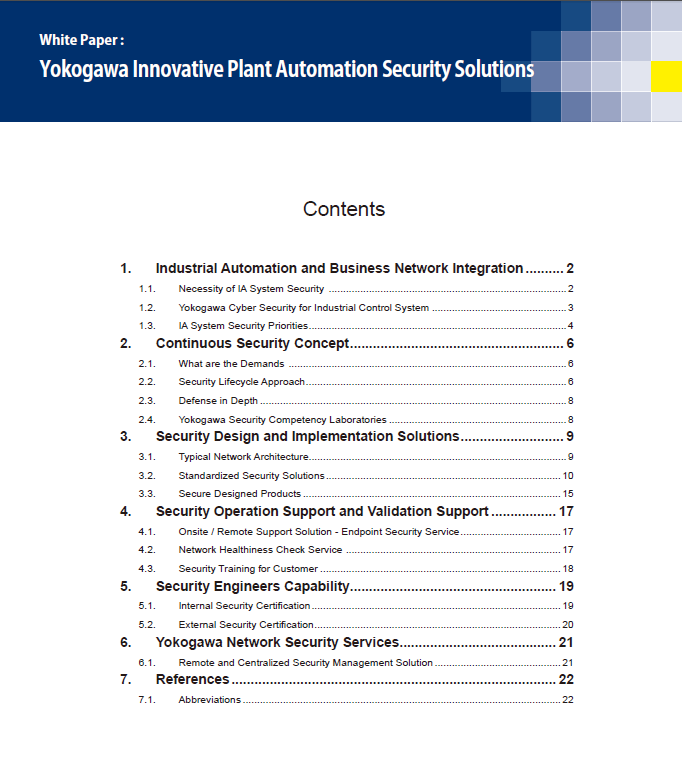
Network and system security is now a necessity in process automation industry. YOKOGAWA provides a service lifecycle solution for cyber security to ensure that the security measures and deployments are continuously enhanced, monitored and inspected.
This white paper explains the details of the security design, implementation, operation and validation solutions from the technical perspective.

Recently, several ARC Advisory Group analysts and management team members had a chance to sit down with the new Yokogawa President and COO, Mr. Takashi Nishijima, and several other top Yokogawa executives to discuss the company's burgeoning presence in the worldwide upstream and midstream oil & gas industry.

Due to emerging competitors from the rapidly growing countries such as India and China and the global economic downturn triggered by the Lehman shock, many companies in the process industries are struggling to survive the severe global competition.


September 2006
Launched in February 2005, Yokogawa's ProSafe-RS safety instrumented system (SIS) quickly gained a significant share of the market. Just 18 months later, 100 units had been sold-quite a feat considering the generally conservative nature of the SIS market. So what is behind this rapid success?


下載
產品型錄
- Migration from ProSafe-PLC to ProSafe-RS (1.6 MB)
- Safety Instrumented System ProSafe-RS (4.8 MB)
- Deliver Excellence and Create Success - To be the Leader in the Chemical Industry - (4.9 MB)
- ProSafe-RS N-IO (Network I/O) (1.2 MB)
- ProSafe-RS Standalone SIS (3.1 MB)
- ProSafe-RS Partial Stroke Test (PST) (1.1 MB)
- Sustainable SIS (7.3 MB)
- SIL2 Wireless Gas Detection System (1.6 MB)
影片


Yokogawa South Africa was appointed to design, supply and commission the Integrated Control and Safety System (ICSS) as well as the overall Terminal Management System at Sunrise Energy’s liquid petroleum gas (LPG) Import Terminal, the largest on- and offshore open-access LPG import terminal facility in Africa. Yokogawa’s Terminal Management System, Terminal Logistic Suite VP (TLSVP), was designed and developed to meet the exacting operational demands and logistic needs in terminals. Yokogawa’s experienced engineering resources ensured the project was successfully delivered, enabling Sunrise Energy to provide accurate mass balances and efficient terminal operations to its customers.
新聞
-
新聞 | 解決方案&產品相關 2022年1月12日 升級OpreX控制和安全系統,強化網路安全防禦
已獲得ISASecure CSA 1級認證
-
新聞 | 解決方案&產品相關 2021年5月24日 OpreX控制/安全系統系列產品: ProSafe-RS安全儀表系統獲得ISASecure CSA 1級認證
-
新聞 | 解決方案&產品相關 2017年4月11日 Yokogawa Releases Enhanced Version of ProSafe-RS Safety Instrumented System
- Easy adoption and use as a fire and gas system -
-
新聞 | 專案 2016年7月14日 橫河電機贏得韓國S-Oil公司煉油廠控制系統訂單
-
新聞 | 解決方案&產品相關 2014年1月21日 Yokogawa Obtains ISASecure EDSA Certification for ProSafe-RS Safety Instrumented System
想了解更多技術&解決方案嗎?
聯絡我們