Can Intellectual Property Drive Co‑creation?
When you hear the term “intellectual property” or “IP,” what comes to mind? Movies and music, perhaps?
People who are familiar with technology-driven businesses may think first of patents. As a technology company, Yokogawa places great importance on patents, which play an essential role alongside technological innovation.
Now consider the term “patent.” What does this call to mind?
Many people associate patents with preventing others from using an invention and securing an exclusive position in the market. This characteristic is often referred to as exclusivity. In fact, many forms of intellectual property are granted the right of exclusivity. For example, movies cannot be copied without permission, and someone else's design cannot be reproduced without authorization.
But what would it surprise you to learn that intellectual property is a valuable asset for co‑creation? This may seem to run counter to the traditional image associated with exclusivity.
Yokogawa views intellectual property as an important asset for co‑creation. Going one step further, we believe that businesses can grow by allowing intellectual property to be shared, leveraged, and combined through collaboration with others. In other words, intellectual property is not only a tool for protecting business interests but also a means of creating new values together.
In this article, we would like to give an easy-to-understand introduction to this way of thinking.
There Are Many Ways to Leverage Intellectual Property
First, take a look at the figure below.
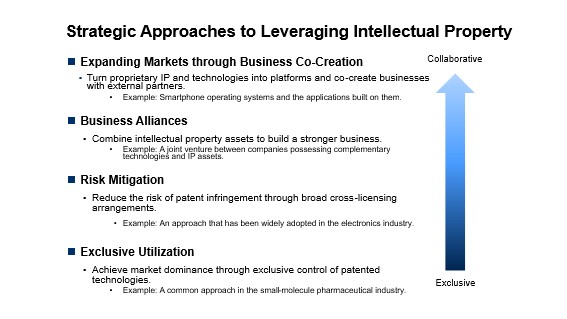
At the bottom is the traditional model, in which exclusivity is used to secure a competitive advantage and establish a dominant position in the market. We refer to this as the exclusive utilization model. Moving upward, the models become increasingly collaborative: a risk mitigation model, in which companies make use of each other’s intellectual property to reduce business risks; a business alliance model, in which intellectual property is used to form alliances around shared business objectives; and a co‑creation model, in which intellectual property is used to create and expand entire markets. As the degree of collaboration increases, the models are positioned higher on the chart.
Of course, this does not mean that one approach is inherently superior to another. Each has its own strengths as well as its own challenges.
As reflected in its brand philosophy, “Co‑innovating tomorrow,” *1 Yokogawa seeks to create the future through collaboration with business partners. Yokogawa aims to address societal challenges through its business activities. However, we believe that many of these challenges are too large and complex to be solved by a single company alone. Meaningful solutions require business collaboration among multiple stakeholders.
Based on this belief, we seek to leverage intellectual property as a means of promoting and strengthening collaboration.
Transforming Yokogawa’s Intellectual Property Practices to Support Co‑creation
Simply declaring that intellectual property should be used to promote collaboration is not enough. To make it a reality, we recognized the need to establish a clear philosophy regarding intellectual property across the Yokogawa Group, to implement governance mechanisms aligned with that philosophy, and to execute our activities strategically.
Guided by this approach, we have developed systems and organizational structures that make it easier to use intellectual property to foster collaboration. Here, we would like to introduce some examples of these initiatives.
First, Yokogawa has established a set of policies known as the Group Management Standards (GMS *2), which provide the fundamental principles for management across the Group. In 2021, Yokogawa revised the GMS related to intellectual property and introduced a centralized model under which the Japanese headquarters holds primary authority and responsibility for intellectual property matters. This change significantly simplified coordination among Group companies and, as a result, accelerated decision-making related to collaboration with external partners, including companies, universities, and research institutions.
Second, we have been developing a framework that enables the Intellectual Property Department (IP Department) to take a proactive role in M&A activities and joint development projects. Specifically, the IP Department provides advice on contracts such as joint research agreements and conducts intellectual property evaluations, facilitating smooth collaboration.
Third, the IP Department is positioned within the Marketing Headquarters, which is the key organization responsible for creating new businesses. This organizational structure enables the IP Department to actively participate in new business development, where collaboration is a key pillar. Because both the IP Department and the New Business Development Center operate under the direction of the Head of the Marketing Headquarters, decision can be made more quickly.
In parallel with these organizational initiatives, we have also been promoting strategic activities that align with our philosophy. For example, based on our recognition that technologies are increasingly converging across industries, we plan and execute strategic intellectual property activities within the company. Externally, in 2020, we joined the LOT Network, a non-profit organization dedicated to promoting and protecting open innovation *3. Similarly, we joined the Open Invention Network so that collaboration involving Linux systems can be carried out with greater confidence and lower intellectual property risks *4.
■ An Example Case: Regional IP Hubs Strengthening Connections with Colleagues Overseas
To see another example of our efforts to build an effective framework, let’s turn our attention to collaboration across regions. Here, we introduce an initiative that supports stronger connections with colleagues and counterparts overseas through regional IP hubs.
In addition to its headquarters in Japan, Yokogawa has intellectual property hubs in the United States, China and elsewhere in Asia, and other regions. These hubs serve as a bridge between headquarters and overseas Group companies, enabling consultations and decisions that require taking local business activities and market conditions into account to be handled closer to where they arise.
For example, when an overseas Group company wishes to launch a new initiative with a local partner, the regional IP team can participate as a point of contact from the early stages. As a result, decisions that reflect local circumstances can be provided more quickly.
At the same time, we have been working to build relationships based on direct personal connections. Every year, personnel from around the world gather in one place to exchange views openly, and year by year, our shared understanding of issues and challenges has deepened.
Regional hubs rooted in their local markets help connect colleagues around the world. We believe that this kind of steady foundation-building is also one of the mechanisms that supports collaboration with our partners.
Creating Tomorrow Together, with Intellectual Property as the Lubricant
Yokogawa actively promotes joint research and development projects and M&A activities with its partners. In all of these activities, the IP Department works alongside the business teams as a close partner throughout the process.
These internal and external initiatives have been recognized by outside organizations. In 2023, Yokogawa received an award for promoting open innovation from the Commissioner of the Japan Patent Office (JPO), a government agency under the Ministry of Economy, Trade and Industry (METI), as part of the FY2023 Intellectual Property Achievement Awards. *5 This award reflects recognition of Yokogawa 's commitment to collaboration. We intend to continue valuing this collaborative approach in the years ahead.
Yokogawa's reason for being is embodied in Yokogawa's Purpose: “Utilizing our ability to measure and connect, we fulfill our responsibilities for the future of our planet.” Here, our ability to connect refers to how Yokogawa not only combines valuable information, but also builds trusted relationships with customers in various industries and brings together businesses and industries, giving resonance to the value that we create.
We believe that intellectual property should be used to strengthen this power of connecting. By using intellectual property as a lubricant that enables companies to connect smoothly with other companies and technologies, we aim to remain a trusted partner to our customers. Why not take the first step with us toward collaboration that creates new value together?
The names of corporations, organizations, products and logos herein are either registered trademarks or trademarks of Yokogawa Electric Corporation and their respective holders.
*1 The “Co-innovating tomorrow” corporate brand slogan was established in 2015 to mark the 100th anniversary of our founding. It reflects our commitment to co-create value together with our customers. The slogan has been registered as a trademark in countries around the world.: https://www.yokogawa.com/about/company-overview/our-brand-and-identity/
*2 Yokogawa’s Internal Control: https://www.yokogawa.com/about/ir/governance/internal_control/
*3 Yokogawa’s Press Release dated December 10, 2020: https://www.yokogawa.com/news/press-releases/2020/2020-12-10/
*4 Yokogawa’s News Brief dated January 27, 2026: https://www.yokogawa.com/news/briefs/2026/2026-01-27/
*5 Yokogawa’s Press Release dated April 11, 2023: https://www.yokogawa.com/news/press-releases/2023/2023-04-11/