The Foundation Behind India’s Growth: Reliable Power
In 2022, India surpassed China to become the world’s most populous country and is home to an estimated 1.46 billion people as of mid-2025 (Source: United Nations). With its young and dynamic population, the country continues to attract global attention as one of the world’s most significant growth engines.
Behind this remarkable economic growth is a critical enabler: electricity.
Reliable power keeps factories running, cities illuminated, and essential services functioning. As India’s economy grows, so does its demand for energy. At the same time, the country faces the challenge of meeting that demand while reducing greenhouse gas emissions and advancing its decarbonization goals.
For more than four decades, Yokogawa has worked alongside India’s industrial and energy sectors. Today, as we accelerate our “India Shift” strategy, we are strengthening our commitment to supporting the country’s next phase of sustainable growth.
India’s Growth Story and a Changing Energy Landscape
Few countries can match India’s combination of demographic strength and economic momentum. A large workforce and an expanding domestic market continue to drive robust growth across manufacturing and services, positioning India as one of the world’s fastest-growing major economies.
Yet rapid growth also brings challenges. Significant disparities remain between urban and rural communities, as well as between higher- and lower-income populations. Expanding access to reliable infrastructure is therefore essential not only for realizing economic development but also for improving the quality of life across Indian society.
Electricity lies at the heart of this transformation. A stable and resilient power system is fundamental to sustaining industrial productivity, supporting modern lifestyles, and enabling long-term economic development. Without reliable power, growth can quickly stall.
Historically, India’s electricity system has relied heavily on coal-fired power generation. While coal has provided energy security by utilizing domestic resources, it has also contributed significantly to carbon emissions. Recognizing this challenge, the Indian government has accelerated investment in renewable energy under Prime Minister Narendra Modi’s leadership, promoting rapid deployment of solar and wind power generation.
At the same time, India must balance its decarbonization ambitions with energy security concerns. Periods of global energy uncertainty have occasionally prompted renewed interest in coal generation to ensure a stable power supply. As a result, policymakers continue to navigate the complex task of balancing sustainability, affordability, and reliability.
In such a rapidly evolving environment, trusted long-term partners with deep local knowledge become increasingly valuable.
More Than 40 Years of Partnership with India
Yokogawa’s relationship with India did not emerge overnight. Our journey began in the 1980s with three major refinery projects. Starting through local agency partnerships, we steadily expanded our presence and today operate from our Indian headquarters in Bengaluru, supported by an extensive network of regional offices across the country.
Over the years, we have built more than a customer base—we have cultivated strong relationships throughout India’s industrial ecosystem. Through our commitment amid changing market conditions and economic cycles, we have earned the trust of customers who rely on our technologies to support critical operations.
This trust is reflected in our market leadership. According to industry assessments by ARC Advisory Group, Yokogawa holds a leading market position in India for Distributed Control Systems (DCS) and pressure transmitters. These technologies form the operational backbone of refineries, chemical plants, power stations, and other critical industrial facilities.
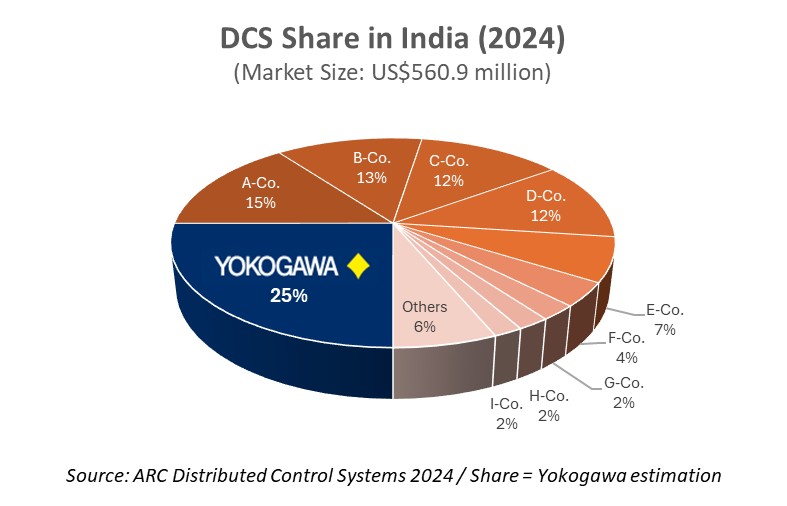
Reliable plant operations are essential not only for productivity and profitability but also for safety and environmental performance. Our long-standing presence in these mission-critical industries demonstrates the role Yokogawa has played in supporting India's industrial development.
Establishing such a presence in a market as large and diverse as India is no easy task. Regional differences in business culture, regulations, climate, and customer needs require local understanding and long-term commitment. The foundation we have built over the past 40 years now serves as a platform for contributing to India's next stage of growth.
Accelerating the “India Shift”
As India continues its rise, Yokogawa is evolving its business strategy to deepen its engagement with the country.
The first pillar of this transformation is manufacturing. To better serve growing demand and improve competitiveness, we are strengthening our production capabilities in India. Expanding local manufacturing enables shorter lead times, greater flexibility, and improved responsiveness to market needs.
The second pillar is engineering and innovation. India is home to a vast pool of highly skilled technical talent. Increasingly, the country serves not only as a major market but also as a strategic hub for engineering, software development, and research that support projects worldwide. India is becoming an increasingly important center of expertise within Yokogawa’s global operations.
We are also strengthening our capabilities through strategic investments and acquisitions.
In 2024, Yokogawa acquired Adept Fluidyne, enhancing our portfolio and competitiveness in flow measurement technologies. We are also expanding our energy management capabilities through BaxEnergy, whose solutions help monitor and optimize renewable energy assets and power generation portfolios.
As solar and wind power continue to expand across India, managing increasingly complex and variable power systems becomes essential. Energy management systems (EMS) play a critical role in integrating diverse energy resources, optimizing performance, and maintaining grid reliability.
The future of energy is moving beyond the control of individual facilities toward the orchestration of entire energy ecosystems. By combining our expertise in measurement, control, and digital transformation (DX), Yokogawa is well-positioned to support India’s energy transition while helping customers improve operational efficiency and sustainability.
At its core, our India Shift strategy reflects our belief that India is not simply a market where products are sold. It is a partner for shared growth. By embedding ourselves more deeply across the value chain—from manufacturing and engineering to digital energy management—we aim to create lasting value for customers, partners, and communities alike.
Supporting Sustainable Growth for the Long Term
India’s growth story is far from over.
As the world’s most populous nation continues to expand, it must address the dual challenge of meeting rising energy demand while pursuing decarbonization. Balancing these objectives will require innovation, investment, and collaboration across industries.
For more than 40 years, Yokogawa has contributed to India’s industrial and energy development. Drawing on our expertise in measurement, control, and digital technologies, we remain committed to supporting the country’s sustainable future.
What distinguishes Yokogawa is not merely our technology, but our long-term commitment. By staying close to customers, understanding local challenges, and adapting along with a changing energy landscape, we have become a trusted partner in India’s development journey.
As India continues to transform, we look forward to building the future together with customers, partners, researchers, and innovators who share our vision for a more sustainable society.
If you are exploring opportunities in renewable energy, industrial transformation, proof-of-concept projects, or collaborative innovation initiatives in India, we welcome the chance to connect and create value together.
The names of corporations, organizations, products and logos herein are either registered trademarks or trademarks of Yokogawa Electric Corporation and their respective holders.