Introduction
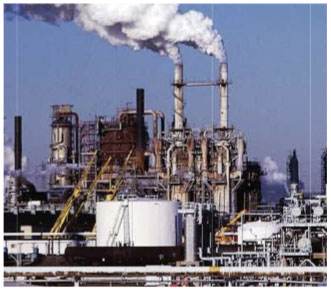
 Delayed Coker is a type of coker who's process consists of heating residual oil feed to its thermal cracking temperature in a furnace. The most important variable in industrial furnace control is temperature. Temperature is measured throughout the furnace in different zones and temperature effects the materials being manufactured and therefore must be precisely monitored to prevent deviations in quality of the final product.
Benefits
- Minimized plant startup time and downtime
- Improved product quality, continuous temperature monitoring leads to improvement of the product quality
- Reduced maintenance effort (NO wires, NO routing problems, NO cable maintenance issue)
- Optimized fuel consumption and reduced operation cost (OPEX)
- Reduced total power consumption, low power consumption devices enable cost savings
- Enabled easy integration with existing host system, industry proven Modbus platform enables easy and seamless integration with a wide range of host systems
Requirements
 Coker tube furnace is the heart of the delayed coking process. The heater provides all the heat in the process. The output temperature of the furnace is typically around 500 degree C.
- Temperature monitoring is required due to the following reasons:
-
- Coker furnaces are designed to have a constantly rising temperature gradient to reach the thermal cracking temperature quickly and thus optimize the fuel consumption.
- The burners are controlled by the measurement of tube temperatures.
- The furnace needs to be decoked or cleaned. Continuous operation of the cork drum forms a layer of insulation on the inner lining of the tubes resulting in the variation of temperature on the coke drum skin.
- Delayed coking is one of the processes used in many refineries. Depending on the capacity, number of coke drums in operation varies from 4 to 8. Each coke drum will require up to 24 temperature points to be monitored.
 Coker tube furnace is the heart of the delayed coking process. The heater provides all the heat in the process. The output temperature of the furnace is typically around 500 degree C.
Solution
 Three YTMX580 multi input temperature transmitters were installed. Each of these accepts 8 temperature inputs and it reduces the quantity of transmitters required to only 3 on each coke drum. Field wireless access point was installed on the control room located 600m from the measurement area with dense obstructions. Two repeaters were used to establish redundant communication paths between the measurement devices and the field wireless access point. The field wireless management station was integrated with 3rd party host system using RS485 series Modbus communication.
The ISA100 wireless system provides an easy customizable GUI with deterministic topology monitoring for the operator. It identifies the wireless condition such as error rate of both primary and secondary communication paths to visualize communication quality.
Conclusion
- Wireless solutions enabled reduction of huge bundles of cable running from the field to the control room.
- High capacity Lithium Thionyl battery powered devices enabled savings in OPEX with proven battery life of better than 1.6 years with an update time of 10 sec for the temperature measurements (eight inputs).
- Industry proven Modbus platform enabled easy integration with existing 3rd party host systems.
- Wider application coverage ISA100 wireless minimized infrastructure which reduces installation time and expense, this is reflected as direct savings to the users.

- Best in class signal availability of ISA100 wireless architecture with stable wireless connections proved to be a trustworthy wireless solution, perfectly meeting the user requirements.
- Maintainable topology reduced the cost of ownership and enabled more points to be added as necessary in the future.

Yokogawa has a proven track record of delivering reliable, scalable and open technologies for a century. ISA100 wireless solutions address the specific challenges of the industrial automation industry while lowering cost ownership for our end users and maximizing their return on the investment.
相关行业
-
炼油
在不断变化的市场环境中,炼油厂不仅被视为原油加工单元,更是利润中心。与此同时,业界对这些设施的安全需求保持着高度重视。要实现长期盈利、效率提升与环境保护的目标,需要一套涵盖规划、调度、管理与控制的完整生产解决方案。凭借在自动化领域多年的专业积淀,横河电机能够为您提供高性价比的整体解决方案,助力提升运营效能,共创更清洁的世界。
-
油气下游
近年来,石油天然气下游行业正面临日益增多的挑战。这些挑战包括:需处理的原料特性不断变化、工艺设施与设备逐渐老化、能源成本持续攀升、能够安全高效运营炼油厂的熟练操作人员紧缺,以及市场和客户需求的快速变化。
多年来,横河电机与众多下游企业携手合作,提供专注于解决这些挑战与难题的工业解决方案。横河电机的 VigilantPlant解决方案助力工厂业主实现工厂内的更大盈利和可持续安全运营。
相关产品&解决方案
-
YFGW410现场无线管理站
YFGW410现场无线管理站具备符合ISA100.11a标准的系统管理/安全管理/网关功能,与现场无线接入点(YFGW520)和/或现场无线媒介转换器(YFGW610)组合使用,可构建完整的现场无线系统。
-
YFGW520现场无线接入点
YFGW520现场无线接入点具备基于ISA标准的骨干路由器功能,与现场无线管理站(YFGW410)和/或现场无线媒介转换器(YFGW610)组合使用,可构建完整的现场无线系统。
-
YTA510无线温度变送器
高性能温度变送器YTA510接收热电偶、RTD、欧姆或DC mV输入信号。该变送器通过无线信号传输过程变量以及设定参数。该变送器采用内置电池,由于无需硬接线,因此可降低安装成本。通信规格以ISA100.11a协议为基础。
-
YTMX580多点输入温度变送器
YTMX580至多可接收8点测量输入值,如热电偶(8种类型:K、E、J等)或RTD信号(3种类型:Pt100等),并将相应的测量输入值转换为无线信号。它也可以接收DC电压、电阻和4~20 mA DC信号输入。
-
现场无线
无线解决方案的灵活性可减少对基础设施的投入,同时可以对工厂运营有更深入的了解。