Introduction
Level transmitter configuration can be very time consuming. Calculations required to determine proper range values for traditional transmitters can become complex due to the physical layout of an application.
DPharp transmitters with advanced software functionality eliminate this time consuming task. With maintenance shops getting smaller, finding equipment that allows us to do more with less becomes a priority.
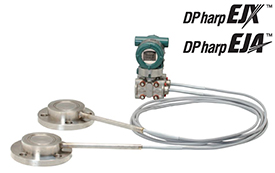
Application
Using typical smart or conventional products all of the following must be considered:
- The specific gravity (SG) of the process;
- Precise location of 0% and 100%;
- Specific gravity of the capillary fill fluid or sealing liquid (for impulse tubing);
- Vertical height of capillary or impulse piping;
- Exact orientation of the transmitter to the vessel;
- Vertical distance between the flanges.
Depending on the application, the vessel may be open (referencing atmosphere), or closed (under some blanket pressure).
Elevation is typically used when the vessel is closed. To reference blanket pressures, a low side wet leg or remote seal must be used. The low side pressure creates a negative force on the transmitter equal to the vertical height times the specific gravity of the fill fluid.
Suppression is positive pressure created on the high side of the transmitter typically due to a zero point above the transmitter. It is normally employed in an open vessel referencing atmosphere. This is a positive pressure equal to the vertical distance between the 0% point and the transmitter times the specific gravity of the liquid.
Elevation/suppression distance almost never agrees with the piping and instrumentation diagram (P&ID) because actual piping (or remote seal capillaries) do not form exacting angles in the field. In most cases, the precise vertical height is not known until the unit is installed.
Span is the vertical distance of the process times the specific gravity: Figure 1. 10.5 * 0.9 = 9.45 mH2O (31.5 inH2O).
Calibration range is the calculated 0 and 100% taking into consideration positive and negative pressures. In figure 1, the following applies:

Figure 1
0 % = H - L
= ( 4.5 x 0.8 ) - ( 15 x 0.8 )
= 3.6 - 12
= -8.4 mH2O ( -28 inH2O )
100 % = H - L
= ( 4.5 x 0.8 ) + ( 10.5 x 0.9 ) - ( 15 x 0.8 )
= 3.6 + 9.45 - 12
= 1.05 mH2O ( 3.5 inH2O )
The calibration range is: -8.4 to 1.05 mH2O ( -28 to 3.5 inH2O )
Note: SG stands for specific gravity.
The information required to perform the calculation is not readily available. It exists in vendors instruction manuals, P&ID's, but not until the unit is actually installed will all the variables be known because the process piping and capillaries do not form exacting angles in the field.
Solution
DPharp has a smart level setup feature that eliminates the need for elevation/suppression calculations, making set up quick and painless.
Calibration is accomplished by simply following these four steps (for Brain):
- Span the transmitter to the process, height * specific gravity of 0 to 9.45 mH2O (0 to 31.5 inH2O) using the BT200 in C21: LRV and C22: HRV.
- Install to the process using either capillaries or impulse tubing.
- Bring the process to a zero (4mA) condition.
- Through the BT200 execute H10: Auto LRV in the H: AUTO SET menu.
DPharp will calculate the total elevation/suppression and automatically setup the device for that installation. It will even correct the values in software at C21: LRV -28 and C22: HRV 3.5 so the customer can print and record the actual configuration for their maintenance documents.
But what if I cannot bring my process to zero? I have installed the unit, fluid is now in the tank, and the output of the transmitter does not agree with my sight glass. What do I do?
Most transmitters can only make adjustments at 0% or 100%. DPharp can make adjustments anywhere with full elevation or suppression. Once the transmitter is programmed with the correct span, all that is needed is a known point in the process (usually provided by the sight glass.) The output can be adjusted in one of two ways.
- Simply adjust the encoder on the DPharp until the output reaches the known point. In figure 1, the output would be adjusted to 60%.
- The correct value can be entered into J10: Zero Adj. In the case of this example, the proper output value of 60% would be entered. The amount of deviation can be viewed in J11: Zero Dev.
DPharp's digital sensing technology makes this possible. With analog sensing technologies (like capacitance sensors), range changes often necessitate a re-calibration or a trimming of the A/D converter to achieve specified performance. The digital DPharp sensor has no A/D converter, no trimming is necessary. The new range is guaranteed to perform within specification.
Notes
- In level measurement, it is important to maintain a consistent reference pressure. On a closed tank system, this is most efficiently achieved by the use of remote seals and capillary systems.
- It is important to note that the span is to be calculated on process height x specific gravity of the process fluid, and will not necessarily agree with the physical height.
- Output will be linear to the level, regardless of fluid or blanketing system.
- Use of remote seals eliminates problems such as condensation in impulse piping, the requirement for maintenance of condensate pots and fill fluid leaking into the process.
Main Features of DPharp
- ±0.03% Overpressure calibration protection
- ±0.1% per 10years long term stability
- 100:1 turndown
- ±0.055% accuracy
- SIL2 standard
- ±0.1% per 15years long term stability
- 200:1 turndown
- Best-in-class high accuracy, 0.04%
- Multi-sensing output
- Multi-variable transmitter as EJX family line-up
- SIL2 standard
相关行业
-
电力
20世纪70年代中期,横河电机推出了EBS电气控制系统,并以此进入电力业务领域。自此以后,横河电机坚定不移地持续提升技术水平和业务能力,旨在为全球客户提供更优的服务和解决方案。
横河电机凭借着全球电力解决方案网络,在充满活力的全球电力市场中发挥着积极的作用。这使得横河电机内部能够进行更紧密的团队协作,将全球资源与行业知识库有机结合。横河电力的行业专家团队通力合作,为每位客户量身打造适合其复杂需求的解决方案。
-
供排水
水资源是有限的,因此促进可持续水循环是联合国可持续发展目标(SDGs)之一。横河电机一直致力于提供先进的数字化控制解决方案,以实现清洁安全用水的稳定供应、通过污水处理保护水环境、管理水资源流失,并优化工厂运行以减少二氧化碳排放和运营成本。凭借我们先进的技术、可靠的产品以及在全球各类水务项目中积累的丰富专业经验,我们与您携手提供可持续的水务解决方案,助力您的业务发展,并在工厂整个生命周期内创造价值。
横河电机为市政用水和工业用水市场提供广泛的水控制应用支持。
-
石油和天然气
横河电机在石油天然气行业的各个环节均拥有丰富经验,业务覆盖海上与陆上设施、管道运输、终端处理及深水作业等领域。我们提供的解决方案能够提升安全水平、确保设备准确可靠地运行,并有效提高工厂运营效率。
-
化工
化工厂存在连续生产与批次生产两种流程,两者对控制系统需求各异。连续工艺要求控制系统具备高稳定性与可靠性,避免因故障导致生产线停机;而批次工艺则强调灵活调整配方、工序等参数的能力。两类系统均需实现产品质量追溯管理,并支持非常规操作执行。横河电机凭借丰富的产品组合、资深系统工程师团队及全球销售服务网络,可为不同工艺流程提供定制化解决方案。
-
油气下游
近年来,石油天然气下游行业正面临日益增多的挑战。这些挑战包括:需处理的原料特性不断变化、工艺设施与设备逐渐老化、能源成本持续攀升、能够安全高效运营炼油厂的熟练操作人员紧缺,以及市场和客户需求的快速变化。
多年来,横河电机与众多下游企业携手合作,提供专注于解决这些挑战与难题的工业解决方案。横河电机的 VigilantPlant解决方案助力工厂业主实现工厂内的更大盈利和可持续安全运营。
相关产品&解决方案
-
EJA110E
Standard Traditional-mount Differential Pressure Transmitter based on the EJA-E Series.
-
EJA115E
Standard Differential Pressure Transmitter attached to an IFO assembly based on the EJA-E Series.
-
EJA118E
Standard Differential Pressure Transmitter with Remote Diaphragm Seals based on the EJA-E Series.
-
EJA120E
Standard Traditional-mount Differential Pressure Transmitter designed for Draft Range applications based on the EJA-E Series.
-
EJA130E
Standard Traditional-mount High Static Differential Pressure Transmitter based on the EJA-E Series.
-
EJA210E
Standard Flange-mounted Differential Pressure Transmitter designed for Liquid-level applications based on the EJA-E series.
-
EJA310E
Standard Traditional-mount Absolute Pressure Transmitter based on the EJA-E Series.
-
EJA430E
Standard Traditional-mount Gauge Pressure Transmitter based on the EJA-E series.
-
EJA438E
Standard Gauge Pressure Transmitter with Remote Diaphragm Seal based on the EJA-E Series.
-
EJA440E
Standard Traditional-mount High Gauge Pressure Transmitter based on the EJA-E Series.
-
EJA510E
Standard In-Line Mount Absolute Pressure Transmitter based on the EJA-E Series.
-
EJA530E
Standard In-Line Mount Gauge Pressure Transmitter based on the EJA-E Series.
-
EJAC60E Hygienic Adapter System (Fluidless Type)
Yokogawa introduces Fluidless series – EJAC60E Hygienic Adapter System (Fluidless Type).
This system composes of replaceable adapters(16 adapters in total) with hygienic function of pressure detection.
Suitable for various kind of process including hygienic connection. -
EJX110A
Traditional-mount Differential Pressure Transmitter based on the EJX-A Series as a high performance model.
-
EJX115A
Differential Pressure Transmitter attached to an IFO assembly based on the EJX-A Series as a high performance model.
-
EJX118A
Differential Pressure Transmitter with Remote Diaphragm Seals based on the EJX-A Series as a high performance model.
-
EJX120A
Traditional-mount Differential Pressure Transmitter designed for Draft Range applications based on the EJX-A Series as a high performance model.
-
EJX130A
Traditional-mount High Static Differential Pressure Transmitter based on the EJX-A Series as a high performance model.
-
EJX310A
Traditional-mount Absolute Pressure Transmitter based on the EJX-A Series as a high performance model.
-
EJX430A
Traditional-mount Gauge Pressure Transmitter based on the EJX-A Series as a high performance model.
-
EJX438A
Gauge Pressure Transmitter with a Remote Diaphragm Seal based on the EJX-A Series as a high performance model.
-
EJX440A
Traditional-mount High Gauge Pressure Transmitter based on the EJX-A Series as a high performance model.
-
EJX510A
In-Line Mount Absolute Pressure Transmitter based on the EJX-A Series as a high performance model.
-
EJX530A
In-Line Gauge Pressure Transmitter based on the EJX-A Series as a high performance model.
-
EJX610A
High Performance In-Line Mount Absolute Pressure Transmitter based on the EJX-A Series.
-
EJX630A
In-Line Mount High Performance Gauge Pressure Transmitter based on the EJX-A Series.
-
EJX910A
This transmitter precisely measures differential pressure, static pressure, and process temperature; then uses these values in a high-performance on-board flow computer to deliver fully compensated Mass Flow.
-
EJX930A
Designed specifically for high static pressure applications, this transmitter precisely measures differential pressure, static pressure, and process temperature; then uses these values in a high-performance on-board flow computer to deliver fully compensated Mass Flow.
-
EJXC40A(数字远传)
数字远传(DRS)变送器可将二个远距离的高压侧(主机)和低压侧(次机)压力传感器,通过DRS专用通讯电缆连接进行差压测量。
-
EJXC50A、EJAC50E表压直接安装隔膜密封系统
直接安装隔膜密封系统由表压变送器和一个直接安装隔膜密封组成。
-
EJXC80A、EJAC80E差压/表压隔膜密封系统
隔膜密封系统由表压或差压变送器和一个或两个隔膜密封组成。
-
EJXC80A、EJAC80E差压直接安装隔膜密封系统
差压直接安装隔膜密封系统由差压变送器和一个直接安装隔膜密封组成。
-
EJXC81A、EJAC81E绝压隔膜密封系统
绝压隔膜密封系统由绝压变送器和一个隔膜密封组成。
-
压力变送器
使用横河电机的压力变送器,可以对过程压力进行准确且稳定的测量,支持安全、可靠和可盈利的工厂运营。
-
隔膜密封系统
隔膜密封系统可用于测量液体、气体或蒸汽的流量以及液位、密度和压力。