化學工廠依賴連續生產與批次生產流程,兩者對控制系統的需求各不相同。連續流程需要具備高穩定性與可靠性的控制系統,以避免故障導致生產線停機;而批次流程則強調控制系統的彈性,能靈活調整配方、作業程序等。這兩種類型的系統都需能管理產品的可用品質歷史,並執行非常規操作。憑藉完整的產品組合、經驗豐富的系統工程師,以及全球銷售與服務網絡,Yokogawa 能為每一個工廠製程提供解決方案。
-
基礎化工
Yokogawa一直服務於全球大宗化工市場,廣泛受到客戶的認同和肯定。 藉由產品、解決方案和產業專業知識,Yokogawa了解客戶的市場和生產需求,與客戶攜手合作,在您工廠的整個生命週期內提供可靠且具有成本效益的解決方案。
-
特用化學品與精細化學品
本頁介紹Yokogawa在特用化學品與精細化學品領域的理念與解決方案,展示我們的專業服務與技術專長。
-
大宗化學與石化
無論是生產石化品、無機化學品或中間體,化工企業都面臨成本與利潤壓力,需要在安全、符合法規的前提下,及時且高效率地交付產品。同時,化工企業也必須因應原料與能源價格波動,並提供最具利潤的產品組合。
Yokogawa 長期滿足全球大宗化學市場的自動化需求,並被公認為該市場的領導者。憑藉產品、解決方案及產業專業知識,Yokogawa 深入了解市場與製程需求,並將與您合作,提供可靠且具成本效益的全生命周期解決方案。
Details
化工產業價值鏈
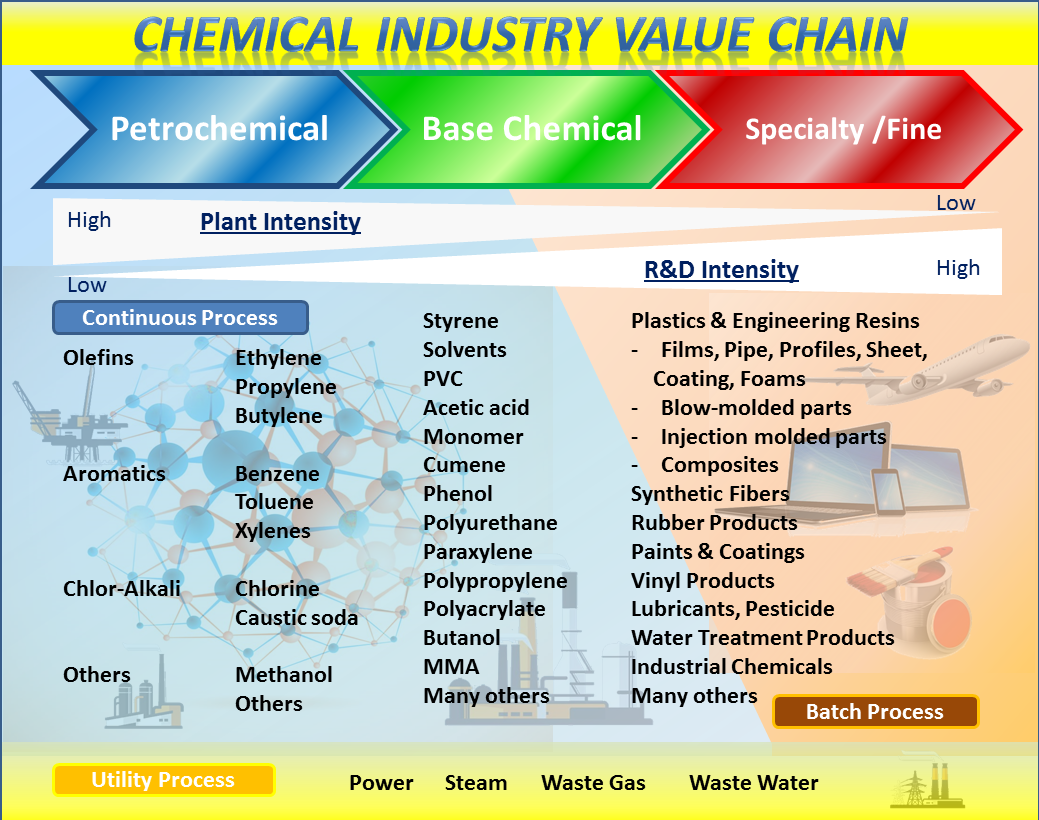
Yokogawa於1975年推出全球首款DCS(分散式控制系統),迅速在全球化工產業中獲得廣泛採用。作為化工產業製程控制解決方案的領先供應商,Yokogawa專注於用戶工廠的安全與穩定運行。
隨著化工產業的製程、產品及供應鏈日益複雜與精密,客戶需求亦隨之提升。Yokogawa憑藉在此領域豐富的經驗與專業,持續提供符合需求的工業解決方案與服務。同時,我們也推出了各種新解決方案,例如能源管理,以達到工廠運行的最佳化。
Yokogawa將持續以先進的自動化解決方案,作為全面供應商滿足化工產業客戶的期望。
生產精進
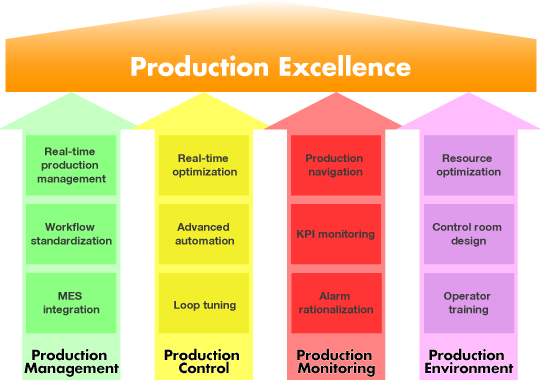
生產管理
- MES整合
各種單一系統執行排程等功能,包含於製造執行系統(MES)範疇中。系統間的連通性是靈活生產管理的關鍵。 - 工作流程標準化
應定義並監控生產工作流程,以確保可靠的生產管理。對於多工廠企業,流程標準化尤為有效。 - 即時生產管理
需要整體即時生產管理,以加快生產計畫-執行-檢查-行動(PDCA)循環。
生產控制
- 迴路調校
製程辨識(PID)控制在製程控制中扮演核心角色。穩定製程控制需適當調校,且是進階控制的前提。 - 進階自動化
進階製程控制與知識型導航系統是實現高自動化操作的重要因素。 - 即時優化
透過嚴謹模型計算的即時優化器,可達到整廠優化。
生產監控
- 警報合理化
建議採用工程設備與材料用戶協會(EEMUA)No.191 指南的警報管理方法。警報根本原因分析亦是成功警報合理化的有效方法。 - KPI監控
各種關鍵績效指標(KPI)需由各負責人監控。KPI監控需與目標比較並深入分析詳細資訊。 - 生產導航
生產任務需由系統正確管理。任務進度監控是計畫與製造之間的重要橋樑,有助於生產管理協作。
生產環境
- 操作員訓練
操作員訓練系統可讓操作員在面對設備故障、啟動等日常操作時累積經驗,幫助提升操作技能。 - 控制室設計
控制室設計需考慮工作環境各方面,包括人體工學、安全性、溝通便利性、功能性、系統自動化及企業政策。 - 資源最佳化
中央控制室有助於打造高效的生產環境。所有生產相關單位應集中設定以確保良好溝通。除了中央控制室設定外,也可考慮人力與其他資源最佳化,以達到生產精進目標。
參考
- PRM allows a preventive maintenance approach where maintenance can be scheduled and performed before a field device fails.
- Exaquantum gathers plant data from the CENTUM VP to generate a variety of reports on the polymerization process.
橫河電機為台灣永光化學工業股份有限公司提供「工業智慧化轉型評估」(S.I.R.I.)諮詢服務。
S.I.R.I. 幫助剖析客戶工廠未來轉型的數位化成熟度。
Syngenta aimed to promote sustainable agriculture as a social responsibility through digital transformation. Syngenta selected Yokogawa to start the smart manufacturing transformation journey.
可樂麗工程有限公司與橫河電機合作提供物聯網大數據分析解決方案。
為客戶分析製程數據實現了高質量的穩定生產。
大阪燃氣化學株式會社選擇橫河電機解決碳纖維制造製程中長期存在的問題。
大阪燃氣化學株式會社利用橫河電機的製程數據分析解決方案建立了獨特的問題解決方法。
Nippon Sanso越南股份有限公司(NSVN)配備了數字化供應鏈管理系統,以優化工業氣體交付效率。
ODMS(訂單交付管理系統)是NSVN和橫河電機合作,使用DevOps敏捷方法快速開發的。
- Based on a careful review of all operational procedures and operator roles and configured new SOPs in Exapilot.
- As a result, SFC has been able to reduce operator workload, improve product quality, and reduce production losses.
- 自1990年代工廠投產以來,南亞一直在使用橫河電機的Micro-XL DCS。
- 逐步從Micro-XL遷移到CENTUM VP的方法可盡可能地降低停機時間。
- Legacy System Replaced with Yokogawa CENTUM VP and ProSafe-RS at PTA plant in Indonesia.
- PID parameters imported to CENTUM VP without complex calculations.
The AFCO project is a showcase of the good coordination between Yokogawa Middle East, Yokogawa Thailand, Yokogawa Singapore, and Yokogawa Electric Corporation. Yokogawa Middle East and Yokogawa headquarters both were involved in the project execution.
- Main instrument vendor (MIV) concept was applied in this project to reduce the total project engineering cost.
- This consisted DCS, SIS, all instruments, control valves and tank gauging system under working with project management consultant (PMC) and EPC.
- Integration of CENTUM CS 3000 with ProSafe-RS improves plant safety and reliability.
- Yokogawa's PRM package manages more than 500 HART field devices including control valves.
- CENTUM CS 3000 production control system contributes to smooth HDPE production.
- The challenge for this replacement project was in completing the work and starting up the new CS 3000 system as soon as possible, keeping downtime to a minimum.
- CS 3000 efficiently controls and monitors coal gasification process.
- Once an operator selects "Start", the necessary instructions are sent to all plant equipment via the sequence control.
- Rapid Implementation of Integrated CENTUM CS 3000 and ProSafe-RS.
- The highly reliable CENTUM CS 3000 system has also helped TOL maintain high productivity at this plant.
- Migration from Micro-XL and CENTUM CS 1000 to CENTUM CS 3000 Improves Reliability.
- Operations at this plant, which runs more than 330 days per year, are carefully managed by the CENTUM CS 3000 DCS and the CS Batch package.
- CS Batch is used to automate a wide range of Reichhold's batch processes and multi-product/multi-path processes.
- Using PRM, process engineers can immediately find out the status of every field device without having to do an onsite inspection.
Samsung Petrochemical Co. Ltd. (SPCL), a major Korean petrochemical company, produces 700,000 tons per year of purified terephthalic acid (PTA) at its Daesan plant. PTA, a white powder substance that is produced by oxidizing and refining para-xylene, is a precursor to polyethylene terephthalate (PET), a polyester material that has excellent thermal resistance and wear resistance and is widely used as a substitute for natural cotton fibers and in film packaging, beverage bottles, tire cords, paints, adhesives, and other applications.
- Installation of Exaquantum PIMS package improves efficiency of process data management.
- Improve quality and yield through proactive maintenance of plant assets.
- Introduction of CENTUM CS 3000 maximizes productivity and improves product quality at special polymer plant.
- A major improvement as a result of this project is that butadiene monomer recovery efficiency jumped huge.
- CENTUM CS 3000 distributed control system to control the ethanol plant and it's utility boilers
- Batch processes that require careful automated control for maximum efficiency and product quality
- CENTUM VP Batch replaces the legacy system and improves production efficiency in the acrylic plant.
- CENTUM VP Batch capability can handle the recipe management to Batch report handling and unit management.
- CENTUM VP Batch package improves productivity.
- Reduction of operator workload and safe operation.
- PetroChina Dushanzi Petrochemicals Polyethylene Plant system migration.
- The revamp included the challenging creation of function design specifications (FDS) as well as FAT and SAT.
- Highly reliable CENTUM CS 3000 replaces legacy system and automates batch plant operation.
- Working together, Hanwha Chemical and Yokogawa Korea project personnel completed this work on time and on schedule.
- Yokogawa provides STARDOM and FAST/TOOLS for biomass pilot plant.
- FAST/TOOLS is an "all in one" SCADA solution that functionsa a data historian.
- Fieldbus technology introduced to realize predictive and preventive maintenance.
- ISAE to improve the reliability of diagnosis and parameter setting, utilizing data collected by PRM.
- Kaneka Corporation has urgently needed to implement countermeasures that would reduce this facility's energy costs.
- Optimization of control strategy helps BTG plant save energy and operate more efficiently.
- Yokogawa's CENTUM VP and PRM improve efficiency at new nylon plant in Thailand.
- At the plant startup stage, PRM was used together with FieldMate to thoroughly check all loops.
- At the company's Ulsan resin plant, six Exaquantum servers were connected to CENTUM CS 3000 and other vendor's systems.
- KKPC needed to expand its SBC capabilities and improve production efficiency at its plants.
- Up to 90% of all manual tasks can now be carried out automatically.
- Increasing productivity by means of partially automated start-up and load change procedures.
- Reinstrumentation project at HDPE plant replaced legacy pneumatic instruments and PLCs with integrated CENTUM CS 3000 PCS and ProSafe-RS SIS.
- HART field devices can be monitored from the central control room with the plant resource manager (PRM) package, enabling a more predictive and proactive maintenance approach that reduces total cost of ownership.
- Implementation of AOA package for improved grade-change operation
- Dramatically reduced operators' workload and transient products, as well as sharable operation know-how
- Exapilot automates comlex and non-routine decoking process of NCUs.
- Operator workload has been drastically reduced.
- Exapilot was built up as e-SOP system based on the standard operating procedures and the know-how of experienced operators.
- e-SOP system improved the quality and productivity in the performance chemical plant in China.
As the demand for food is increasing worldwide, fertilizers are playing an essential role in improving agricultural productivity. OCI Nitrogen (hereinafter OCI) is a leading producer of mineral fertilizers and the world's largest producer of melamine, which is used to make adhesives and resins for a wide range of applications, such as furniture panels, laminate flooring, coatings, paints, and plastics.
Tsurumi Soda Corporation,Yokohama,Kanagawa Prefecture, Japan
- IFCo chose Omegaland operator training system to make ready for a flawless and safe plant start-up.
- Omegaland is contributing to operator training prior to completion of the greenfield fertilizer plant.
Yokogawa CENTUM VP and SIS were selected for the Evonik Oxeno's BTX facility expansion project.
CENTUM provides the operational transparency, and more efficient diagnosis of compressors which are the heart of the facility.
Yokogawa's network healthiness check service helped the customer identify what they need to protect against cyber-attacks.
By “visualizing” network traffic in control system, the customer was able to detect unauthorized communication in their system.
- A Japanese petrochemical plant leverages FDT/DTM-compliant intelligent field devices and Yokogawa's PRM asset management system for maintenance efficiency.
- The customer aims to improve maintenance efficiency further by introducing condition-based maintenance (CBM).
- Yokogawa assisted in the project implementation by providing design review, calculation modifications, pre-commissioning, training of operators and engineers, commissioning and post implementation review.
- Shell Global Solutions and Shell Deer Park Management were completely satisfied with the way the project was implemented and with the results achieved.
- Yokogawa's operational performance program bench mark service enhanced the automation performance at the chemical plant.
- Operator stress was dramatically reduced by identifying the causes of excessive manual interventions.
- FDT compliant FieldMate manages a wide variety of digital process instruments of multi-vendors.
- The SNF engineers can manage the complete lifecycle of assets and configure devices by using FieldMate.
Remote monitoring of supply pump conditions in the agitation process reduces operator rounds and contributes to stabilization of the product quality.
DP Level transmitter configuration can be very time consuming. Yokogawa DPharp EJA/EJX Pressure transmitters realize reduction in man hours by smart level setup feature.
Operators must receive diagnostic information before a line block leads to a malfunction. Yokogawa provides predictive diagnostics based on trend analysis of the blocking factor, which improves maintenance efficiency and reduces maintenance costs.
Recently, air pollution legislations such as the Clean Air Act to reduce the amount of air pollution are increasing worldwide. The Clean Air Act address numerous air quality problems. One of these problems is acid rain caused by sulfur dioxide and nitrogen oxide emissions from fossil-fueled power plants and other industrial and transportation sources.
In flue gas desulfurization systems that use magnesium hydroxide (Mg(OH)2) slurry, the consumption of the desulfurization agent (Mg(OH)2) is controlled by using online pH analyzers. A great concern in the pH measurement is heavy staining of the pH electrodes by the Mg(OH)2 slurry. To ensure accurate measurement, frequent cleaning of the electrodes with an acid is required, adding to both maintenance workload and cost.
Industry:Chemical, Power
O2 measurement in hydrocarbon vapor is used for safety monitoring in vacuum distillation columns in petroleum refining. With conventional paramagnetic oxygen analyzers, O2 concentrations are obtained through an extractive sampling system, which conditions the sample prior to being analyzed.
The ADMAG AXR is the world's first 2-wire magnetic flow meter which employs the unique "Dual Frequency Excitation Method," achieving 0.5% of rate of best-in-class accuracy and excellent stability for process measurement. In addition, the newly developed AXR key technologies," achieves the same level of noise immunity as 4-wire type under the fluid condition change and delivers enough performance to meet the requirement to apply in the control loop.
Control of sodium chloride (NaCl) concentration at a salt dissolver where solid salt is dissolved in water, is highly important because of the electrolysis efficiency. A conventional way of measuring the concentration of supersaturated NaCl solution had been performed by using non-contact type sensors (e.g., γ-ray density meter) since NaCl, impurities, and precipitates are in the solution.
There are various methods for continuous fabric dyeing as well as dye fixing. When dye is directly applied, steaming (heat treatment) is required. At present the pad-steam method is widely used for continuous dyeing. To ensure stable product quality, the humidity in the steamer is kept at a constant level.
Caustic soda is an important basic material in the chemical industry and is mainly produced by the electrolysis of soda. In the electrolysis process to make concentrated caustic soda, the DM8 Liquid Density Meter ensures high product quality through accurate measurement of liquid density.
Process liquid analyzers such as pH meters, conductivity meters, ORP meters, and density meters play an important role at electrolysis plants in the control of concentrations of various process solutions. This requires both precision and stability under harsh conditions that include highly corrosive substances, high temperatures, and many impurities.
For safe and efficient operation, the quality of feedwater, steam, and condensate in boiler plants must be controlled and maintained in the most favorable conditions.
- Effeciently controls the inlet valve and blow-off valve when the compressor starts and stops.
- During steady operation, controls the inlet valve so that the amount of discharged compressed air becomes constant (flow control)
- Surging: Load decreases, the amount of discharge flow and pressure drop, and a limit is exceeded, possibly destroying the compressor.
In the manufacturing process of Pharmaceutical, Chemical and Food & Beverage industries, the cleaning and sterilization of tanks and piping are done with various cleaning solutions, fresh or hot water and steam after manufacturing products. Clean-In-Place (CIP) is the system designed for automatic cleaning and disinfecting.
- Emergency interlock circuits for petrochemical plants and other facilities must be independent of the main control system.
- The YS80 Rack Instrument interfaces not only with field devices and upstream control systems, but also with emergency interlock circuits guarding against process abnormalities.
What if you could detect signs of abnormalities in bus ducts (bus bars) quickly during maintenance and inspection work and respond to them at just the right time? Yokogawa DTSX monitoring solution constantly monitors connections that tend to deteriorate over time and contributes by pinpointing abnormality locations and reducing workload of maintenance personnel, helping to ensure stability in plant operations.
Many different types of gases are consumed in industries as varied as chemicals, food & beverages, and medical. These gases are normally delivered in liquid form by trucks and dispensed at the customer site. Although the flow volume of cryogenic liquefied gas is used for billing purposes, it is not easy to accurately measure this because the gas is always at saturation temperatures.
With industrial and economic development comes increasingly large and advanced power plants and factories. Nevertheless, we find many cases where the original cables, cable tunnels, and other components of the power infrastructure have languished under continuous operation.
Reverse osmosis (RO) is a separation process that uses pressure to force a solution through a membrane that retains the solute on one side and allows the pure solvent to pass to the other side. More formally, it is the process of forcing a solvent from a region of high solute concentration through a membrane to a region of low solute concentration by applying a pressure in excess of the osmotic pressure.
- In the YS170 and SLPC, single-element control needs to be configured within the user program.
- The YS1700, however, offers the primary direct mode so that the user program can switch on and off single-element control by changing a parameter.
Both bulk and finished inventories are stored in distributed tank farm remote from the site operations. These are difficult to instrument due to the infrastructure cost involved. These are then monitored daily by patrol rounds. While effective, this method does require a large skilled labor force to monitor all of tanks. This can impose an additional risk when the stored medium is of a hazardous nature.
Install a YTMX580 on the side of the rotating furnace that can wirelessly transmit measured values from multiple temperature sensors.
- Manual temperature reading requires walking about 130 m and climbing up and down elevated sections of the dryer stages.
- Multiple temperature measurement points along the various stages of the dryer require many cables to the control room.
- Very high humidity.
- Temperature is monitored to maintain consistency of the viscous fiber entering the drum.
- Existing system requires manual temperature readings.
- Wired temperature measurement is not available because the tank is rotating.
- Wireless temperature measurement
Gateway x1, transmitter (YTA) x1, repeater x2 (The 2 repeaters are for redundancy) - Extended antenna to circumvent obstacles and improve the radio path for stable measurement (communication was unstable when the height of the antenna was low).
The ammonia (NH3) gas is injected to remove the NOx and thus reduce the NOx concentration in the stack flue gas. With conventional NH3 analyzers that perform measurements indirectly, NH3 concentrations are obtained through a sampling system. Therefore, there are problems with the maintenance and running costs of the sampling system, and time delays in measurement. The TDLS8000 Laser Analyzer is the solution to all these problems.
ISA100 wireless temperature and pressure transmitters with orifice plates allow:
- No cabling installations or maintenance.
- Small amount of hardware and simple equipment implementation means minimizing potential vandalism.
ISA100 Wireless Monitoring
- Gateway x1, Temperature Transmitter (YTA) x3, Pressure Transmitter (EJX) x1, Repeater x1
Gateway is installed at control room and 3m height extended antenna is set.
- Temperature Transmitter (YTA) and Pressure Transmitter (EJX) are installed at each monitoring point.
- Repeater is installed on high position.
Controls temperature in, and acquires data from, various internal components of plastic film manufacturing equipment. An easy to use, high cost-performance data acquisition and monitoring system can be assembled by using Ethernet compatible instruments and GA10.
In maintaining and managing industrial plants, monitoring waste water pH/ORP is both a legal obligation and an unavoidable necessity for protecting the environment. Monitoring without an attentive eye can lead to severe consequences.
Pressure measurement of tubeless tyres to monitor the air loss is one of the key performance tests in the tyre manufacturing units. Relocation of tyres from one testing rack to the other for various tests and frequent movement of the testing setup for conditional tests to various locations calls for cable free implementation for ease of handling.
To defray energy costs, many industrial plants have their own boilers to generate steam in order to produce a portion of their energy needs. In addition to generating power, the steam may also be used directly in plant processes or indirectly via heat exchangers or steam jacketed vessels.
The proliferation of microorganisms and the resultant formation of slime is a problem which commonly occurs in aqueous systems. Problematic slime producing microbes may include bacteria, fungi and/or algae. Slime deposits typically occur in many industrial aqueous systems including cooling water systems, pulp and paper mill systems, petroleum operations, clay and pigment slurries, recreational water systems, air washer systems, decorative fountains, food, beverage, and industrial process pasteurizers, sweetwater systems, gas scrubber systems, latex systems, industrial lubricants, cutting fluids, etc.
Industry:Refining, Food and beverage, Power, Oil and Gas, Pulp and Paper, Chemical
Visual MESA© is a steam system optimization and management computer program that was originally developed at Chevron and now marketed by Nelson & Roseme, Inc. Visual MESA is currently used at refinery and chemical manufacturing sites to optimize the overall site steam system and the parts of the electrical system that economically trade off with the steam system.
This paper will explore significant optimization variables and constraints commonly encountered in refinery steam system optimization, the strategies Visual MESA uses to deal with them.
In the course of more than twenty years as an engineer involved directly in utility related projects in a number of industries, I have seen a great variety of energy efficiency projects and programs covering the entire spectrum of efficacy. The Deer Park, Texas, plant of the Rohm and Haas Company has a unique energy management program that has proven to be highly successful. This program has resulted in a 17 percent reduction in energy use on a per pound of product basis, saving 3.25 trillion btus and $15 million each year! This article discusses this program, its history, successes, and the unique characteristics that have contributed to those successes.
In general, refineries exhibit a very good potential for real time monitoring and optimization using Visual MESA Energy Management System.
Based on our extensive experience, overall benefit in the range of 2% to 5% of the total energy cost can be achieved. Expected project payback is always less than one year.
Outline
- Introduction
- What is Energy Optimization
- How does a Real Time Online Energy Management System based on Visual MESA work
- Calculation Foundation for Key Performance Indicators
- Visual MESA implementation at Saudi Kayan (A SABIC Affiliate) (SK)
- Optimization Actionable Items
- Economic Benefits
- Relevance of Visual MESA RTEMS for SK's Sustainability Initiative
- Conclusions
The REPSOL company had in mind the improvement of the control on one of their chemical reactors. A feasibility study for the implementation of an Advanced Control technique (Predictive Control for temperature control for chemical Reactors - PCR) for a batch reactor for Polyols production has been performed. The proposed technique PCR is based on a dynamic model of the unit which makes the prediction of the process variables behaviour.
This paper will not describe just all the features of the software or fully explain on-line optimization technology. The objective of this work is to present some interesting facts and lessons from the experience of implementing a cost based optimization program at thirty oil refineries and petrochemical complexes, around the world, since 1997. This paper will focus on the key optimization variables and constraints in steam system optimization, how they should be handled and how the human and organizational aspects can be addressed.
Industrial facilities where power and steam is produced (i.e., Cogeneration) exhibit a very good potential for real time monitoring and optimization using Visual MESA Energy Management System.
Based on our extensive experience, overall benefit in the range of 2% to 5% of the total energy cost can be achieved. Expected project payback is always less than one year.
Visual MESA was successfully applied to many industrial facilities worldwide, several of them operating steam and power generation networks of different complexity and capacity but all with energy cost savings.
This paper discusses real industrial examples in which the sitewide utilities system of refinery and petrochemical Sites are optimized with a real time, on line, industrially proven software. Experiences gained during more than 20 years of industrial projects deployed worldwide are commented (Refs. 1 to 10 are related to some recent projects). Main project steps are explained and critical details to be taken into account to assure successful use and proper technology transfer are presented. Specific case studies will be discussed in the paper.
Utilities and energy systems are often the major source of SOx, NOx and CO2 emissions, therefore, emissions control and the management of credits and quotas are tightly interrelated with energy management.
In the case of refineries, chemical and petrochemical plants, energy represents the main cost (second to feedstock) and therefore its reduction has become a bottom line business decision. The energy systems at these sites are inherently complex, with the emissions cost analysis and limits compliance introducing an additional factor to the complexity of the energy costs reduction challenge.
Process plants use different type of fuels, they often operate cogeneration units, their steam networks consist of several pressure levels, there are different types of energy consumers and there are emission limits to be observed. Import or export of electricity in deregulated markets, which could also be traded off with more or less CO2 and other contaminant gaseous emissions, increase the optimization problem complexity.
After a feasibility study, Repsol YPF decided to apply a model-based predictive controller to a batch reactor producing polyols. The predictive controller for reactors (PCR) is a set of control modules that are designed to face most of the reactor configurations. The important increase of production is a consequence of the better handling of the reactor temperature. Here's a description of the unit and control objectives, methodology, project steps, results and the corresponding benefits.
Big and complex industrial facilities like Refineries and Petrochemicals are becoming increasingly aware that power systems need to be optimally managed because any energy reduction that Operations accomplish in the producing Units could eventually be wasted if the overall power system cost is not properly managed. However, process engineers always attempted to develop some kind of tools, many times spreadsheet based, to improve the way utilities systems were operated. The main drawback of the earlier attempts was the lack of data: engineers spent the whole day at phone or visiting the control rooms to gather information from the Distributed Control System (DCS) data historian, process it at the spreadsheet and produce recommendations that, when ready to be applied, were outdated and not any more applicable.
This paper addresses some of the root causes for issues and discusses the best practices that will help to avoid project failures. Main project steps are explained and critical details to be taken into account to assure successful use and proper technology transfer are discussed. It also presents real industrial examples in which the whole utilities system cost of a production Site (i.e., steam, fuels, boiler feed water and electricity) is optimized with a real time, online, industrially well established software.
Utilities and energy systems are often the major source of SOx, NOx and CO2 emissions, therefore, emissions control and the management of credits and quotas are tightly interrelated with energy management. In the case of refineries, chemical and petrochemical plants, energy represents the main cost (second to feedstock) and therefore its reduction has become a bottom line business decision. The energy systems at these sites are inherently complex, with the emissions cost analysis and limits compliance introducing an additional factor to the complexity of the energy costs reduction challenge.
The energy systems, the steps for the implementation of Visual MESA and several features of the model are described in this article, with a focus on the use of the software for the calculation of energy-related KPIs. The EMS implementation project is discussed and the main conclusions relative to the reduction in operating costs are also presented.
Experiences gained during more than 20 years of industrial projects deployed worldwide are commented. Main project steps are explained and critical details to be taken into account to assure successful use and proper technology transfer are presented. Specific case studies will be discussed in the paper. Open loop vs Closed loop implementation is also presented.
Rohm and Haas Company is one of the world's largest manufacturers of specialty materials, including adhesives, sealants, coatings, monomers, electronic materials, inorganic and specialty solutions, and ion exchange resins. Founded in 1909 by two German entrepreneurs, Rohm and Haas has grown to approximately $6 billion in annual revenues.
Alarm management is not just a project that has a start and end date; it's a continuous cycle. Once the alarm system has been reviewed and improvements have been identified, we must check that controls are in place to ensure the alarm system remains functional. The key is to ensure that the system is continuously monitored and any changes are fully documented. There are seven key steps for alarm management. Rationalization is one of those critical steps.
This paper shows how to improve distillation operations by focusing on procedure automation. It will review the importance of using procedures in distillation operations and highlights the collaboration work underway between Fractionation Research Inc. (FRI) and Yokogawa Corporation to improve procedural operations.
The worlds of process automation and production management have been converging for some time. What once used to be islands of automation and production management functionality connected through highly proprietary integration schemes that were costly to maintain have developed into integrated platforms that provide seamless data exchange between the world of automation and the plant floor, the functions of production and operations management, and integration with business level systems.
The world of process automation is governed by procedures. While we like to refer to the process industries as being largely "continuous", this could not be further from the truth. Process manufacturing is constantly in flux.
From engineering to installation, commissioning, operations, and maintenance, FOUNDATION fieldbus offer significant cost reductions of 30 percent or more versus conventional analog systems. Many of these cost reductions come from the advanced functions that fieldbus offers versus analog technology.
The automation suppliers that will be successful in the long term will be those that effectively address application or industry specific problems for end users with a value proposition that cannot be ignored. These problems exist throughout the process industries today, and they won't be solved by simply offering a product, but through a combination of hardware, software, services, application expertise, and knowledge.
In ARC's view, customers need a compelling business value proposition to justify investment in any kind of automation. Vigilance and VigilantPlant were created with this in mind. Yokogawa's vision with VigilantPlant is to create an environment where plant personnel and operators are well informed, alert, and ready to take action.
Yokogawa has come a long way in making its message clear to the world of process automation. Last year, the company embarked on a full-scale global marketing campaign to make customers aware of the company's focus on system reliability, security, dependability, and robustness. Dubbed "Vigilance", the campaign created a unified message for the company and greatly helped expand awareness of the Yokogawa brand and corporate philosophy.
Process automation end users are under more pressure than ever to do more with less. The current economic climate means that many automation capital projects are on hold. With capital budgets tighter than ever, users instead focus on operational budgets (where cost cutting is also a key concern), or on automation investments with a very rapid return on investment.
In today's dynamic industrial marketplace, the only constant is change. Raw material costs, energy costs, market demands, environmental and safety regulations, technology, and even the nature of the labor force itself are constantly changing, and not always in predictable directions.
Differential pressure level measurement has an enemy- temperature. Temperature can have a negative effect on the accuracy of level measurement. This article covers why temperature has this effect and how it can be reduced.
With fired heaters, users hope to get greater efficiency and reduced emissions but often are disappointed. Given the number of fired heaters operating every day and their importance in the process industries, any improvements realized across the board will have huge impacts. More units can reach their potential with some simple changes in work practices and technology upgrades.
July 2011
Process plants are run according to operational procedures. These procedures consist of a set of tasks that are executed in a consistent manner to achieve a specific objective, such as starting up, shutting down or transitioning a unit as part of making a product.
March 2006
The new CSPC (CNOOC and Shell Petrochemicals Company Limited) petrochemical complex at Daya Bay in southern China is one of the world's largest process industry projects (see box, Figure 1 and Table). It has a control system to match. Process Worldwide spoke to Johan Veerman, principal instrument and process control engineer at CSPC, about the challenges of managing such a huge job.
In times of abnormal operations, systems are configured to produce lots of data – humans are not configured to handle or interpret them. However, when presented with the right information, in the right context, during an abnormal condition, humans are able to do things machines cannot.
ISA S88.01 provides great benefit to users and vendors by solidifying batch operating models and standardizing batch control terminology. On the other hand, as befits an industry-wide standard, ISA S88.01 leaves great flexibility for individual users to apply their own project practices and implementation methodology. Even when utilizing ISA S88.01 models and terminology, many pitfalls remain for those who implement batch controls and recipe management without thinking ahead. Real-world project experience has demonstrated a number of design and implementation "lessons" which might be overlooked to the eventual grief of the batch engineer.
The S88.02 draft standard defines a means for depicting procedural control in master and control recipes. This depiction method is called a Procedural Function Chart (PFC). This standard depiction is based on the requirements of S88.01, technical report ISA-TR88.0.03-1996, user requirements, previous standards and commonly used procedure depiction methods in use today. PFCs can provide a common basis for the exchange of recipes, reduce the learning curve between control systems, and establish a common ground for improved human communication. This paper provides a brief overview of the development of PFCs, the rules for their use and some of the benefits expected by their adoption in the industry.
The case study in this paper illustrates the value of integrating front-end scheduling with a batch control system. Recipe changes, and addition of recipes, occur frequently in the target process. However, since both scheduler and batch packages were designed with the ISA-S88.01 model in mind, these packages could be tightly coupled (well integrated) – and, as a result, it is easy to add or change recipes. The front- end scheduler is not limited to performing scheduling; it also provides an easy-to-grasp real-time production status display which can help enhance efficiency and productivity.
As batch processes are automated, it is common to leave certain less essential field devices without automatic actuators. Thus, the initial control design must accommodate both automated and manual activities. Later, the manual field devices may be automated, either one-at-a-time or in related groups as equipment modules. These field changes, often occurring over a period of years, each require rework of the batch control logic, which can easily exceed the cost of the actuator. In response to this undesirable situation, a technique has been developed which permits the batch design to automatically modify itself, or evolve, to accommodate changes in field automation.
Six Sigma is a quality improvement methodology applied to improving any type of process. It is a methodology endorsed by and heavily integrated into several major chemical companies.
Key Performance Indicators (KPIs) are used in batch processing industries as measurements of production performance. Their use is one element in the current trend of real-time performance management. A single KPI used as the primary measurement of production can cause other dimensions of production performance lose importance. When multiple KPIs are used to measure a batch's production performance it can be difficult to reconcile differences between them for individual batches or for groups of batches. KPIs based upon meeting a target, or specification, measure absolute performance yet do not provide relative information regarding how a batch performed against its peers. The peer comparisons are important for monitoring variability of production performance, which is a critical factor in documenting ROI.
The application of DCS-based "advanced controls" is a common method of achieving enhanced performance from continuous processes such as refinery units. However, it is less widely recognized, but nonetheless true, that modern DCS systems can include other software tools for the significant improvement of batch plant productivity, product quality, and economic performance. Due to the fundamental processing differences between the two types of plants, unique batch "advanced control" features are required which are different from those used for continuous plants.
Process automation in oil refineries is undergoing major changes, driven by customers frustrated by what they consider to be slow and incremental advances from the main automation original equipment manufacturers (OEMs) in the industry. ExxonMobil has become a de facto industry representative and is driving vendors like Yokogawa and others to reevaluate how large-scale automation projects are implemented.
Supervisory control and data acquisition (SCADA) systems have been part of the process industries for many decades and cyber security measures need to grow as technology advances. SCADA systems are used in oil and gas pipeline and other remote control and monitoring applications, such as electrical transmission and distribution, and water/wastewater.
Many lubricant blending businesses find themselves in a challenging situation: there are opportunities to increase their overall business volume and profits by improving production flexibility, expanding their product slate and optimizing high-margin blends. At the same time, they find themselves constrained by current manufacturing limitations. However, launching a capital project for a significant manufacturing expansion may not be possible, and it may not be necessary.
Spectrometric technology can assess many critical characteristics about products, but it has limits. It can be challenging to determine when the line has been crossed
Honeywell and Yokogawa have both been producing Distributed Control System (DCS) platforms for decades, and both are very active in this area. In 1975, Honeywell introduced its TDC2000 platform and Yokogawa brought out CENTUM. These two competing systems emerged from a similar place, oil refining and petrochemical industries, so they started out with similar basic concepts and use cases in mind.
下載
產品型錄
- Solutions for the Chemical Operations Executive (2.0 MB)
- Temperature Sensing Solutions (596 KB)
- Differential Pressure Level Solutions (8.0 MB)
認證證明
影片
Showcases the OpreX Intelligent Manufacturing Hub, an AI-enabled platform that enhances manufacturing with seamless data integration, intelligent reporting, optimized workflows, and advanced visualization for smarter decision-making and efficiency.
Chet Mroz, President & CEO Yokogawa North America, discusses the benefits of IoT at the 2015 ARC Industry Forum in Orlando.
How much do you know about pressure transmitters? Are you accurately, quickly and reliably measuring pressure? Ultimately, the drive of any good pressure transmitter is to get an accurate, reliable pressure measurement to the data user quickly. This video gives you the answers to your basic questions about pressure and pressure transmitters.
As a gateway to further expand Yokogawa's messaging as a One-stop Solution Business, Yokogawa has partnered up with INCIT, to introduce the S.I.R.I. framework.
Join this webinar to better understand which manifolds you should use for specific applications and conditions. You will learn:
- A brief history of manifolds
- An overview of the different types of manifolds that are available
- The advantages, disadvantages, and application considerations you should consider when selecting a manifold
新聞
-
新聞 | 解決方案&產品相關 2025年2月3日 發表OpreX 品質管理系統,加速製藥及食品飲料業品質保證流程的數位轉型
- 基於雲端的系統,可實現快速且靈活的流程改善 -
-
新聞 | 企業 2023年2月20日 橫河電機與Radial Software Group建立合作夥伴關係,提供全球AI驅動的Viewport軟體
- 為客戶提供所有技術數據的單一視圖 -
-
新聞摘要 2019年9月18日 橫河電機支援在工業環境中實現世界首創的模組類型封裝
-
新聞 | 專案 2013年11月14日 橫河電機入圍雪佛龍菲利浦化學公司的USGC石化項目
- 被選為主要自動化承包商 -
想了解更多技術&解決方案嗎?
聯絡我們