What is Advanced Process Control APC?
Advanced process control, or APC, is a control and optimization approach used in industrial plants to manage complex processes with multiple interacting variables. APC uses process models, multivariable control, constraints, quality estimation, and optimization logic to help operations run more consistently than basic regulatory control alone.
APC is commonly used when plants need to reduce variability, manage operating constraints, improve product quality control, support energy optimization, and reduce the manual control burden on operators.
Yokogawa provides APC software, consulting, engineering, implementation, and lifecycle support through its advanced control portfolio, including Platform for Advanced Control and Estimation (PACE).
Yokogawa's Approach to Advanced Process Control
Yokogawa combines advanced control software, process knowledge, control system expertise, and lifecycle support to help industrial organizations evaluate, implement, and sustain APC applications, also known as the Platform for Advanced Control and Estimation (PACE).
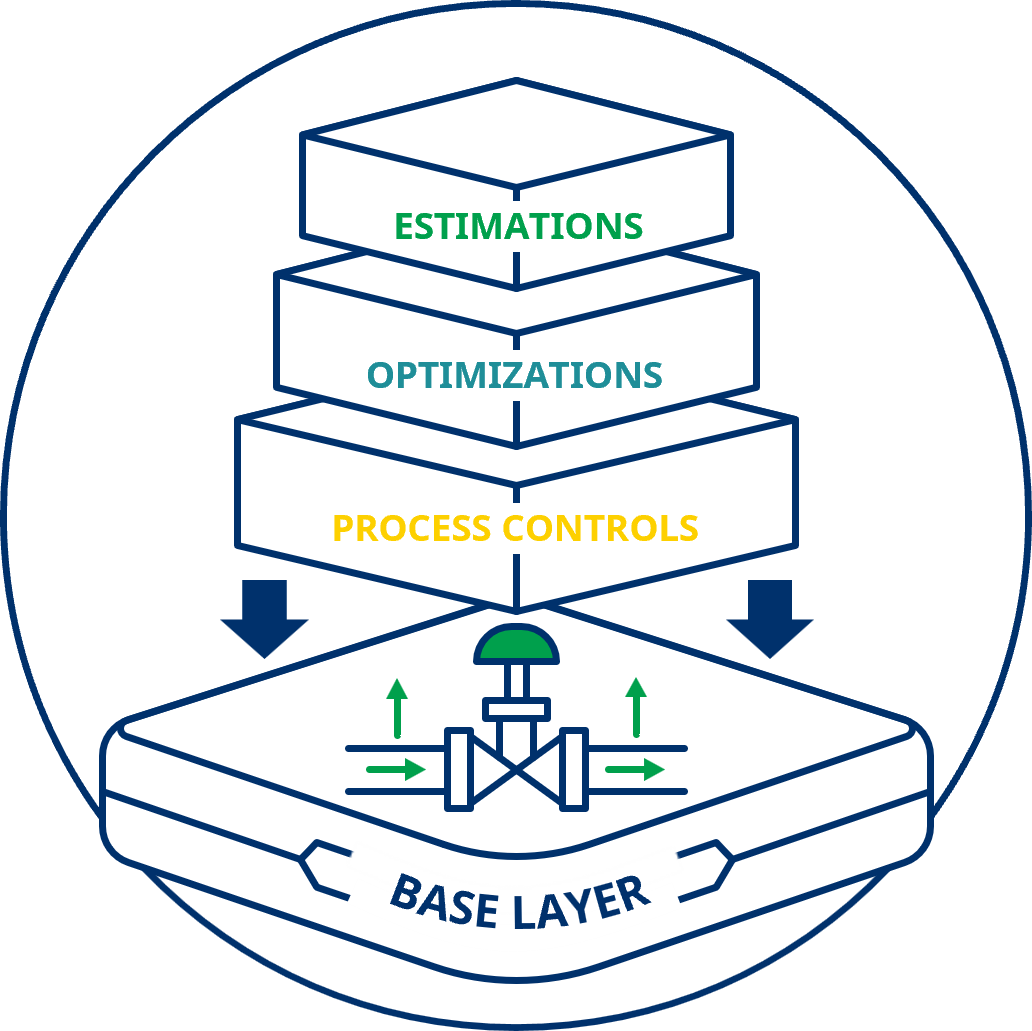
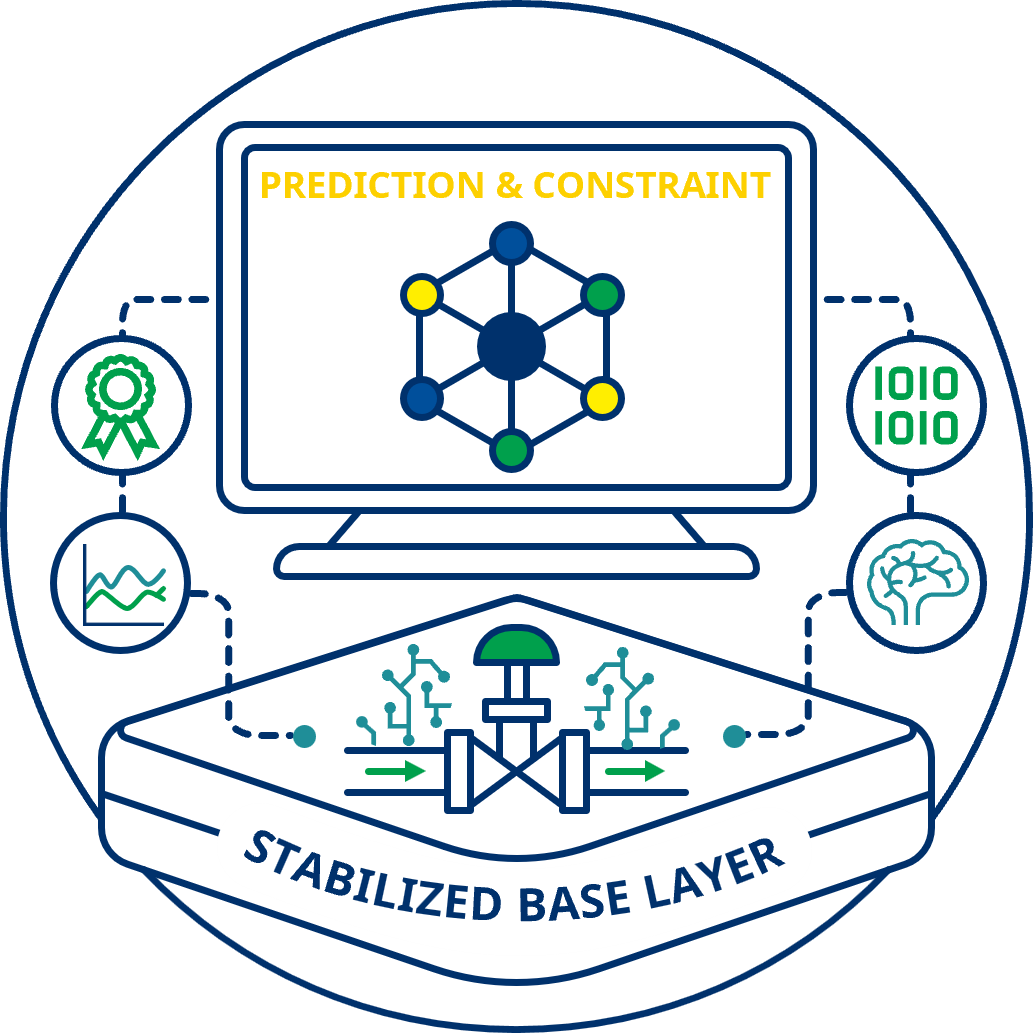
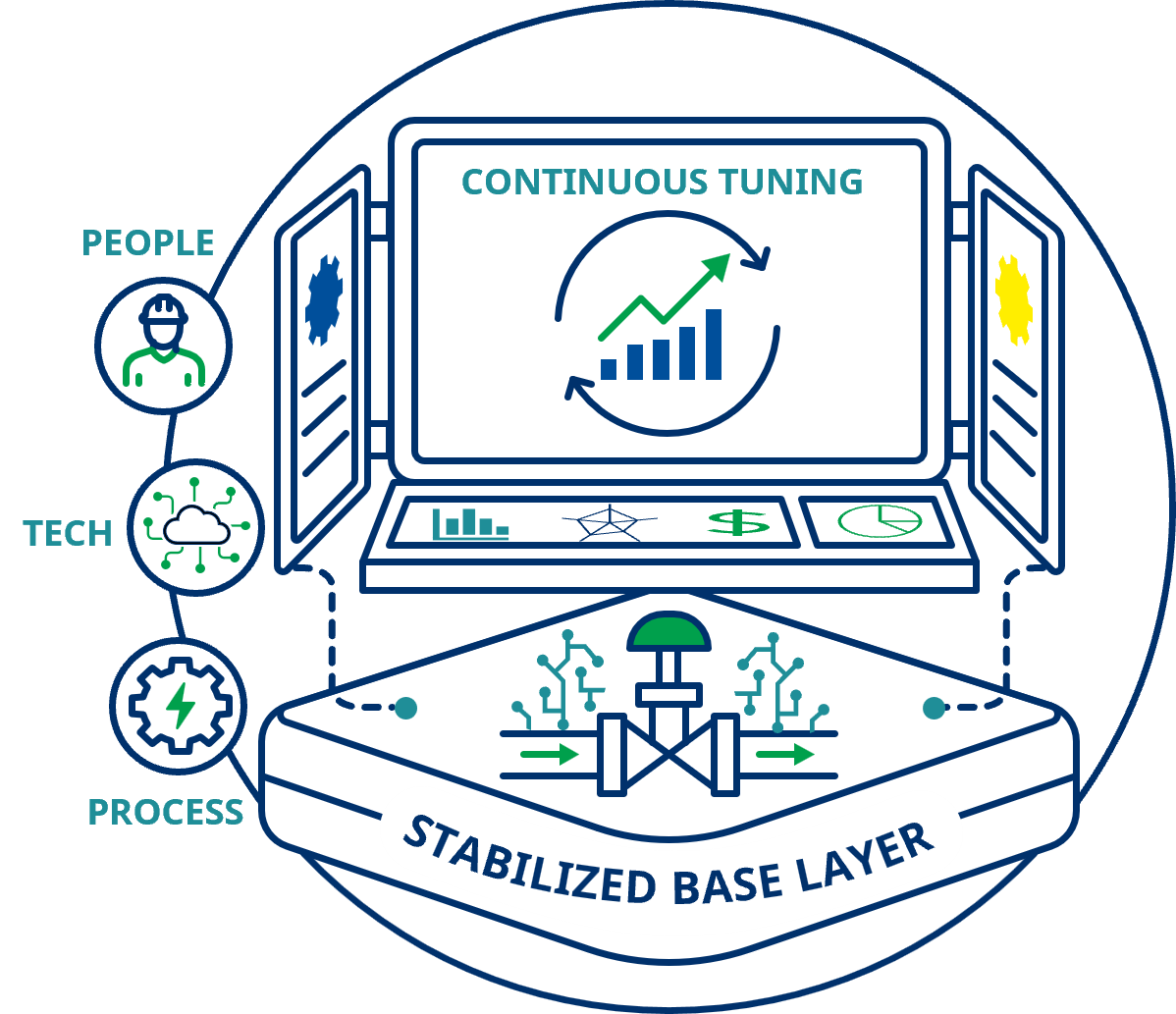
Yokogawa’s APC approach is built around three connected areas:
 |
 |
 |
|
1. Stabilize the Base Layer Yokogawa supports improvements to base-layer control and advanced regulatory control before or alongside APC deployment. |
2. Deploy the APC Applications Yokogawa’s APC software platform supports multivariable control, quality estimation, dynamic modeling, simulation, custom calculations, operator HMI, and application execution within a single environment. |
3. Sustain APC Performance Yokogawa supports monitoring, diagnostics, tuning, model maintenance, and lifecycle improvement to help sustain APC value over time. |
Details
Why Industrial Plants Use Advanced Process Control
Industrial process units often operate with interacting control loops, long dead times, changing feed conditions, energy limits, product quality requirements, and equipment constraints. Traditional regulatory control is essential, but it may not be sufficient to coordinate decisions across an entire process unit.
As plants become more complex, operators and engineers may need to manage more control loops, tighter specifications, more frequent operating changes, and greater pressure to improve profitability, reliability, and sustainability. APC helps address this complexity by using process models and multivariable control strategies to coordinate control moves across the process.
- Process variability across interacting variables
- Product quality giveaway
- Operating constraints and production limits
- Long process dead times
- Frequent feedstock or operating condition changes
- Energy-intensive process behavior
- Operator workload from repetitive manual adjustments
- Degradation in control performance over time

Advanced Process Control (APC) Software from Yokogawa
 Platform for Advanced Control and Estimation is Yokogawa’s advanced process control software platform for developing, deploying, operating, and maintaining applications.
The platform supports multivariable optimizing control, quality estimation, complex calculations, process data management, process dynamics modeling, simulation, operator HMI, monitoring, diagnostics, and integration with plant systems.
Business Outcomes Advanced Process Control Can Support
The value of APC depends on the process unit, current control performance, implementation scope, operating constraints, and business objectives. A feasibility assessment can help determine where APC may deliver measurable value.
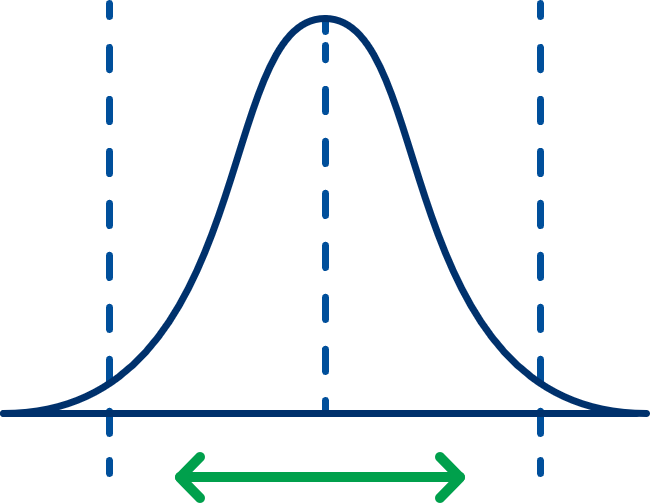 |
Reduce process variability APC helps coordinate control moves across interacting variables, supporting more stable operation than isolated loop control alone. |
 |
Support energy optimization APC can help manage the behavior of energy-intensive processes by coordinating control decisions across related variables. |
|
 |
Improve product quality control Quality estimation and multivariable control can help operations manage product properties closer to defined targets. |
 |
Reduce manual operator adjustments APC can reduce repetitive manual intervention by automatically coordinating control actions within defined operating limits. |
|
 |
Support throughput objectives APC can help plants operate closer to controlled constraints when process conditions and operating objectives allow. |
 |
Improve lifecycle visibility Monitoring and diagnostic tools help engineering teams identify degraded control performance, model mismatch, and maintenance needs for control applications. |
Advanced Process Control Capabilities
Multivariable Control
APC coordinates multiple manipulated variables, controlled variables, disturbance variables, and constraints across a process unit.
Model Predictive Control
Model predictive control uses process models to anticipate process behavior and calculate control actions that support defined operating objectives.
Quality Estimation
Quality estimation, sometimes called soft sensing, estimates quality or process properties when direct measurements are delayed, unavailable, or limited.
Process Modeling and Simulation
APC applications rely on process models that describe how variables respond over time. Modeling and simulation help engineers validate control strategies before deployment.
Automatic Step Testing
Automatic step testing can support model development by collecting plant response data for dynamic model identification.
Operator HMI
Operator and engineer interfaces help users monitor APC application status, process conditions, trends, and relationships among variables.
Monitoring and Diagnostics
Monitoring tools help identify APC performance issues, model errors, operator interventions, and potential bad actors.
OPC Integration
APC applications can connect with control systems and plant information systems through supported interfaces such as OPC DA and OPC UA.
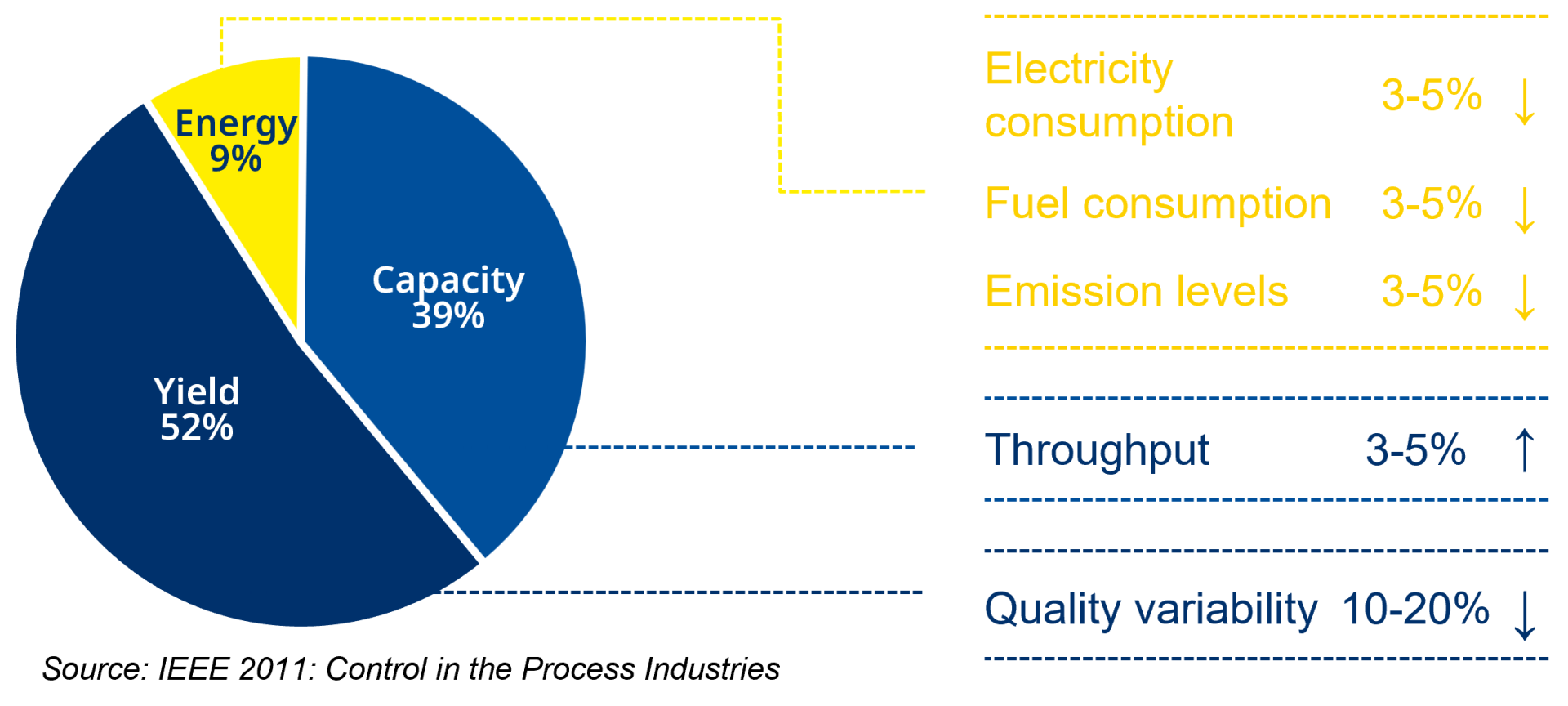
ROI Conventional vs Advanced Controls
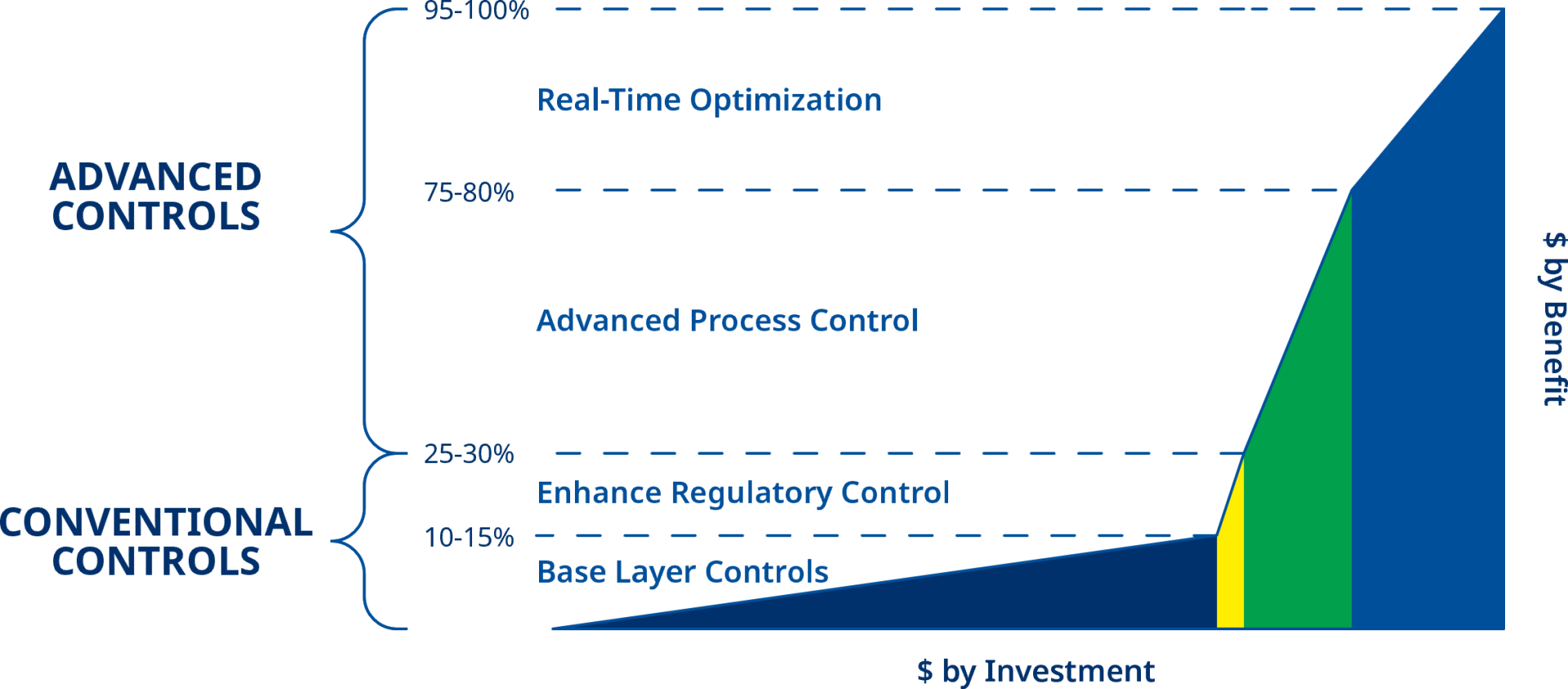
Typical 2-12 Month Payback
Advanced Process Control Consulting and Lifecycle Services
Successful APC programs require more than software. Yokogawa supports APC initiatives through assessment, control strategy development, engineering, implementation, commissioning support, operator adoption, performance monitoring, and lifecycle maintenance.
 |
 |
 |
 |
 |
| APC Feasibility Assessment Evaluate historical operating data, control constraints, process variability, and potential improvement opportunities. |
Base-Layer Control Review Assess regulatory control performance and identify stabilization needs before APC deployment. |
APC Application Design Define controlled variables, manipulated variables, disturbance variables, operating constraints, quality estimators, and control objectives. |
Implementation and Commissioning Support Support staged validation, commissioning, live deployment, and operational handover. |
Performance Monitoring and Lifecycle Support Review performance trends, model mismatch, operator interventions, and tuning opportunities. |
Related Advanced Process Control and Optimization Topics
 |
 |
 |
 |
| CENTUM VP | Exaquantum/Historian | Procedural Automation (Exapilot) | Alarm Management |
 |
 |
 |
|
| Digital Transformation | CI Server/Digital Twin | Integration Solutions | |
Advanced Process Control FAQs
What is Advanced Process Control?
Advanced Process Control is a process optimization approach that uses models, multivariable control, quality estimation, and constraint management to help industrial plants operate more consistently than they can with basic regulatory control alone.
What is APC software?
APC software helps control engineers design, deploy, operate, monitor, and maintain advanced control applications for complex process units.
What Yokogawa software is used for Advanced Process Control?
Yokogawa’s Advanced Process Control solution uses the Platform for Advanced Control and Estimation, which combines multivariable control, quality estimation, custom calculations, HMI, modeling, simulation, and monitoring functions in one APC platform.
Is Advanced Process Control the same as model predictive control?
Model predictive control is a key APC method, but APC can also include quality estimation, advanced regulatory control, custom calculations, monitoring, diagnostics, and lifecycle services.
What types of plants can benefit from APC?
APC is most relevant for industrial process units with interacting variables, long response times, quality constraints, feed changes, energy-intensive equipment, or operating limits.
Does Yokogawa APC integrate with DCS systems?
Yes. Yokogawa APC product content references integration with DCS and PIMS environments through OPC interfaces, including OPC DA and OPC UA.
What is the first step in evaluating APC?
The first step is usually a feasibility assessment that reviews historical operating data, process constraints, control objectives, and potential improvement opportunities.
Resources

- A phased upgrade approach from CENTUM CS to CENTUM VP was planned to meet tight LNG carriers schedules.
- The collaboration using CENTUM VP and APC provides optimization of gas liquefaction operation.

- This is the first project in which Shell Global Solutions US has used a contractor outside of Shell for its Advanced Process Control implementation
- The post implementation study shows that the overall Delayed Coker APC controller returns a benefit which is almost three times the original promise.

- To decrease downtime and maintenance costs, the decision was made to introduce Yokogawa's CENTUM DCS.
- With well-experienced MAC approach, Yokogawa replaced successfully legacy DCS.

Samsung Petrochemical Co. Ltd. (SPCL), a major Korean petrochemical company, produces 700,000 tons per year of purified terephthalic acid (PTA) at its Daesan plant. PTA, a white powder substance that is produced by oxidizing and refining para-xylene, is a precursor to polyethylene terephthalate (PET), a polyester material that has excellent thermal resistance and wear resistance and is widely used as a substitute for natural cotton fibers and in film packaging, beverage bottles, tire cords, paints, adhesives, and other applications.

- HMEL selected an integrated solution from Yokogawa
- Yokogawa India oversaw and implemented the engineering, installation, and commissioning of the refinery

- Based on a careful review of all operational procedures and operator roles and configured new SOPs in Exapilot.
- As a result, SFC has been able to reduce operator workload, improve product quality, and reduce production losses.

- At the company's Ulsan resin plant, six Exaquantum servers were connected to CENTUM CS 3000 and other vendor's systems.
- KKPC needed to expand its SBC capabilities and improve production efficiency at its plants.

A Malaysian Gas Processing and Transmission Company a subsidiary of the national oil & gas major, plays a prominent role in the gas business value chain. The company operates as a throughput service company providing the services of processing and transmission of gas to the power generation sectors and various customers.

- Implementation of multivariable optimizing controllers and robust quality estimators within a record short period
- 3% rise expected in CCR feed amount

PT. Tanjung Enim Lestari Pulp and Paper (PT. TEL) operates a pulp mill in Muara Enim, which is 130 km west of Palembang, the capital of Indonesia's South Sumatra province. This is the only pulp mill in the world to produce high-quality, bleached-hardwood kraft pulp solely from plantation grown Acacia mangium trees.

- The Advanced Process Control application on the GOHT unit helped control the plant with less variation during Coker drum switch and with less operator interactions and minimized giveaway.
- A post-implementation study estimated that the overall GOHT Unit APC controller returns a savings about 198% greater than the originally estimated.

- The Advanced Process Control application implemented on the Scotford MEG unit helped control the plant with less variation, resulting in maximized TEG production and reductions in overall steam consumption.
- TEG production increases were greater than originally estimated and the prices for steam and TEG used in the post-implementation study were reduced significantly.
Achieving autonomous operations is primarily about empowering the plant to run, learn, adapt and thrive in tomorrow’s environment—whatever that environment might be. Download this whitepaper to learn the steps in the journey to autonomous operations.
Downloads
Brochures
News
-
Press Release | Solutions & Products Jun 4, 2015 Yokogawa and Shell Jointly Develop Next-generation Platform for Advanced Control and Estimation
- Improved design, deployment, and maintenance of advanced process control applications -
Looking for more information on our people, technology and solutions?
Contact Us