Pre-Engineered Process Analyzer Systems
Standardized process analyzer packages for demanding industrial measurement applications
Yokogawa Pre-Engineered Solutions, or YES, combine proven analyzer-system designs with application engineering to simplify the specification and execution of common process analytical measurements. Available solutions include trace moisture measurement in chlorine, ambient air monitoring, and continuous emissions monitoring system (CEMS).
By starting with a defined design and collecting the required operating conditions early, Yokogawa can help reduce repetitive engineering, clarify project scope, and support more consistent implementation across units or sites.
| Request an Analyzer Consultation | Download the Application Data Sheet |
What is a Pre-Engineered Analyzer Solution?
A pre-engineered analyzer solution is a standardized package that combines analyzer technology, sample handling, materials, communications, documentation, and application-specific engineering for a defined industrial measurement. It provides a repeatable starting design while allowing project requirements and operating conditions to be reviewed before quotation and configuration.
Yokogawa calls this approach Yokogawa Pre-Engineered Solutions, or YES. The solutions currently developed:
 |
 |
 |
|
Trace Moisture Measurement in Chlorine Monitor low moisture concentrations in chlorine gas to help identify drying problems or moisture ingress before corrosion and product-quality issues escalate. |
Ambient Air & Fugitive Gas Monitoring Continuously collect gas concentration data at selected plant locations and support scheduled reporting for defined monitoring applications. |
Continuous Emissions Monitoring Systems (CEMS) Monitor stack emissions continuously for environmental reporting, operational optimization, and regulatory compliance. |
Why Standardized Analyzer Designs Matter
Process analyzer projects can become difficult to scope when design decisions, interfaces, operating conditions, and documentation are addressed separately. Common challenges include:

Repeated Engineering |
Inconsistent System Designs |
Unclear Project Scope |
|
The engineering and design process is convoluted with increased costs associated with complex engineering and frequent design changes requiring the need for a pre-engineered solution. |
Differences in components, layouts, communication methods, and documentation can complicate training, maintenance, and spare-parts planning. |
Missing process conditions, late design changes, interface questions, and misunderstood responsibilities can affect quotations, documentation, installation planning, and project execution. |
A Defined Starting Point for Analyzer System Execution
Yokogawa Pre-Engineered Solutions use repeatable application designs as the starting point for a specific measurement requirement. The customer supplies the required process, environmental, measurement, and installation conditions. Yokogawa reviews the application and develops the applicable project scope, quotation, and documentation package.

Depending on the selected solution and project requirements, the package may address:
- Analyzer selection and application engineering
- Sample extraction, conditioning, transport, or return requirements
- Wetted material selection
- Measurement range and operating conditions
- Cabinet, rack, shelter, or mounting requirements
- Plant communication interfaces
- Hazardous-area requirements
- Drawings and project documentation
- Testing, commissioning, training, and lifecycle support
Details
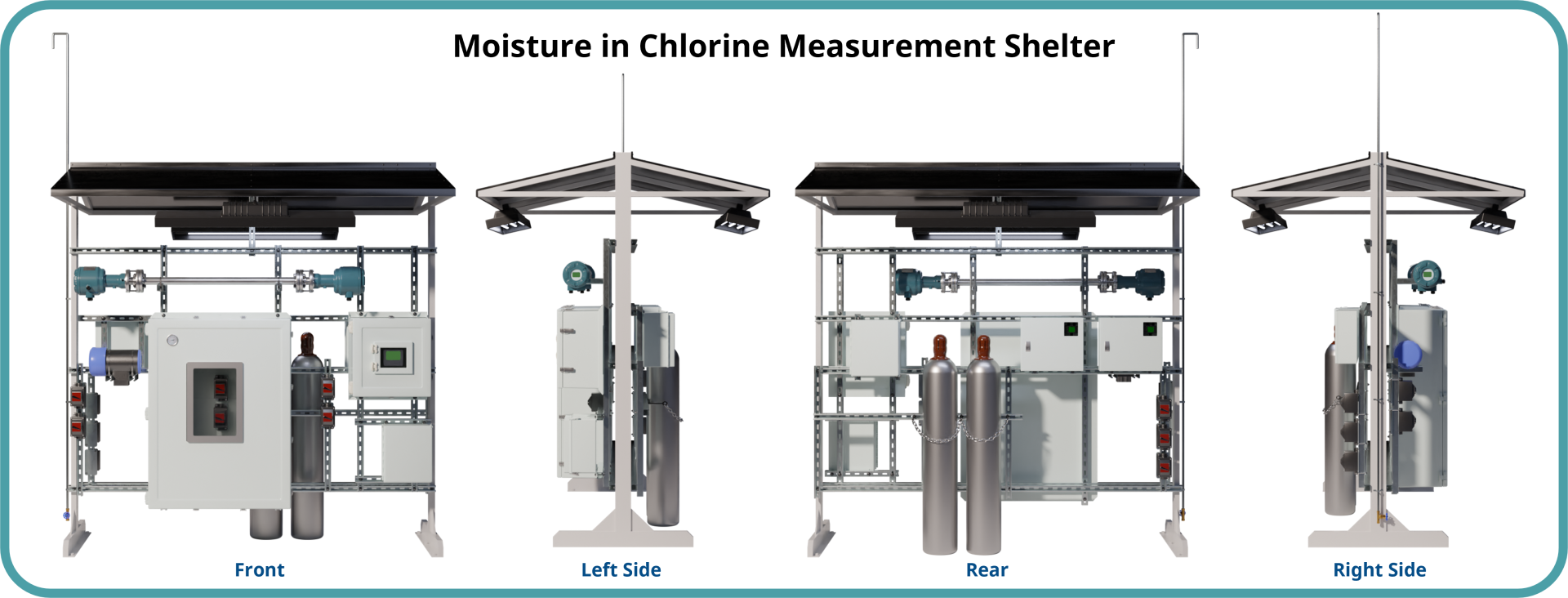
Moisture in Chlorine Measurement Shelter
 Yokogawa’s moisture-in-chlorine solution is a pre-engineered analyzer package for measuring low moisture concentrations in chlorine gas. The published application uses a TDLS8000 tunable diode laser spectrometer and an application-specific sample-system design to support rapid detection and recovery following moisture events.
View Flyer Request an Analyzer Consultation
Download the Application Data Sheet
The Challenge
Moisture entering dry chlorine service can contribute to corrosive compounds, equipment damage, product contamination, and unplanned process intervention. Conventional contact-based sensors may also require maintenance or prolonged recovery after exposure to a high-moisture event.
Plants therefore need a measurement system that can:
- Detect low moisture concentrations
- Respond to a moisture breakthrough
- Recover after elevated moisture exposure
- Withstand the process environment
- Integrate with site monitoring and control systems
The Solution
The Yokogawa package combines a TDLS8000 tunable diode laser spectrometer with an engineered sampling configuration for the moisture-in-chlorine application. The system is configured from the customer’s process conditions and installation requirements.
The Benefits
Yokogawa's application expertise eliminates any design uncertainties, increases measurement integrity and reliability, and eliminates additional installation and maintenance costs.
Specifications
| Ambient Temperature | -13 to 140ºF |
|---|---|
| Process Supply Pressure | 0 to 100 psig |
| Process Supply Temperature | 50 to 131ºF |
| Process Return Pressure | 0 to 80 psig |
| Sample Transport Bundles | By Yokogawa, By Others |
| Sample Transport Tubing Material | Monel, Hastelloy C |
| Sample Handling System Materials | Monel, Hastelloy C |
| Nitrogen Dryers | Single, Dual |
| Communication | Ethernet, Fiber |
| Hazardous Area Classification | Class I, Division 2, Group BC&D, T3 |
How the Configuration Process Works
Provide application data: Submit the required moisture range, process pressure, process temperature, ambient temperature, return pressure, materials, and site requirements.
Download the Application Data Sheet
Review the application: Yokogawa evaluates the operating conditions and confirms whether the pre-engineered configuration is appropriate.
Define the system scope: Yokogawa prepares the applicable quotation and drawing or documentation package.
Complete project execution: Testing, installation supervision, commissioning, training, and support can be scoped as required.
Ambient Air Monitoring of "Fugitive Gas Emissions" Shelter
 Yokogawa’s ambient air monitoring solution is a configurable analyzer system for collecting gas concentration data from selected monitoring locations. The published system supports multiple sample streams and can be paired with SMARTDAC+ for data collection and scheduled reporting.
Discuss an Ambient Air Monitoring Application
Download the Application Data Sheet
The Challenge
Industrial facilities may need to monitor selected gases around process equipment, plant boundaries, populated areas, or other defined locations. Monitoring systems must account for the target gas, concentration range, number of locations, sample distance, environmental conditions, reporting frequency, and applicable regulatory requirements.
Common evaluation requirements include:
- Target gases and expected concentration ranges
- Number and location of monitoring points
- Sample-line distance and routing
- Detection and response requirements
- Data recording and report format
- Utilities, shelter, and environmental protection
- Plant communication and alarm interfaces
- Hazardous-area classification
- Applicable permits, regulations, and quality procedures
The Solution
The system draws samples from defined monitoring locations and routes them to the applicable analyzer configuration. The published design supports up to 15 streams and can be paired with SMARTDAC+ for recording concentration values and generating reports at user-selected intervals.
The Benefit
The standardized design based on application expertise shortens project execution time and minimizes engineering and design costs to provide repeatable, reliable measurements, quicker response, and recovery time.
Specifications
| Ambient Temperature | -40 to 140ºF |
|---|---|
| Benzene Analysis Range | 0 to 1 ppb |
| VCM Analysis Range | 0 to 20 ppm |
| EDC Analysis Range | 0 to 50 mol% |
| Stream Count | Up to 15 |
| Stream Length | User-Defined |
| Sample Transport Bundles | By Yokogawa, By Others |
| 3-Sided Shelter | Included or Not Included |
| Instrument Air Filters | Single, Dual, None |
| Communication | Ethernet, Fiber |
| Hazardous Area Classification | Class I, Division 2, Group BC&D, T3 |
How the Configuration Process Works
Provide application data: Submit the required moisture range, process pressure, process temperature, ambient temperature, return pressure, materials, and site requirements. Can be modified for other gas area monitoring as well.
Download the Application Data Sheet
Review the application: Yokogawa evaluates the operating conditions and confirms whether the pre-engineered configuration is appropriate.
Define the system scope: Yokogawa prepares the applicable quotation and drawing or documentation package.
Complete project execution: Testing, installation supervision, commissioning, training, and support can be scoped as required.

Continuous Emissions Monitoring System (CEMS) Cabinet
 A Continuous Emissions Monitoring System (CEMS) continuously extracts, conditions, analyzes, records, and reports stack gas emissions from industrial combustion sources such as boilers, heaters, furnaces, and gas turbines. Yokogawa's pre-engineered CEMS solutions integrate sampling, conditioning, analyzers, communications, and reporting into a standardized package.
Download the Application Data Sheet
The Challenge
Industrial facilities face increasing environmental reporting requirements while maintaining plant reliability and efficiency. A successful emissions monitoring program must:
- Continuously measure regulated pollutants
- Maintain data quality and availability
- Support reporting requirements
- Minimize maintenance burden
- Integrate with plant automation systems
The Solution
Yokogawa Pre-Engineered CEMS cabinet combines:
- Sample extraction systems
- Sample conditioning panels
- Continuous gas analyzers
- Calibration and validation systems
- Data acquisition and reporting systems
- Communications interfaces
The current Yokogawa CEMS solution utilizes the IR800 analyzer platform and integrated sample conditioning architecture
How It Works

The Benefits

Frequently Asked Questions
What is a Yokogawa Pre-Engineered Solution?
A Yokogawa Pre-Engineered Solution, or YES, is a standardized analyzer-system design for a defined industrial measurement application. It combines analyzer technology, sample-system requirements, materials, communications, documentation, and application engineering as part of a configurable package.
What applications are available?
The solutions currently described on this page are trace moisture measurement in chlorine and ambient air monitoring for selected industrial gases. Additional applications should be confirmed with Yokogawa.
Is a pre-engineered analyzer solution the same as an off-the-shelf analyzer?
No. An analyzer is one part of the measurement system. A pre-engineered solution addresses the analyzer together with application-specific sampling, materials, installation, communication, and documentation requirements. Final configuration remains dependent on process and site conditions.
What information is needed for a quotation?
Typical inputs include the target component, measurement range, process pressure and temperature, ambient conditions, sample return pressure, required materials, utilities, communication needs, hazardous-area classification, and installation requirements.
How is moisture measured in chlorine gas?
The pre-engineered solution uses a TDLS8000 tunable diode laser spectrometer with an application-specific sampling arrangement. The final system must be reviewed against the chlorine process conditions and required measurement range.
Why is moisture measurement important in chlorine production?
Moisture in dry chlorine service can contribute to corrosion, equipment damage, and product contamination. Early detection helps plant personnel identify drying problems or moisture ingress and determine an appropriate operational response.
What gases can the ambient air system monitor?
The existing page references benzene, hydrogen sulfide, vinyl chloride monomer, 1,3-butadiene, and other gases. Available analyzers, measurement ranges, sampling methods, and configurations must be confirmed for the intended application.
Can the ambient air system monitor multiple locations?
The published configuration lists support for up to 15 streams. The number of locations, sample-line distance, measurement cycle, target compounds, and response requirements must be evaluated for each project.
Can the analyzer system connect to plant systems?
The published configurations list Ethernet and fiber options. Required signals, protocols, network architecture, reporting, alarms, and cybersecurity responsibilities should be defined during the application review.
Are hazardous-area configurations available?
The current page lists Class I, Division 2, Groups B, C and D, T3 for the published configurations. Certification, installation practices, and suitability must be confirmed for the selected system and site.
What project services are available?
Depending on scope, Yokogawa analyzer integration services may include engineering, fabrication, project management, factory acceptance testing, installation supervision, commissioning, start-up, training, repair, and maintenance support.
What is a Continuous Emissions Monitoring System (CEMS)?
A CEMS continuously measures and reports emissions from combustion sources using integrated sampling, conditioning, analyzer, and reporting technologies.
Which gases can Yokogawa CEMS measure?
Current Yokogawa documentation references NOx, SO₂, CO, CO₂, and O₂ measurement. Additional configurations should be validated by the product owner.
What industries use CEMS?
CEMS are commonly used in power generation, refining, petrochemical, chemical manufacturing, industrial boilers, and combustion processes requiring emissions monitoring. Yokogawa materials specifically reference combustion sources such as gas turbines, boilers, heaters, and industrial furnaces.
Can the design be standardized across multiple sites?
A pre-engineered design can provide a repeatable starting point for similar applications across units or sites. Each installation still requires review of process conditions, regulations, utilities, area classification, interfaces, and local requirements.
Resources

Electrolysis plants create hydrogen and chlorine from a brine solution. Chlorine gas generated from the anolyte of the electrolysis tank generally contains between 0.5 to 2.0 vol% H2O. The sample is then cooled and filtered to remove brine, subsequently coming out as wet chlorine gas. The wet gas is sent to a drying tower where it is treated with sulfuric acid to get moisture down to the ppm level.
Downloads
Brochures
General Specifications
Forms
- Pre-Engineered Solutions Application Data Sheet (50.2 KB)
- YCACEMS Application Data Sheet (287.3 KB)
Looking for more information on our people, technology and solutions?
Contact Us