Yokogawa는 축적된 산업 경험을 바탕으로 해양 산업의 요구에 부합하는 차별화된 솔루션을 제공해 왔으며, 수십 년간 전 세계 LNG 운반선에 IAS를 공급해 왔습니다. Yokogawa와의 장기적인 파트너십은 전 생애주기에 걸친 지원을 통해 총소유가치(TVO)를 극대화합니다.

Integrated Automation System
LNG 운반선에서는 화물 탱크 내 LNG가 기화되면서 보일오프 가스(BOG)가 발생합니다. 통합자동화시스템(IAS)은 추진 시스템에 따라 BOG를 관리하는 한편, 화물 시스템과 기계 시스템을 제어 및 모니터링합니다. 통합된 운전 및 모니터링 환경은 복잡한 LNG 화물 및 엔진 제어 운용에서 의사결정을 보다 효율적으로 지원합니다. 또한 개방형 인터페이스를 통해 상위 컴퓨터가 트렌드 데이터, 메시지 및 공정 데이터에 접근할 수 있도록 합니다. 모든 공정 데이터는 휴먼-머신 인터페이스(HMI)에서 효과적으로 모니터링할 수 있으며, 이를 통해 LNG 운반선의 운항을 보다 신속하고 안전하게 수행할 수 있습니다.


Challenges
Lifecycle Dynamic Simulator
동적 시뮬레이터는 비정상 운전에 대비할 수 있도록 운전자를 교육합니다.
Yokogawa는 LNG 운반선의 전 생애주기에 걸쳐 다양한 목적으로 활용할 수 있는 동적 시뮬레이터의 고도화된 활용을 주도하고 있습니다. 동적 시뮬레이터는 운전자 교육에 이상적일 뿐만 아니라, 모든 운전 조건에서의 철저한 시스템 테스트를 가능하게 함으로써 시스템 설계 검증을 위한 유용한 도구로 활용될 수 있습니다. 또한 ICSS 테스트 기능과 공정 동적 시뮬레이터를 결합함으로써 공정 반응을 예측할 수 있습니다.

Customer Challenge

이중연료 2행정 저속 엔진은 고압 연료가스 공급 시스템(FGSS)을 사용합니다. FGSS 공정에는 고압 압축기, 고압 펌프, 재액화 시스템 등이 포함되며, 적용 방식에 따라 다양한 구성과 변형이 존재합니다.
Our Solutions
동적 시뮬레이터는 다양한 조합과 운전 시나리오에 대해 플랜트 설계, 제어 철학 및 운전 개념을 검증할 수 있도록 합니다.
Customer Benefits
이러한 접근 방식은 프로젝트 초기 단계에서 신규 공정으로 인한 잠재적 위험을 줄이는 데 유용합니다.
Enabling Technology

OmegaLand는 동적 시뮬레이터를 위한 통합 환경을 통칭하는 용어입니다. OmegaLand는 다양한 산업의 여러 부서에서 폭넓은 활용 요구를 충족할 수 있도록 구성된 기능 모듈로 이루어져 있습니다. OmegaLand의 동적 시뮬레이션 환경은 필요에 맞는 모듈을 조합함으로써 보다 낮은 비용으로 시스템 효율을 향상시킵니다.
Fleet Monitoring System
Real-Time Fleet Monitoring System은 선박 통합 모니터링을 지원합니다.
Yokogawa는 안전한 데이터 전송 기반의 실시간 선박 모니터링 시스템을 제공합니다. 실시간 데이터를 통해 지연 없이 선박 상태를 모니터링할 수 있으며 완전히 맞춤 설정이 가능한 KPI 대시보드로 신속한 선박 운용 의사결정을 지원합니다.


Network IO
N-IO(Network I/O)는 구성 요소를 최소화한 설계로, 단일 모듈에서 AI, AO, DI, DO를 모두 지원할 수 있습니다. 옵션 신호 컨디셔너를 통해 다양한 I/O 신호 타입을 유연하게 수용할 수 있습니다. 또한 백플레인 설계 단계에서부터 I/O 이중화를 지원하여 추가 설치 공간 없이 시스템 안정성을 확보하고, 전체 설치 공간을 줄일 수 있습니다. N-IO의 유연한 I/O 구성은 엔지니어링 및 시운전 과정에서 발생하는 설계 변경에도 하드웨어 수정 부담을 최소화합니다.

Automation Design Suite (AD Suite)
AD suite는 플랜트 전 생애주기에 걸쳐 새로운 기술의 적용과 제공을 지속적으로 지원하는 엔지니어링 환경을 제공합니다. 이러한 기술에는 모듈형 설계, 벌크 엔지니어링, 변경 관리, 자동 as-built 문서 생성, 유연한 바인딩 등이 포함됩니다.
Yokogawa의 해양 분야 노하우는 풍부한 해양 프로젝트 수행 경험을 바탕으로 축적되었으며, 이러한 노하우는 AD Suite Class Modules에 반영되어 있습니다. AD Suite를 활용한 Yokogawa의 해양 엔지니어링 팀은 효율적인 프로젝트 수행을 통해 고객 만족을 실현하는 고품질 소프트웨어를 제공합니다.
Details
Power Management System
- Control of circuit breakers and monitoring
- Load Dependent Start/Stop
- Load Sharing
- Frequency Control
- Blocking of Heavy Consumers
- Load Reduction to Propulsion Drives
- Load Shedding (preferential trip)
- Automatic restarting after blackout
- Generator Control & Monitoring
- Propulsion Drive Interface
- Emergency Switchboard Interface
Machinery System
- Fuel Oil & Fuel Gas System
- Personnel Alarm System
- Extension Alarm System
- Reduction Gear System
- Fresh, Cooling, Feed Water System
- Bilge Level Monitoring System
- Air Ventilation and Fans
- Compressed Air System
- Lube Oil System
- Machinery Miscellaneous
Cargo Containment System
- Temperature Monitoring
- Pressure Monitoring
- Level Monitoring
Cargo Control System
- Cargo Pumps Control
- Stripping/Spray Pumps Control
- Emergency Cargo Pumps
- Cargo Operation (Loading/Unloading)
Cargo ESDS
- ESD for Cargo Containment System
- Cargo Tank Protection System
- Fuel Gas Master Valve
- Ship/Shore Communication System
Ballast System
- Ballast Pumps & Valves
- Automatic Ballast/Deballast Control
- Automatic Ballast Water Exchange
Steam Turbine
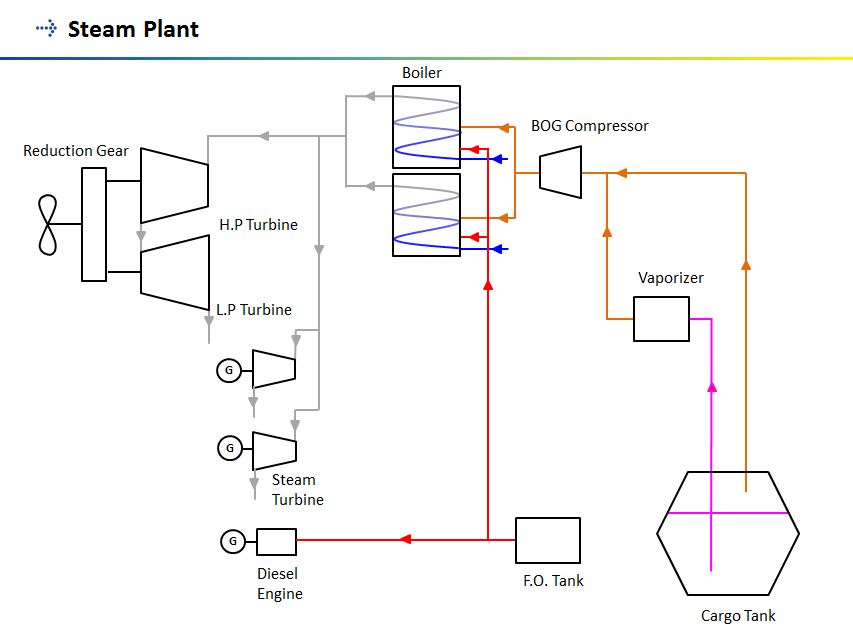
The steam turbine provides propulsion for utilizing the BOG to run the carrier. BOG is spent for boiler fuel, and the steam from the boiler is used to rotate the turbine. The power of the turbine is conveyed to the propeller.
IAS integrates boiler control, gas management, compressor control, power management, etc., using a sophisticated control philosophy.
Dual Fuel Diesel Electric Propulsion
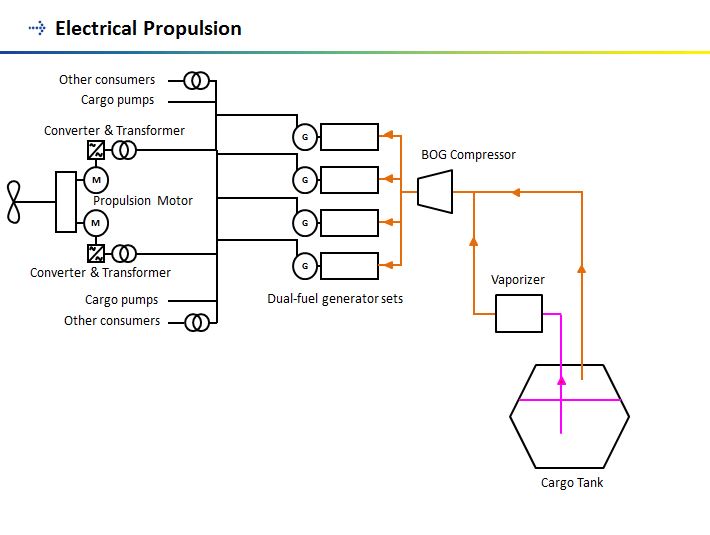
DFDE stands for dual fuel diesel electric propulsion. The propulsion system consists of several generator engines and electrical propulsion motors. Normally, generator engines burn only oil as fuel; however, the DFDE generator engines can burn both oil and gas. The gas or oil is supplied to the generator engine and the propulsion motor is driven by electrical power generated by the generator engine. Then, the power of the propulsion motor is conveyed to the propeller.
IAS integrates gas management, compressor control, power management, etc., using a sophisticated control philosophy.
About Two-Stroke Low Speed Dual Fuel Engines
Characteristics of Two-Stroke Low Speed Dual Fuel Engines
- With the growing environmental awareness in recent years, environmental regulations are being strengthened for marine engines. Currently, the International Maritime Organization (IMO) is working toward the following regulations.
- Reduction of NOx emissions (third regulation)
- Regulation of sulfur oxides
- Reduction of greenhouse gases
- To comply with the third regulation, engineers can use natural gas as fuel instead of heavy oil and perform a lean premixed combustion. In addition, since natural gas does not contain sulfur, the second regulation is satisfied.
- Furthermore, CO2 emissions can be reduced by 20 to 30%. Therefore, the current marine market desires dual fuel two-stroke engines that can be operate on heavy oil or gas fuel as needed. These dual two-stroke low speed engines require LNG gas handling systems to supply suitable fuel on board.
To optimize BOG and fuel economy, YOKOGAWA IAS integrates a fuel gas supply system (FGSS) and reliquefication control for the dual two-stroke low speed engines into cargo and machinery systems of LNG carriers or LNG fuel vessels. Called CENTUM and STARDOM, these systems provide reliable, high performance control of FGSS for dual fuel two-stroke engines, and provide total control of vessels as smart ships.
In a two-stroke low speed engine, the main shaft is directly connected to the engine and the shaft speed is low. Therefore, the propulsion system has higher power, higher efficiency, and higher reliability. Conventional two-stroke low-speed engines only ran on oil, but current mainstream ones can also run on gas. These new two-stroke low-speed engines come in two types each with different combustion methods.
High Pressure: ME-GI
The left figure shows a gas supply system for ME-GI. This is a handling system in which fuel gas is directly injected into the combustion chamber containing pre- ignited pilot oil. In this method supply gas must be pressurized to about 30 MPa in order to inject into the engine.
The basic fuel gas supply system consists of a high pressure LNG pump, forcing vaporizer, and BOG compressor. Depending on customer requirements, a re-liquefaction system can also be added to the system for LNG carriers. When loading LNG, a large amount of BOG is directly boosted to 30 MPa by a compressor and supplied to the engine. However if the amount of BOG generated is small, the LNG is pressurized by a high pressure pump and then heated to around 45 degC and supplied to the engine. If the LNG is a fuel vessel, the FGSS will be more simple.
Low Pressure: X-DF
The left figure shows the gas supply system for the X-DF. This is the fuel gas handling system used when a premixed combustion type dual two-stroke low speed engine is mounted on a vessel. In the premixed combustion method, the fuel gas can be injected at low pressure when the air flowing in from the scavenging port reaches a position higher than the gas valve position while pushing out the burnt gas (exhaust gas) upward.
This system consists of an LNG pump, forcing vaporizer, and BOG compressor. Depending on customer requirements, a re-liquefaction system can also be added to the fuel gas supply system for an LNG carrier. When loading LNG, a large amount of BOG is directly boosted to 1.6 MPa by a compressor and supplied to the engine. However if the amount of BOG generated is small, the LNG is pressurized by a pump directly and then fed into the evaporator, gasified, and supplied to the engine. If the LNG is fuel vessel, the FGSS will be more simple.
자료실

- CENTUM CS 3000 ensures safe and reliable operation of one of the world's most advanced LNG carriers.
- Yokogawa successfully installed a CENTUM CS 3000 integrated control automation system(ICAS).

- MISC could be ensured of better information visibility, performance foresight, and operational agility.
- Yokogawa CS 3000 system has proven in both the Tenaga and the Seri Class LNG carriers that their hardware is very reliable with very less problem.

Over the past decade, companies have been using unconventional drilling technology to extract gas and liquid from the readily available shale formations in North America. As the industry gains experience, the production rates continue to rise based on better use of technology to locate resources and to decrease the time from exploration to production.

As LNG moves from a niche to a major area of the oil and gas industry, experienced suppliers are required to deliver the technologies that support it.
기술 및 솔루션, 요꼬가와에 대한 자세한 정보를 찾고 계십니까?
견적 및 기술문의