Measuring Flow Rate with Vortex Technology
Accurate Flow Measurements for Decades
Vortex flow meters are long-lasting and robust with field-proven sensor technology and high reliability, improving plant efficiency and reducing operating costs. Yokogawa's digitalYEWFLO vortex meters feature a unique sensor design that accurately identifies and eliminates noise, resulting in stable and accurate measurements without any need for startup tuning.
-
Vortex Flowmeters VY series
Vortex Flowmeters VY Series is the latest model of Yokogawa vortex flowmeter and is the successor to the digitalYEWFLO Series.
VY Series consists of the latest digital technology and Yokogawa's unique structure inherited from YEWFLO Series. -
FSA130 Magnetic Flowmeter / Vortex Flowmeter Verification Tool
Magnetic Flowmeter/Vortex Flowmeter Verification Tool for diagnosis, reporting, and data management.
Details
Features
Advanced Self-Diagnostics
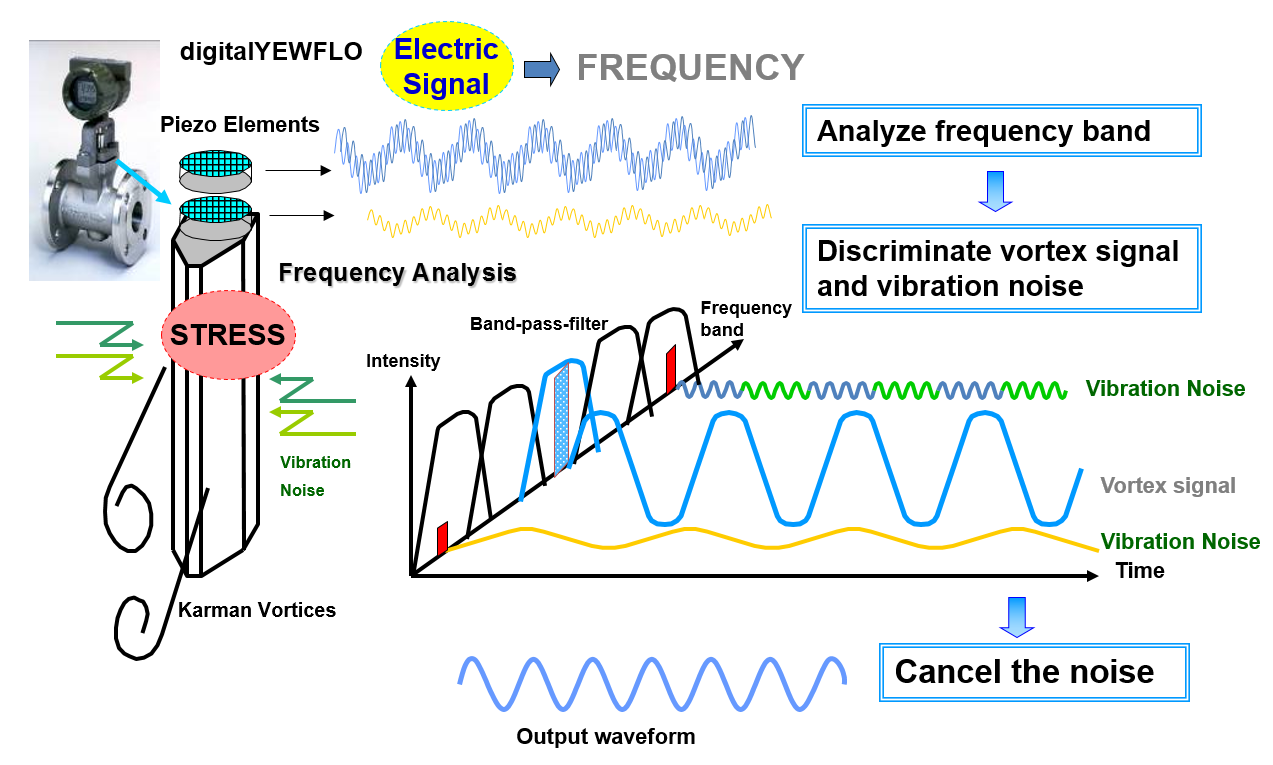
digitalYEWFLO vortex flow meters feature Spectral Signal Processing (SSP) and adaptive noise suppression (ANS) to provide a higher signal to noise ratio and eliminate the need for startup adjustment.
SSP analyzes the vortex waveform into its spectral components to filter noise from the signal for the most optimal flow measurement possible. ANS analyzes the incoming signals and adapts to the changing noise conditions to provide a clear flow signal, making it possible to block out the majority of pipe vibration.
Reduced Maintenance and Total Cost of Ownership
In addition to the advanced self-diagnostics functions, a de-clogging alarm notifies the operator of any obstructions in the pipe, preventing inaccurate measurements. If obstructions are present, Yokogawa’s unique design of the shedder bar allows the operator to replace it without removing it from the process or replacing the meter.
Accurate Measurement
Yokogawa vortex flow meters use an unblemished (hermetically sealed) design with two piezoelectric sensors installed in one single shedder bar. These sensors are 180 degrees out of phase allowing easy identification of potential noise to be eliminated, producing a clearer signal to yield more accurate results.
Wide Range of Applications
Yokogawa vortex meters are ideal for a variety of process condition handling, spanning from high temperature to cryogenic, and high pressure. This makes them ideal for a wide range of industries and applications including:
- Steam related
- Refining
- Chemical
- Oil & Gas
- District energy
- Reverse osmosis
- Petrochemical
Applications
Low Flow Conditions
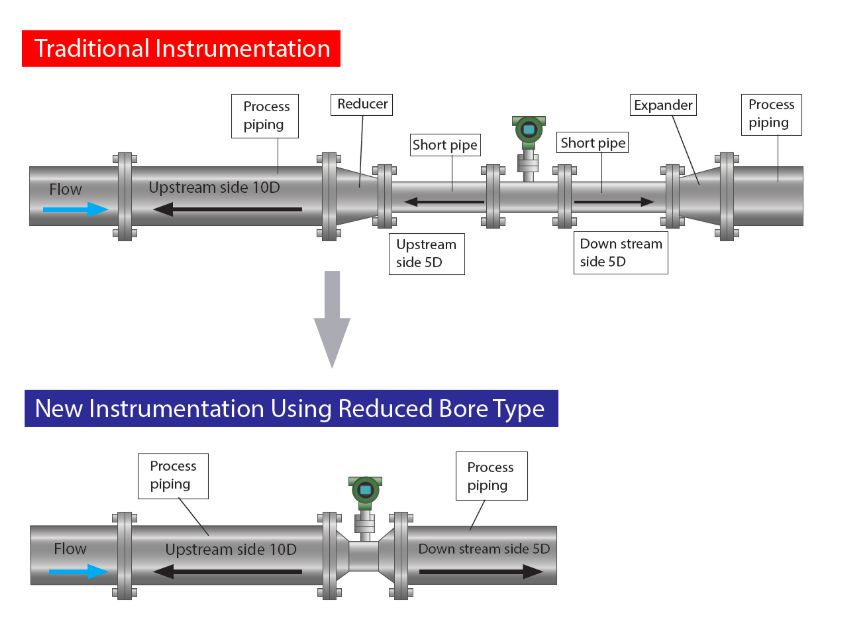
Yokogawa’s digitalYEWFLO Reduced Bore Type Vortex Flow Meter features a built-in concentric reducer and expander that enables stable flow rate measurements in low flow conditions. This expands the range of measurements that can be performed, from the higher flow rates down to the lower end of the flow span, and ensures stable and accurate flow rate output, which is normally difficult for vortex meters.
Steam Flow Measurement
 Steam has often been described as the 'lifeblood' of the industry. Vortex meters are known to be superior devices for steam flow measurement due to their inherent linear measurement, large turndown, low-pressure drop, and high accuracy.
The multivariable vortex flow meter is ideal for high temperature, superheated, and saturated steam applications since it eliminates the need for separate components and associated installation temperature. In addition, it provides quality, dependability, and high-pressure ratings along with stable and reliable flow measurement.
Read the application note to learn more.
Liquid Applications
Liquid applications in the oil refinery industry become challenging since the process liquid is a higher viscosity at lower process temperatures. As a result, clogging becomes an issue when a flow meter has moving parts.
digitalYEWFLO vortex meters have advanced self-diagnostics that alert the operator if clogging or plugging in the area around the shedder bar is present. Alerts are also triggered in high-vibration environments and those with excessive flow fluctuations in the area around the shedder bar. This enables automatic condition-based maintenance.
Reverse Osmosis
RO systems are designed for automatic operation and require routine preventative and corrective maintenance. Common problems include membrane fouling and the use of improper flow rates.
Vortex flow meters measure low-conductivity flow, are cost-efficient, and deliver accurate flow rates, making them perfect for reverse osmosis applications.
Family
 Classic Vortex Flow Meter
Classic digitalYEWFLO vortex flow meters are available in a number of different sizes ranging from 1/2-inch to 16-inch. Available with wafer style or flanged style (ANSI Class 150 to ANSI Class 900), digitalYEWFLO has the size you need.
Classic models include spectral signal processing (SSP) to provide enhanced vibration immunity and optimum, stable flow measurements. Even under fluctuating flow rate conditions, SSP outputs only the appropriate vortex frequencies with no manual adjustments needed.
 Multivariable Vortex Flow Meter
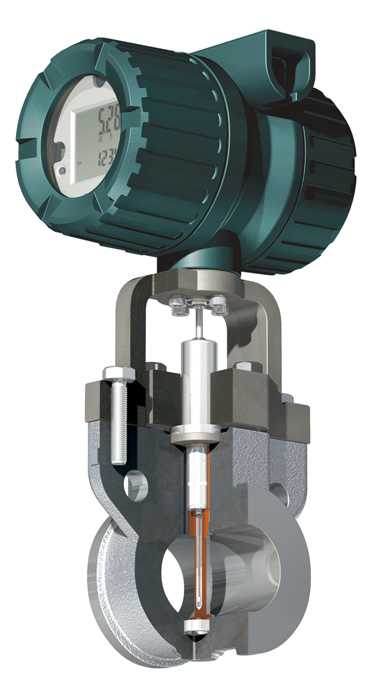
The multivariable vortex flow meter can measure flow rate and temperature simultaneously, eliminating the need for separate components and associated installation costs. The embedded temperature sensor inside the shedder bar directly outputs the mass flow rate of saturated steam and computes the flow rate in real time based on the measured temperature.
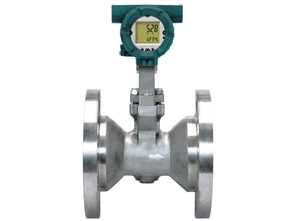 Reduced Bore Vortex Flow Meter
The Reduced Bore model was designed to capture the low flow applications without the need to install concentric reducers. It is very common in vortex flow applications to use a smaller meter compared to the line size. This requires the installation of concentric reducers along with the correct amount of upstream and downstream meter run to ensure a proper flow profile into the meter. By utilizing built-in concentric reducers, we can reduce the meter ID by either one or two meter sizes. This feature allows you to install a line size meter, reduce installation cost, and measure your low flows.
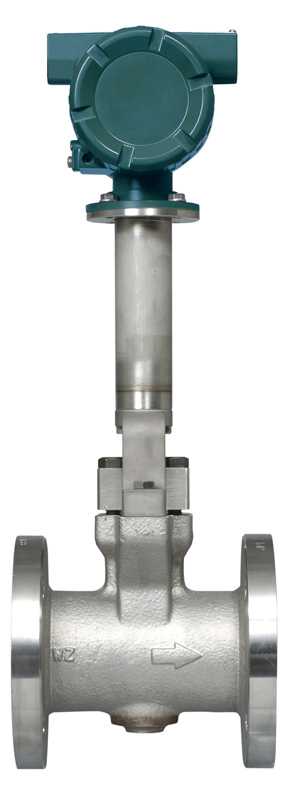 High Temperature / Cryogenic Vortex Flow Meter
digitalYEWFLO meters offer high temperature and cryogenic options for high and low temperature applications.
The High Process Temperature option measures process mediums at temperatures as high as 450 °C, ideal for high temperature superheated and saturated steam applications.
The Cryogenic option can measure process mediums at temperatures as low as -196 °C, ideal for low temperature applications such as liquid oxygen.
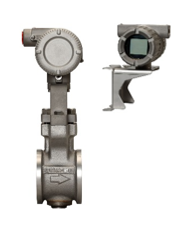 Remote
Remote electronics allows you to locate the indicator away from the process measurement point, so it can be accessed from a more convenient or visible area. Remote digitalYEWFLO vortex flow meters are available in a number of different sizes ranging from 1/2-inch to 16-inch. Available with wafer style or flanged style (ANSI Class 150 to ANSI Class 900), digitalYEWFLO has the size you need.
The image here shows the meter with Stainless Steel housing. The SS housing is an available option for all Yokogawa digitalYEWFLO vortex flow meters.
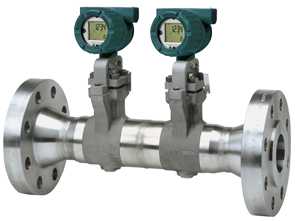 Customized Applications
For customized applications, our digitalYEWFLO meters offer high-pressure, dual sensor, high-purity, and butt welded type options suited for your application.
Von Kármán Effect
What is the Von Kármán Effect?
Vortex Flow Meters use the Von Kármán Effect to measure the rate of flow of a fluid or gas. Early in the 20th century, a Hungarian-American mathematician and physicist, Theodore von Kármán, discovered that a fluid or gas flowing perpendicularly pass a bluff body would generate alternating vortices on both sides of the body. The path of these vortices is called the Von Kármán Street.
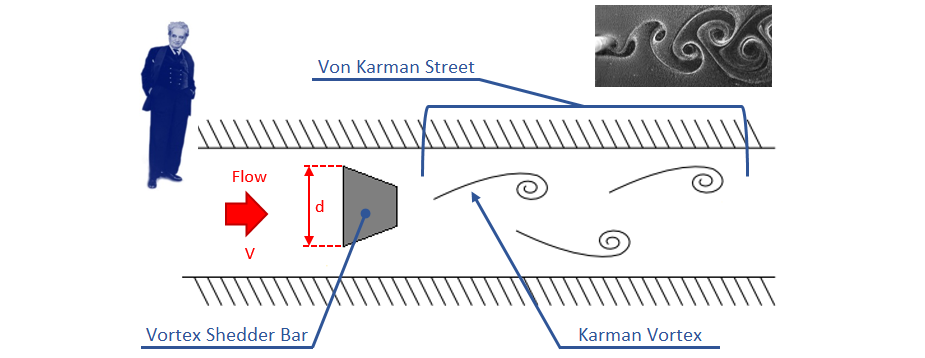
Von Kármán found that if the frequency of these vortices was measured, that the frequency is proportional to the flow velocity that is generating the vortices. This frequency is called the Kármán Vortex Frequency. The relationship of the frequency and the flow velocity can be mathematically expressed with the following formula:

From the equation, we can see that the frequency is proportional to the velocity. If we can measure the frequency (f), know the Strouhal number (St), know the shedder bar width (d); we can solve for v (velocity).

How do we measure the frequency of the vortices?
As vortices form and pass the shedder bar (the bluff body), they create a low pressure as compared to the rest of the fluid. This low pressure produces a differential pressure (dp) across the shedder bar. The high pressure side of the dp exerts stress on the shedder bar in the direction of the low pressure. As the location of the low pressure side alternates due to the vortices switching from side-to-side, the change in direction of the exerted force causes the shedder bar to oscillate. This oscillation is equal to the Kármán Vortex Frequency.

There are several methods in the marketplace to measure the oscillation. Diaphragms or capacitance sensors are two of the more common; but, the best method is the use of Piezo-electric crystal sensors. These sensors, when compressed, produce an electric signal that can be sent to the flow meter's electronics. Now that the Kármán Vortex Frequency is measured (and we know the St and d), the flow meter electronics can do simple calculations to determine volumetric flow through the pipe.
History
Yokogawa released the world's first vortex flow meter in 1968. Thanks to its long-term stability and high accuracy, our customers have achieved significant improvements in productivity over the past forty years. In response to ever-changing market needs, Yokogawa has gone on to release high temperature, cryogenic, dual-sensor, reduced bore, and FOUNDATION Fieldbus communication versions of this product.
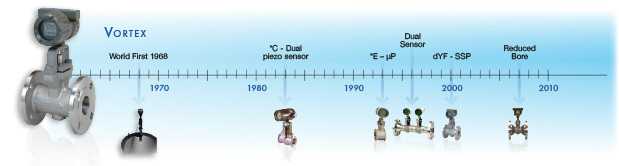
Yokogawa's 40+ years of Vortex Flow Meter innovation.
Resources

- Fieldbus technology introduced to realize predictive and preventive maintenance.
- ISAE to improve the reliability of diagnosis and parameter setting, utilizing data collected by PRM.

- Yokogawa's integrated solution contributed to reliable and efficient operation.
- All the instrument information is fully integrated with the instrument management system.

Accurate Steam Measurement from Start-up to Full Operation; Steam flow varies widely from start-up to full load. This note highlights how multivariable vortex technology ensures accurate, reliable measurement across all conditions.

Best Solution for Automatic Boiler Control
Sensors and controllers for the efficiency and environmental performance
Challenge: The customer's existing measurement device was disturbed by vibration and could not be compensated or corrected by the product that was installed.

Optimizing Steam Injection for Enhanced Oil Recovery with Vortex VY Flowmeter Series. Steam injection is one of the most effective enhanced oil recovery (EOR) methods, but harsh operating conditions demand reliable, maintenance-free flow measurement solutions.

In steam-driven processes, the mass flow rate is a key performance indicator. Without accurate mass flow data, operators risk inefficient fuel use, inaccurate energy balancing, and unstable boiler control. A high-precision, compact vortex flowmeter with built-in temperature sensing helps deliver real-time, reliable mass flow measurement, reducing costs and improving operational efficiency.
A Basic Guide to Accurate & Reliable Flow Measurement.
Progress in digital signal processing and network technologies has enabled advanced functions which cannot be achieved by traditional field devices with 4-20 mA signal, to be implemented on field devices. Standardization of international fieldbus specifications, notably the FOUNDATION™ Fieldbus, has enabled users to build optimum field networks comprised of freely chosen field devices from various device vendors.
Vortex flow meters have been appreciated by users as volume flow meters, which can, in principle, be applied to any flow measurement of liquid, gas, or steam. Volume flow measurement is enough for substances with small variations in density such as liquid.
Vortex flow meters utilize a fluid phenomenon in which frequencies of Karman vortex streets released from a shedder bar inserted in a flow are proportional to flow velocities.

The operating principle of the vortex flow meters YEWFLO series, which first became commercially available in 1979, is based on the phenomenon in which the frequency of a Kàrmàn vortex train that occurs from a vortex shedder placed in a fluid flow, is proportional to the speed of that flow.

This article concisely explains measurement principles of vortex flowmeters and the objects they measure.
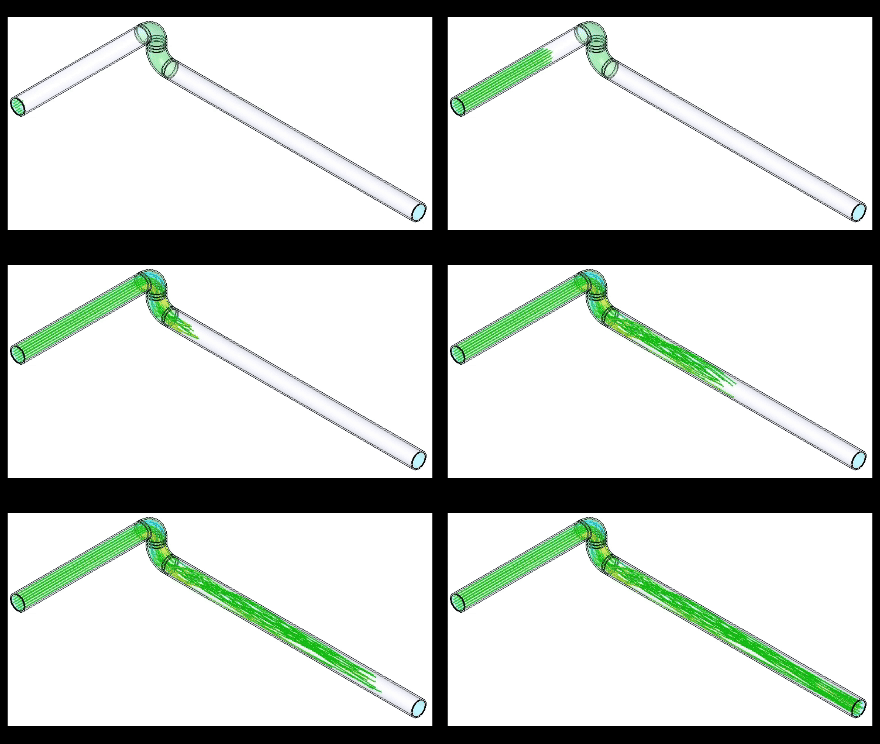
Unbalanced velocity distribution and fluid turbulence in a pipe disturb Karman Vortices and affect the accuracy of flow measurement. Therefore, straight pipe lengths are needed. This article shows the reasons why straight pipe lengths are necessary, using flow simulation and VY Series Vortex Flowmeters as examples.
Downloads
Videos
Discover how Yokogawa’s Total Insight Flowmeters with Process Guard transform operational safety and efficiency. In this video, we highlight its advanced capabilities in monitoring, diagnostics, and proactive intervention to minimize risks and maximize uptime.
Join Yokogawa Specialist Dusty Campbell as he guides you through the steps necessary in changing an amp on a DY Digital Vortex flow meter.
Our experts review the theory behind flow measurement technologies. Discuss common flow application challenges and evaluate the different technologies when selecting a flow meter. They also give examples of best installation practices for successful measurements.
Looking for more information on our people, technology and solutions?
Contact Us